
The tournament is next week. The coach has the logo, the team lead has a head count, and someone has just noticed that the order still lacks confirmed sizes, garment choices, and a production deadline. That scramble usually isn't caused by a complicated logo. It comes from leaving practical decisions until the supplier needs answers.
A reliable order for custom sweatshirts for teams comes down to four operating decisions: choose a garment and fit, match decoration to the garment and artwork, prepare artwork and sizes clearly, then agree on a supplier workflow with checkpoints. Team apparel has also grown beyond competition uniforms. One market analysis reported more than 420 million team-sports jerseys sold worldwide in 2023, while 45% of team-apparel orders that year included customized names, logos, or sponsorships. Sweatshirts can carry that identity onto the sidelines, into travel days, and into everyday fan wear, as part of the broader team-apparel ecosystem (team sports apparel market analysis).
If you're also coordinating coordinated looks for a celebration or group event, group outfit ideas for parties can help you think through how shared colors and styles read across a group. For a team order, the same basic principle applies: people need to recognize the group, but the garments should still suit the people wearing them.
Table of Contents
- What a Smooth Team Sweatshirt Order Actually Looks Like
- Choosing Sweatshirt Styles, Fabrics, and Fits
- Comparing Decoration Methods for Team Sweatshirts
- Preparing Artwork So the First Proof Is the Last Proof
- Building a Sizing Protocol That Prevents Costly Mistakes
- Budgeting, Lead Times, Proofing, and Quality Checks
- Working With Your Supplier and Wrapping the Project
What a Smooth Team Sweatshirt Order Actually Looks Like
Start by working backward from the day the sweatshirts need to be worn. A school team may want warm layers for outdoor practices, while a nonprofit might need comfortable volunteer apparel that also works at an event table. Those uses point to different garments, fits, and decoration choices. The project lead's job is to settle those decisions before asking a decorator to price or proof the order.
The market context supports treating sweatshirts as more than an add-on to a uniform. A separate 2025 assessment valued the global team-uniform market at USD 18.6 billion and projected USD 27.4 billion by 2034, a 5.2% compound annual growth rate; the same assessment identified customization technologies and online ordering as growth drivers (team-uniform market assessment). For a club, school, or company, the practical takeaway is simple: a sweatshirt can serve athletes, supporters, volunteers, and staff without requiring everyone to wear competition gear.
Project rule: Decide what the garment must do before choosing how it will look.
First, narrow the garment to a few options based on audience, season, and activity. Then choose decoration that suits the fabric and artwork. Next, package the logo files and sizing decisions so the decorator can prepare an accurate proof. Finally, confirm milestones, size-change rules, and quality checks with the supplier.
That sequence helps prevent the usual late-stage surprises: an attractive design on a blank that's too warm, a logo too detailed for the chosen decoration, or a box of personalized sweatshirts with the wrong size breakdown. Once those decisions are documented, you can compare quotes on what matters, not just the unit price.
Choosing Sweatshirt Styles, Fabrics, and Fits
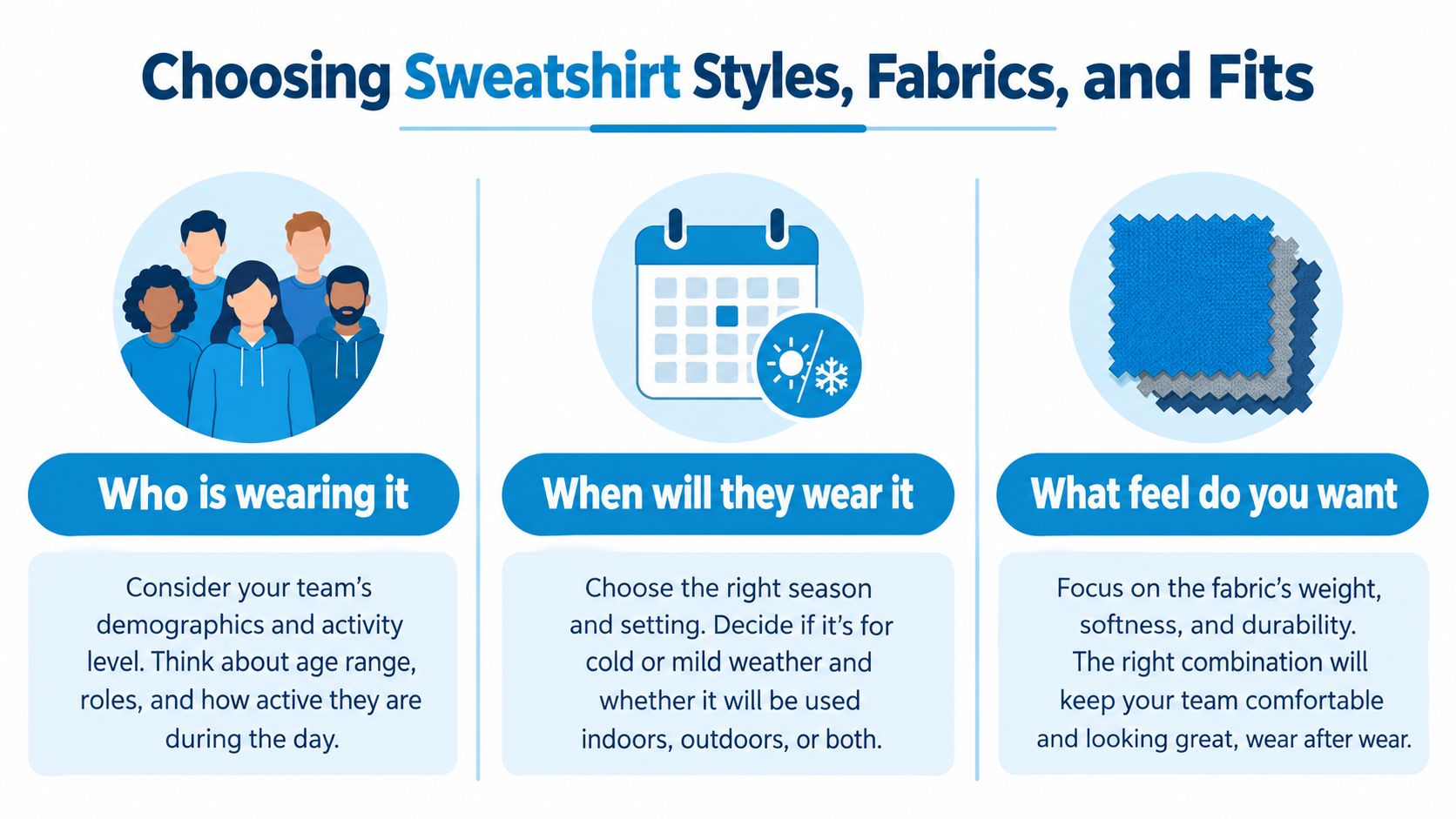
Choose the blank by answering three questions: who's wearing it, when will they wear it, and how should it feel? A team that wants a warm layer for outdoor sidelines has different needs from a group wearing sweatshirts indoors or during active travel. Use those answers to reduce the catalog to a few realistic candidates, then compare the actual garment details.
Start with construction and fabric
A crewneck is straightforward to layer and keeps the chest area open for a prominent logo. A pullover hoodie adds warmth and a casual look, but the hood and front pocket can constrain artwork placement. A zip-up is easy to put on or take off as conditions change; its zipper splits the front, so a large centered design may not work as intended. For a quick construction overview, see this guide to different types of hoodies.
Midweight cotton-rich fleece often feels soft and familiar, but it can be bulky under a dense embroidered design. Polyester-rich performance knits can suit active use and may handle moisture differently, but the fabric's composition can limit which decoration methods are appropriate. A lightweight triblend, for example, won't behave like heavyweight fleece under a heat press. Ask the supplier whether the exact blank is compatible with the decoration you're considering.
Fit the garment to the people
Unisex cuts simplify a mixed group order, but they won't fit everyone the same way. Women's cuts, youth sizes, and athletic fits can change proportions and garment measurements, so don't assume a size label means the same thing across styles. Check the supplier's chart and compare garment measurements before settling on a size range.
| Construction | Best Fit For | Decoration Notes |
|---|---|---|
| Crewneck | Teams wanting a simple layer and clear chest placement | Front and back artwork can be easier to position without a hood or zipper |
| Pullover hoodie | Casual, outdoor, or fan wear | Account for the pocket and hood when confirming placement |
| Zip-up | Layering and temperature changes | Keep front artwork clear of the zipper or consider another placement |
Before requesting a quote, shortlist two or three blanks and note the intended wearer, use, and decoration. That gives the supplier something concrete to assess and makes comparisons more useful than choosing from product photos alone.
Comparing Decoration Methods for Team Sweatshirts
A team order can stall when the artwork suits one decoration method but the sweatshirt or intended use does not. Choose the method alongside the garment, sizing protocol, and supplier workflow, rather than treating decoration as an isolated style choice. A small crest on a heavyweight crewneck has different production demands from a full-color design across a dark hoodie.

Screen printing works well for bold graphics and larger runs, but ink coverage and curing affect the result. Embroidery gives a raised, stitched finish for compact crests, though dense stitching can feel stiff or add weight. DTF handles detailed, full-color artwork on many dark garments; request a sample if the transfer's feel on fleece matters. Sublimation is generally suited to polyester-rich material, not every cotton sweatshirt. Patches create a badge-like look, with texture that adds another layer to the garment.
The choice is a practical trade-off between artwork, hand feel, quantity, and wear. For a useful comparison of printed and embroidered crew apparel, consider how each finish fits the team's use. You can also compare screen printing and embroidery against the specific design before settling on a method.
| Method | Best For | Durability on Fleece | Comfort Feel | Cost at Small Batches |
|---|---|---|---|---|
| Screen print | Bold graphics and larger runs | Depends on ink, curing, and fabric | Can feel heavier with a thicker ink film | Ask for a quote based on colors and quantity |
| Embroidery | Small logos and stitched details | Depends on stitch quality and garment | Can feel raised or stiff on soft fleece | May be less economical for complex designs |
| DTF | Full-color artwork and small runs | Confirm with a decorated wash-tested sample | Transfer feel varies with the design | Compare setup and per-piece charges |
| Sublimation | Polyester-rich garments and all-over designs | Depends on compatible material and process | Often integrated into the fabric surface | Availability depends on garment and artwork |
| Patches | Badge-style artwork and texture | Depends on attachment and patch construction | Adds a distinct raised layer | Price varies with patch and application |
Wash performance belongs in the written acceptance criteria, covered in the quality-check section below. For a team choosing between methods, ask the supplier for a physical decorated sample when color, placement, or feel could change the decision. A sample makes those trade-offs visible before the full run.
Preparing Artwork So the First Proof Is the Last Proof
Artwork delays often start with a file that looks fine on a screen but can't be enlarged cleanly, a logo without usable color references, or placement instructions that leave room for interpretation. Send the decorator the best available version of the logo and name the intended garment location, print dimensions, and colors. If you don't know the technical settings, ask the decorator what formats and color specifications they accept before exporting files.

Give the decorator clear production details
Vector artwork can be resized without the same loss of sharpness that can affect raster images, so provide a vector file if you have one. If the logo exists only as a raster image, send the highest-quality original rather than a screenshot. Ask the supplier to confirm whether the color mode, resolution, and file type are suitable for the selected decoration method.
Before proofing, resolve the details that change the production result:
- Placement: Specify the location, such as left chest, full front, back, or sleeve.
- Size: Give a target width or height, or ask the decorator to recommend dimensions for the garment.
- Color: Provide brand references or approve the closest available ink, thread, or transfer color.
- Artwork versions: Label the approved logo and any alternate artwork clearly.
- Physical sample: Approve a decorated blank if the exact color, placement, or feel matters.
A digital mockup helps you review layout, but it can't show how thread sits on fleece or how a print feels on a particular fabric. Make the physical sample the approval point when those details affect the team's decision.
A clean handoff email can include the garment style and color, decoration method, artwork files, named placements, target dimensions, color references, and a contact who can approve changes. State which version is final. That simple discipline prevents an old logo file or an assumed placement from becoming the production version.
Building a Sizing Protocol That Prevents Costly Mistakes
A size label isn't a measurement, and a personalized sweatshirt that doesn't fit may be difficult to resell. That makes sizing an operations decision, not a last-minute form field. Online apparel returns in the United States reached roughly 24.4%, with size and fit identified as the leading cause by 53% of apparel sellers; a 2025 global consumer survey found 61% of respondents had returned apparel because it didn't fit (fashion ecommerce benchmarks). Those figures describe apparel generally, but custom team orders face an added complication: a wrong size can leave the team with unusable inventory or an event-day gap.

Use three checkpoints, not one size survey
Collect measurements. Share the garment's actual measurements and the supplier's chart, not just a list of S–XXL labels. Ask each participant to compare the chart with a sweatshirt they already own and like. The fit of unisex, women's, youth, and athletic cuts can differ, so keep the exact style attached to the chart.
Validate a sample. Order a sample before production when fit uncertainty could affect the group. Have people try the garment in the sizes and cuts that are most relevant, and record the chosen style and size. For more on one specific garment's fit, consult this Comfort Colors sweatshirt sizing guide.
Document late changes. Set a date after which size changes require written approval from the project lead and supplier. Record the participant, original size, requested replacement, whether production has started, and any cost or delivery impact. Don't rely on a chat message that no one can find when the order is being packed.
Practical rule: Measure first, sample where needed, and put the final size list in one version-controlled file.
This workflow works for a small club as well as a large team: give everyone the same chart and deadline, name one person to resolve discrepancies, and freeze the approved list before production. Groups coordinating matching apparel for performances can also look at ways to unify a choir with custom shirts for ideas about presenting a shared identity across a group.
The lowest-priced blank isn't necessarily the least expensive order if unclear sizing creates replacement purchases, unused garments, or disappointed team members. Compare the total cost of delivering the right garments, not only the blank's unit price.
Budgeting, Lead Times, Proofing, and Quality Checks
A delivery date is only useful if the team has approved the artwork and sample in time for production. Build the schedule backward from arrival, then ask the supplier to confirm each milestone in writing. A quote's production estimate may not include artwork revisions, sample approval, or shipping. Garment availability, decoration method, order details, and supplier capacity also affect timing.
Set approval deadlines that leave room for the work still ahead. For example, a 24-piece order due in two weeks needs artwork approval by day three and sample sign-off by day five, leaving time for production and shipping. If a decision slips, agree with the supplier on what must change: the delivery date, shipping method, or order details.
Price depends on the full specification, not just the blank. The garment, decoration method, stitch or print complexity, number of decoration locations, and rush handling can all affect the quote. Ask for costs to be itemized where possible, then compare suppliers using the same garment, artwork, and delivery requirements.
| Milestone | Timing | What to confirm |
|---|---|---|
| Garment and quote approval | Agree with supplier | Style, color, sizes, decoration locations, and total pricing |
| Artwork proof | Agree with supplier | Logo version, placement, dimensions, and color references |
| Sample and wash-test approval | Agree with supplier | Fabric, decoration settings, test method, and acceptance criteria |
| Production and delivery | Agree with supplier | Start date, shipping plan, tracking, and delivery responsibility |
Put quality acceptance in writing
A digital proof confirms layout, not how decoration holds up after laundering. Test a representative sweatshirt made with the actual fabric mix, color, and weight. AATCC TM61 is an accelerated laundering method for textiles expected to withstand frequent washing, while AATCC TM143 evaluates apparel appearance after home laundering (AATCC quality-control catalog). Properly applied thicker ink films may show no obvious abrasion for approximately 30–50 washes, though results depend on the fabric, ink, film thickness, and curing conditions.
Write down the wash-test protocol and acceptance criteria before approving production. Specify wash cycles, detergent, temperature, drying method, allowable color change, and the defects that will trigger rejection. Check fading, bleeding, cracking, peeling, abrasion, and dimensional change against an approved control. Test the actual garment range, not only a white cotton sample if the order includes dark polyester or fleece, and confirm decoration settings suit the selected blank.
Working With Your Supplier and Wrapping the Project
A good supplier conversation should answer operational questions before the deposit goes in. Confirm turnaround, how many proofing rounds are included, whether you can approve a physical sample, what wash-test evidence is available, when size changes stop, how reorders are priced, and where the supplier ships. Ask who owns each approval and how the team will receive the final size list and delivery updates.
A partner with a broad apparel catalog and in-house screen printing, embroidery, DTF, sublimation, and patch services may be able to assess several decoration options against the same garment. For example, Dirt Cheap Product, Inc. offers custom apparel and promotional-item decoration across those methods, with proofs provided for review of color, placement, and stitching details. Whatever supplier you choose, request clear written answers rather than relying on a general promise that the order will be easy.
Before approving production, check the four decisions:
- Garment and fit: Is the blank appropriate for the team, season, and intended wear?
- Decoration: Does the method suit the fabric, logo, comfort needs, and care routine?
- Artwork and sizing: Are the approved files, placement notes, measurement chart, and size-change process documented?
- Supplier workflow: Are proof, sample, wash-test, production, and delivery checkpoints agreed?
Take one concrete step this week: request a sample in the likely garment style, then use its size chart to start the team's measurement and fit check. You'll have a stronger basis for the quote and a clearer production handoff.
If you're planning custom sweatshirts for a team, Dirt Cheap Product, Inc. offers apparel sourcing and decoration options including screen printing, embroidery, DTF, sublimation, and patches. Send your logo and preferred garment details to request a proof and discuss the right workflow for your order.