
You're probably in the same spot a lot of brand managers, small business owners, and event teams hit sooner or later. The standard merch options still work, but they don't feel special anymore. A basic tee can blend in. A generic cap can look like every other giveaway on the table.
That's where a Corduroy trucker cap starts to make sense. It gives you the familiar wearability of a trucker silhouette, but the fabric changes the message. The texture feels more deliberate. The look reads more retail than throwaway. And for brands that want merch people keep wearing, that difference matters.
I've seen this choice make the most sense when a client wants something between casual promo and store-ready product. If you've already looked at a more worn-in option like a distressed trucker hat, corduroy is the next move when you want a cleaner retro finish with more surface character.
Table of Contents
- Introduction Why Your Next Merch Item Should Be a Corduroy Trucker Cap
- What Is a Corduroy Trucker Cap
- The Benefits of Choosing Corduroy for Branded Headwear
- How to Brand Your Corduroy Trucker Cap
- Choosing the Right Style Color and Fit
- Ordering Bulk Pricing and Simple Care Instructions
Introduction Why Your Next Merch Item Should Be a Corduroy Trucker Cap
A lot of merch problems aren't really pricing problems. They're perception problems. The item may be affordable and functional, but if it looks ordinary, people treat it like ordinary merch.
That's why the corduroy trucker cap keeps showing up in stronger brand programs. It doesn't need flashy graphics to stand out. The fabric already does part of the work. The ridged surface catches light differently, gives the front panel more depth, and makes even a simple logo feel more considered.
For businesses, that has a practical payoff. If you're outfitting staff, the cap can look more polished than a standard foam-front promo hat. If you're building retail merch, it can support a higher-end look without drifting into fashion headwear that's too niche or hard to wear. If you're planning an event, it gives attendees something they're more likely to keep in rotation.
Practical rule: If your logo is simple and your brand needs more personality, change the material before you change the logo.
The strongest use case is a brand that wants to look intentional without looking over-designed. Corduroy does that well. It signals taste, not excess.
What Is a Corduroy Trucker Cap
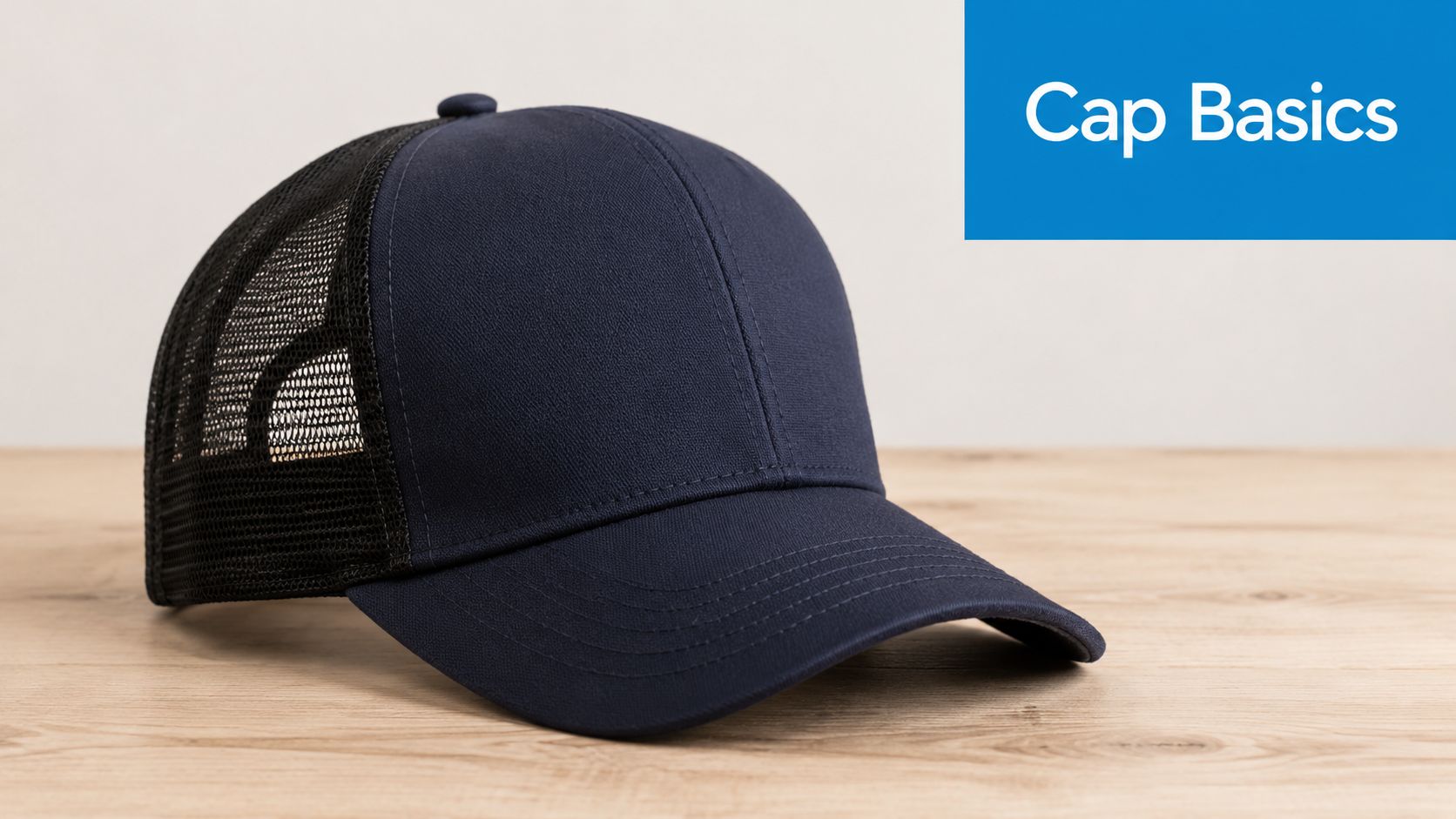
A corduroy trucker cap is a hybrid. It uses the familiar trucker cap shape, then swaps the usual smooth front for corduroy, a ribbed fabric that gives the hat more texture, more visual depth, and a stronger retail feel.
The trucker side of the design
The trucker cap emerged in the early 1970s in the United States as a promotional giveaway from feed, farming-supply, and agribusiness companies, according to this overview of the history of the trucker cap. That origin still matters because the format was built to be practical. The front panel gives a brand a clear decoration area. The mesh back helps with airflow. The curved bill and casual profile make it easy for a wide range of customers to wear.
For branded merchandise, that combination solves a real problem. A cap can carry a logo clearly without feeling too formal or too niche.
What corduroy changes
Textile historians trace corduroy's roots to Fustat, Egypt around 200 AD, according to this background on the history of corduroy. Modern corduroy is usually made from cotton or cotton blends and identified by raised ridges called wales.
On a hat, those ridges do more than change the fabric. They change how the product is read. A logo on corduroy tends to look more intentional because the base material already has character. That is one reason brands use this style when they want merchandise to feel closer to retail product than standard giveaway gear.
Corduroy also shifts the tone. The cap keeps the casual trucker shape, but the fabric adds a heritage and vintage cue that reads as more considered. That trade-off is useful for brands that want stronger shelf appeal without moving into a fashion silhouette that can limit wearability.
In practical terms, a corduroy trucker cap usually means a textured front panel paired with breathable rear panels and an adjustable closure. Some versions feel more structured and hold embroidery cleanly. Others have a softer crown and a more relaxed fit. The core idea stays the same. You get the ventilation and familiarity of a trucker cap, with a front panel that gives branded merchandise a higher perceived value.
That balance is why the style has staying power. It looks distinctive before the logo does.
The Benefits of Choosing Corduroy for Branded Headwear
Set a standard twill trucker cap next to a corduroy version on a merch table. The corduroy cap usually gets picked up first. For brands, that matters. People assign value before they inspect the stitching or read the hangtag, and corduroy gives you that advantage at first glance.
Why texture raises perceived value
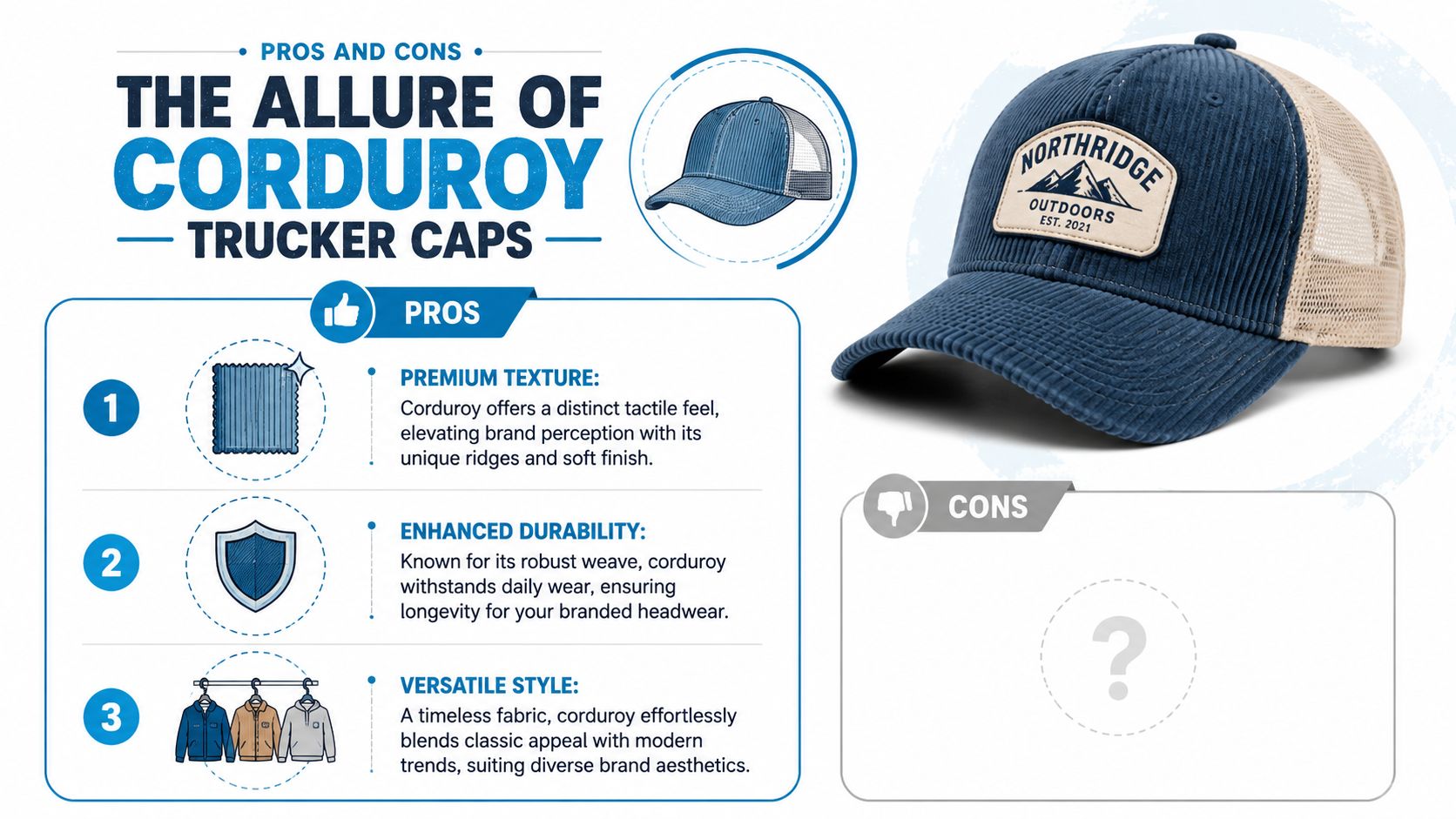
Corduroy does part of the branding work on its own. The ribbed surface catches light, adds depth, and makes the front panel feel more like a retail product than a basic promo hat. That is the business case for the trend. You are not just buying a different fabric. You are buying a stronger first impression.
That shift is useful for brands that want merchandise to feel intentional. A plain logo on a flat cap can look inexpensive unless the decoration does all the heavy lifting. On corduroy, even a simple mark has more presence because the base material already feels considered.
I see this pay off most often in paid merch, client gifts, and limited event runs. In those settings, the cap has to justify a higher perceived value fast. Corduroy helps close that gap.
Where corduroy gives brands an edge
Some categories benefit more than others:
- Retail merch: The texture helps the cap read like store product, not leftover swag.
- Hospitality and lifestyle brands: Cafes, breweries, barbershops, outdoor brands, and creative studios often want warmth and personality. Corduroy supports that tone.
- Simple branding systems: Clean embroidery, initials, icon marks, and patches usually look stronger on a textured front panel than busy artwork does.
- Drops and collaborations: Retro cues make small-batch releases feel more distinct and more collectible.
That is also why brands that want to build your brand with custom apparel often choose corduroy for a statement piece instead of making it their cheapest giveaway option.
The practical trade-offs
Corduroy is not a universal answer. It works best when the goal is style, shelf appeal, and a more premium read. It is a weaker fit for high-sweat uniforms, technical sports use, or very polished corporate programs where a cleaner fabric may match the brand better.
Here is the trade-off in plain terms:
| Use case | Why corduroy works | Where to be careful |
|---|---|---|
| Retail merchandise | Feels giftable and more worth the price | Decoration should stay clean and readable |
| Event merch | Stands out from standard trucker hats | Fine details can get lost in low light or busy environments |
| Team uniforms | Adds personality without getting too fashion-driven | Less comfortable for long, hot outdoor shifts |
| Brand collabs | Supports special-release energy and stronger storytelling | Overbuilt logos can compete with the fabric texture |
Decoration matters more here than on smoother fabrics. Corduroy rewards restraint. If you need help judging logo size and placement before production, use this embroidery placement guide for hats and apparel.
The brands that get the best result usually keep the artwork tight, the color story disciplined, and the message clear. Corduroy gives the cap character. Your job is to avoid covering that up.
How to Brand Your Corduroy Trucker Cap
Decoration is where good cap choices get confirmed or ruined. Corduroy gives you a premium-looking front panel, but it also asks for a little more discipline. The fabric has ribs. The crown has structure. Your logo method has to work with both.
Many corduroy trucker caps use a structured 5-panel construction that offers more space for embroidery, patches, and print. That stable geometry helps logos sit flatter and reduces decoration variability across runs, according to these structured corduroy trucker hat details.
Embroidery patches and transfer decoration
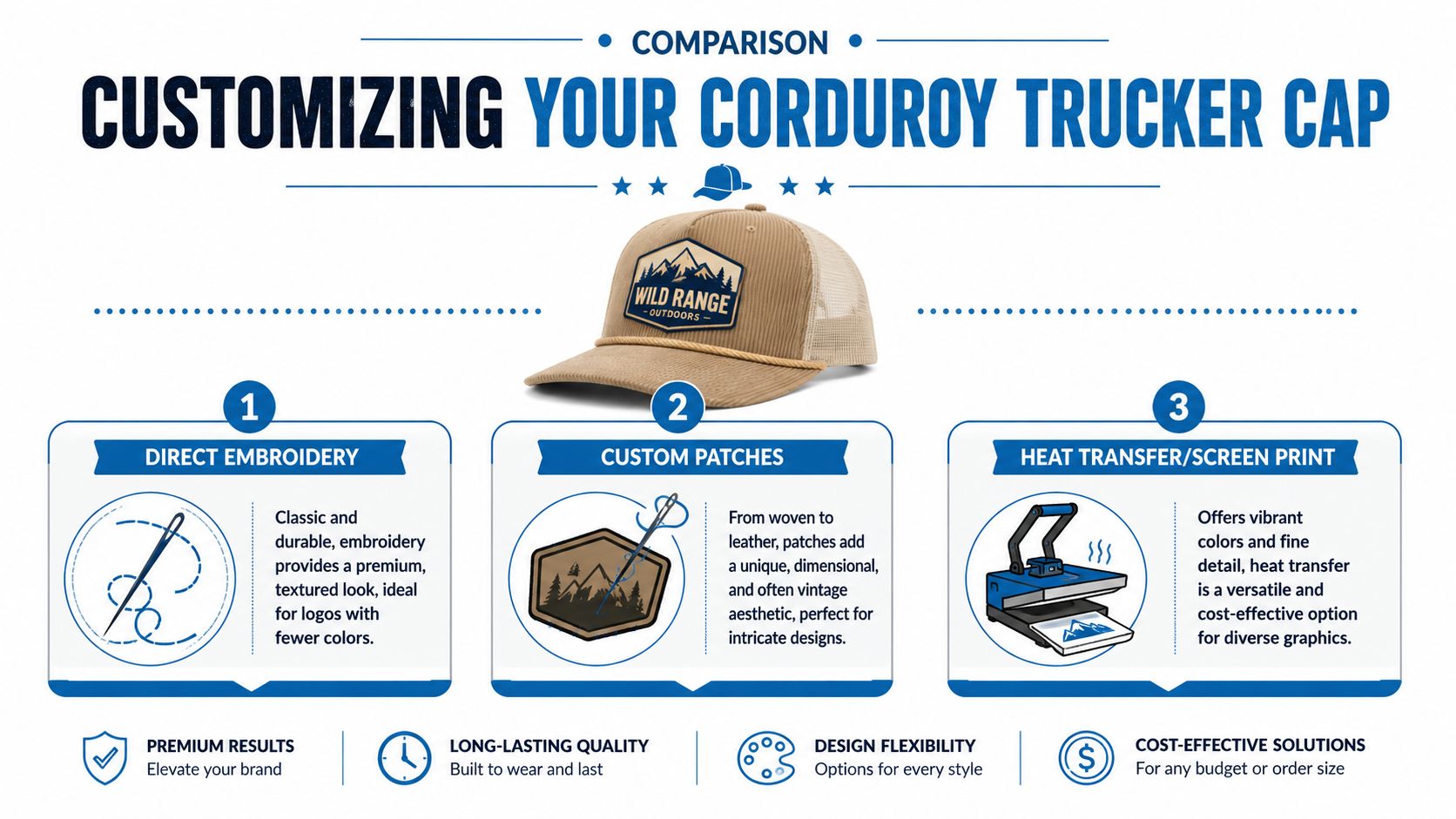
Direct embroidery is usually the safest starting point. It fits the texture of corduroy naturally and gives the cap a finished, classic look. For bold logos, initials, icons, and short wordmarks, embroidery tends to feel right at home.
Patches are often the strongest visual option when you want separation between the logo and the ribbed fabric. A woven patch can hold finer linework than direct stitching on corduroy. Leather-style and PVC patches push the cap toward a more distinct statement piece. If the brand voice is rugged, outdoorsy, heritage-driven, or retail-focused, patches often outperform direct embroidery.
A heat transfer or DTF approach can work when you need more color detail or tighter graphic fidelity. But this is the method I treat most carefully on corduroy. The ribbed surface can affect how the graphic reads from angle to angle, so it's better for designs that can tolerate a little texture underneath rather than artwork that needs a perfectly smooth print field.
For teams comparing broader merch strategy across categories, this guide on how to build your brand with custom apparel is a useful reference because it frames hats as part of a larger branded system instead of a one-off item.
How to choose the right method for your logo
Use this quick comparison before you approve art:
- Choose embroidery if your logo is simple, bold, and meant to feel timeless.
- Choose a patch if your logo has detail, borders, or a badge format that benefits from a framed edge.
- Choose transfer decoration if color fidelity matters more than tactile texture.
This video gives a useful visual sense of how decoration can change a cap's final look.
One practical step that saves headaches is checking logo scale and panel location before production. A placement guide like this one for embroidery placement on hats and apparel helps clients avoid oversized marks that look crowded on the crown.
Small logos often look more expensive on corduroy than oversized ones. The fabric already gives you texture. You don't need to force visual weight.
If you're ordering through a decorator that handles embroidery, patches, and DTF under one roof, that can simplify proofing because the art can be adjusted to the method instead of forcing one method onto every design. Dirt Cheap Product, Inc. offers those decoration types across custom headwear and apparel.
Choosing the Right Style Color and Fit
The wrong cap blank can make a good logo look average. With corduroy, style choice matters even more because the material already carries a point of view. You want the cap shape, color, and closure to support that.
Pick the crown shape first
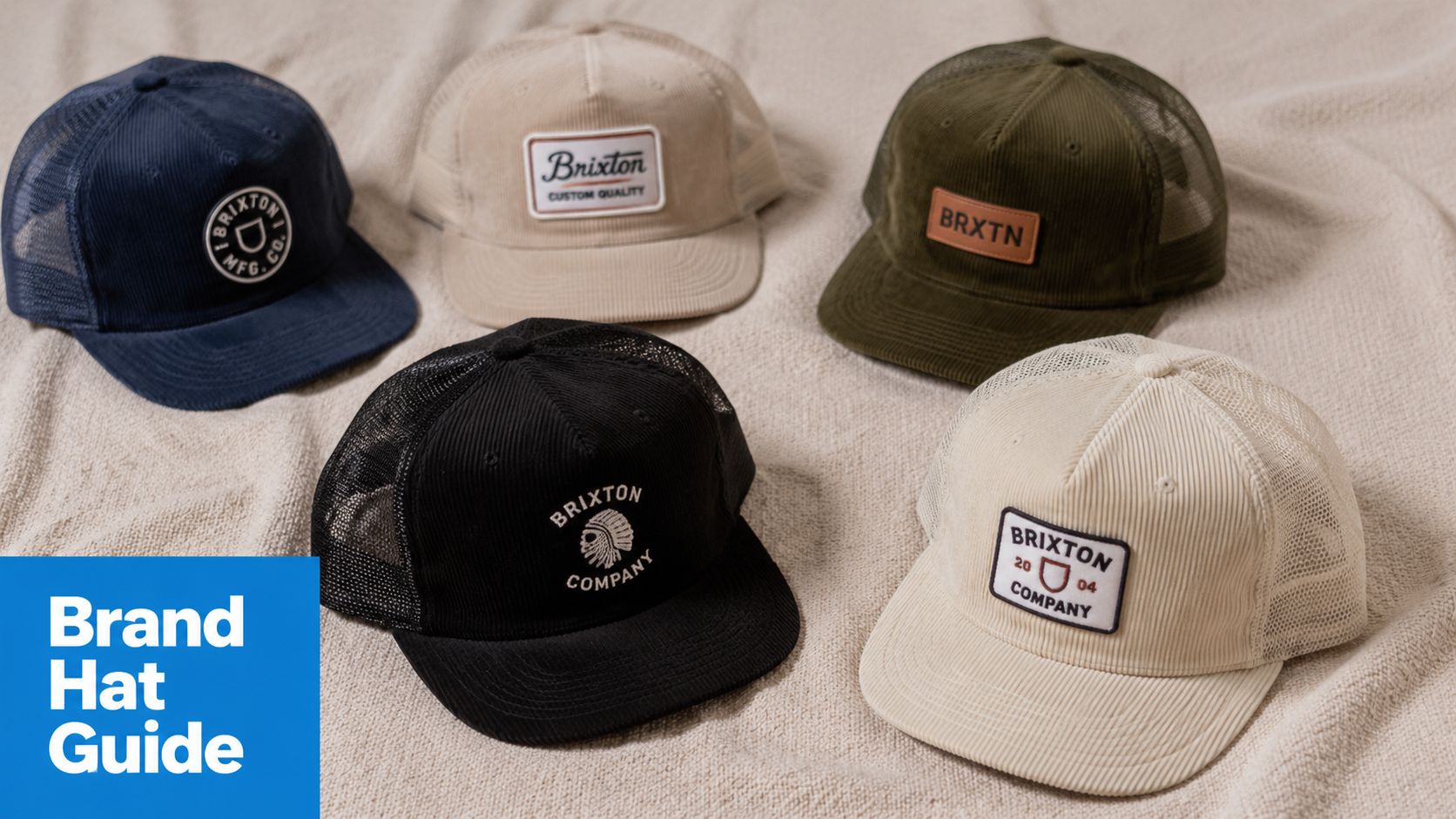
Start with structure before color. A 5-panel cap usually gives you a broad, uninterrupted front area, which works well for centered logos and patches. A modified A-frame look can feel slightly more assertive and more retail-oriented. Some versions also use a rope or paracord accent across the brim, which adds a sharper retro cue and creates a stronger line at the visor seam.
If your logo is horizontal, clean, and badge-like, 5-panel shapes are usually the easiest win. If your branding leans bolder and more fashion-aware, the A-frame direction often fits better.
Match the color to the job
Corduroy already has a visual texture, so color doesn't need to do all the heavy lifting.
A practical way to choose:
- Earth tones: Good for outdoor brands, coffee shops, breweries, and heritage-style merch.
- Navy and black: Easier for staff uniforms, broader customer appeal, and repeat wear.
- Cream, tan, and muted contrast colors: Strong for boutique retail because they show the wale texture clearly.
- Bright colors: Best used when the brand already has a playful identity. On corduroy, they can look stylish, but they can also narrow the audience.
Don't ignore fit and closure
Most clients choose an adjustable snapback because it's straightforward for events, staff gear, and mixed audiences. That flexibility matters when you don't want to split inventory across fitted sizes.
If you want a better sense of sizing before you order for a team or customer base, this guide on how to get the perfect hat fit is worth reviewing. Even when you use adjustable caps, fit awareness helps you avoid crowns that sit too high or profiles that don't match your audience.
Fit check: A great logo won't save a cap that wears awkwardly. Always judge the blank on head shape, crown height, and front-panel presentation before approving final production.
Ordering Bulk Pricing and Simple Care Instructions
The ordering process goes smoother when you treat a corduroy trucker cap like a retail item, not just a logo application. That means finalizing the blank, decoration method, artwork format, and approval standard before production starts.
What to lock down before production
For bulk orders, per-unit pricing usually improves as quantities rise, but primary cost control comes from reducing revisions and avoiding decoration mismatches. Clean artwork helps. So does choosing one cap style and one placement approach early.
Before you place an order, confirm these points:
- Artwork readiness: Vector art or clean high-resolution files prevent delays.
- Decoration choice: Don't decide between embroidery and patch after the proof stage starts.
- Color approval: Corduroy changes how thread and patch colors read against the surface.
- Timeline: Build in time for sampling or proof review if the cap is for an event or launch.
If you're sourcing hats in volume, a wholesale ordering page like custom logo hats for bulk orders helps you compare options before locking in the final spec.
A useful side note for anyone building a wider apparel line is material education. Even though it's a different fabric category, this primer on understanding fleece fabric types is a good reminder that fabric choice changes the end product as much as decoration does.
Simple care you can pass to customers or staff
Corduroy caps hold up well when people treat them like shaped headwear instead of tossing them into a wash cycle with everything else.
Share these care basics:
- Spot clean first: Use a damp cloth and mild soap on marks or sweat areas.
- Avoid machine drying: Heat can affect shape, panel stability, and decoration.
- Air dry naturally: Let the cap dry while maintaining its crown shape.
- Store with care: Don't crush the front panel under heavier items.
Good care protects the texture that made you choose corduroy in the first place.
If you're planning branded headwear for staff, retail, events, or a merch drop, Dirt Cheap Product, Inc. can help you sort through cap styles, decoration methods, artwork setup, and bulk ordering options so the finished product matches the look you're after.