You're probably here because the need just became real. A restaurant is opening in two weeks, an event team needs staff uniforms that don't look thrown together, or a retail shop wants branded aprons that feel consistent across the floor. At that point, buying aprons one by one stops making sense. You need aprons in bulk, but you also need to avoid the common first-order mistake of choosing by price alone.
The apron itself is only half the decision. The other half is whether the fabric, cut, and decoration method fit the job. A logo that looks sharp on a soft promo apron may fail in a hot kitchen. A premium embroidery treatment may look excellent on a host stand uniform but feel like overkill for a short-run event. Those are the choices that separate a reorder-worthy program from a frustrating one.
Table of Contents
- Why Buying Aprons in Bulk is a Smart Business Move
- Choosing Your Apron Style and Material
- Customization Options for Your Brand
- Understanding Pricing MOQ and Budgeting
- The Bulk Ordering Process from Start to Finish
- Apron Use Cases Sizing and Care
- FAQ and a Final Checklist for Placing Your Order
Why Buying Aprons in Bulk is a Smart Business Move
A bulk apron order usually starts as a uniform problem, but it quickly becomes an operations decision. You're not only dressing a team. You're deciding how consistent the brand looks, how easy reorders will be, and whether the staff will get something practical enough to wear every day.
That matters because aprons sit at the point where branding and daily use meet. A good order gives you repeatable color, repeatable decoration, and fewer one-off purchases later. A bad order creates mixed styles, replacement issues, and logos that wear out faster than the garment itself.
The category is also far from niche. The global apron market is projected to reach USD 901.42 million by 2028, growing at a CAGR of 4.99%, according to Cognitive Market Research's apron market report. For a buyer, that scale usually means a more reliable supply base, broader style selection, and stronger competition among vendors.
Practical rule: Bulk buying makes the most sense when you expect repeat hiring, recurring events, multiple locations, or ongoing replacement needs.
There's also a mindset shift that helps. Don't treat aprons like a simple add-on. Treat them like a branded supply item. That approach changes how you compare fabric, decoration, reorder planning, and budget.
If this is your first large branded apparel purchase, it helps to think through aprons the same way you'd think through any custom item order with logo placement, quantity planning, and proof approval. A broader bulk buying guide for custom promotional products can help you build that purchasing habit before you commit to a full run.
Choosing Your Apron Style and Material
The first decision is usually visual, but it should be functional. Style affects coverage, comfort, and how formal the staff looks. Material affects wear, cleaning, and whether your decoration will still look clean after repeated use.
Start with the job, not the look
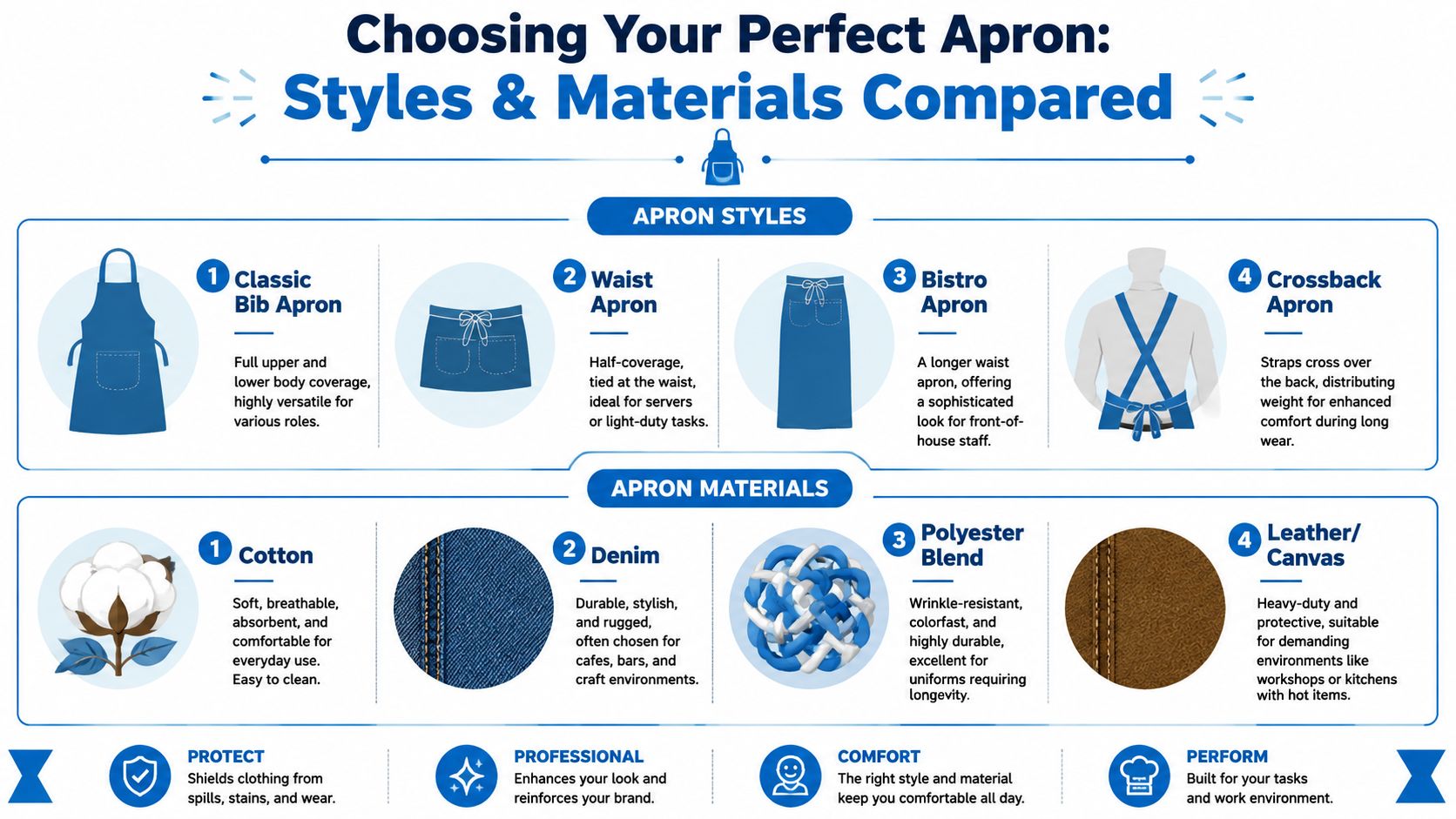
A classic bib apron is the safest starting point for most buyers. It gives full front coverage and works well for kitchens, prep areas, messy service environments, and many retail demos. If you need one style that can cover multiple roles, this is usually it.
A waist apron makes more sense when staff need quick access to order pads, pens, or service tools and don't need upper-body protection. Servers, hosts, tasting-room staff, and light-duty retail teams often prefer it because it feels less restrictive.
A bistro apron gives a more polished front-of-house look. It works when presentation matters and the team wants a longer, cleaner silhouette without moving into full bib coverage.
A crossback apron solves a different problem. It's less about appearance and more about comfort over long shifts. If staff wear aprons for hours at a time, strap design starts to matter more than many first-time buyers expect.
Here's a simple way to choose:
| Style | Best for | Main advantage | Watch out for |
|---|---|---|---|
| Bib apron | Kitchens, prep, crafts, general staff | Broad coverage | Can feel warm in busy environments |
| Waist apron | Servers, hosts, light-duty roles | Fast movement and access | Limited protection |
| Bistro apron | Front-of-house, cafes, hospitality | Cleaner presentation | Still limited upper coverage |
| Crossback apron | Long-wear shifts | Better weight distribution | Fit preference varies by team |
Fabric affects decoration more than most buyers expect
Many bulk orders encounter problems when buyers choose a fabric based on feel or color, then assume any logo method will work equally well. It won't.
Cotton is comfortable and familiar. Denim gives a rugged, lifestyle look that suits cafes, bars, and workshop-style brands. Polyester blends usually win on wrinkle resistance and long-term uniform consistency. Heavy canvas or similar workwear fabrics fit tougher environments where protection matters more than softness.
For decorated aprons, construction matters as much as fiber. Cotton Creations notes that bulk aprons made from poly-blend twill or poly-blend duck weave are “ideal for embroidery,” and that matters because the tighter, heavier structure gives better stitch stability and reduces puckering. You can review that directly on Cotton Creations' apron and accessories collection.
If you expect repeated laundering and daily wear, pick the fabric with the decoration in mind. Don't pick the decoration and hope the fabric cooperates.
A useful buying shortcut is this:
- For embroidery-first orders: Choose stable fabrics with enough body to hold stitching cleanly.
- For print-first orders: Look closely at surface smoothness and how much flex the garment sees in use.
- For mixed-use teams: Favor easy-care blends that keep shape and appearance more consistently across a full staff set.
If you're ordering aprons in bulk for a team that needs the same logo across many units, consistency usually beats novelty. A fabric that looks slightly less exciting on day one often looks much better after weeks of real wear.
Customization Options for Your Brand
Once the apron blank is right, decoration becomes the deciding factor. Here, buyers often focus too much on appearance and not enough on use. A logo can look great in a mockup and still be the wrong choice for heat, abrasion, laundering, or turnaround speed.
How the main decoration methods compare
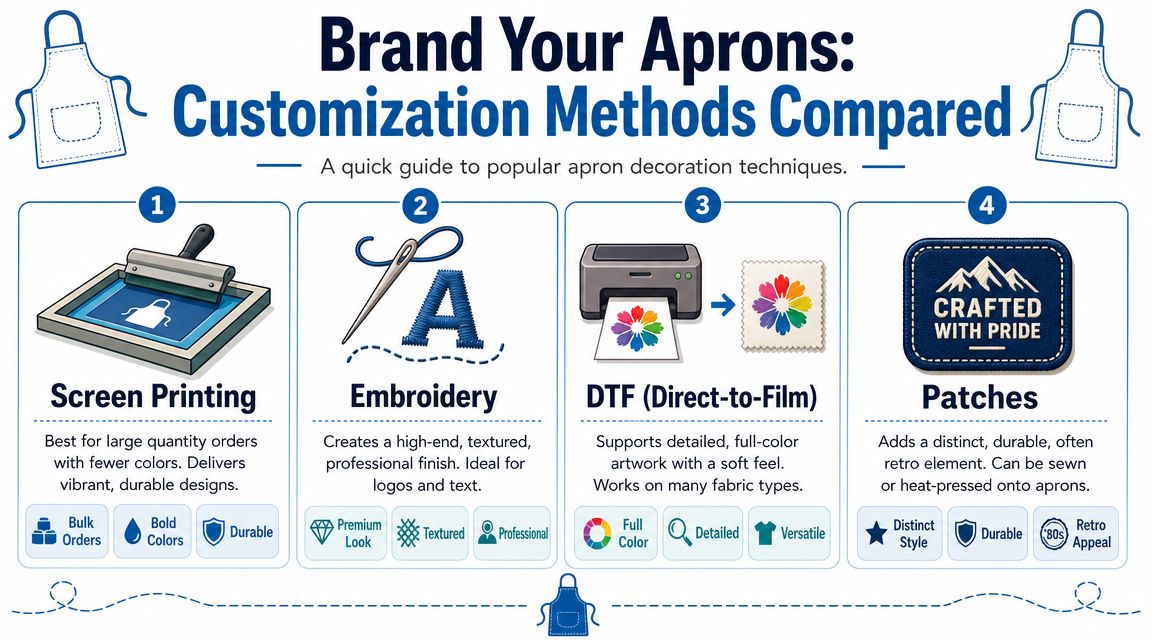
The key trade-off isn't “best” versus “worst.” It's best for this job versus wrong for this job.
| Method | Strongest use | Visual effect | Best fit |
|---|---|---|---|
| Screen printing | Larger runs with simpler graphics | Bold, flat color | Events, promotions, lighter-duty use |
| Embroidery | Professional uniform branding | Textured, premium | Staff uniforms, logos, names |
| DTF | Detailed, full-color artwork | Smooth graphic reproduction | Complex art, smaller runs, flexible applications |
| Patches | Distinct branded look | Layered, badge-like | Heritage branding, rugged styling |
A useful verified point from the wholesale side is that many supplier pages still don't compare decoration methods clearly enough for durability. As noted on SKS Wholesales' bulk leather apron collection, the right choice should be driven by use environment. Kitchens usually need abrasion- and wash-resistant decoration, while event aprons can favor speed and lower minimums.
That lines up with what works in practice:
- Embroidery is usually the safest long-term choice for restaurant staff uniforms, hospitality teams, and any program where the logo needs to hold shape over repeated wear.
- Screen printing makes sense when the apron is a cost-controlled branded item for one-time or short-cycle use.
- DTF helps when the artwork includes more color, finer detail, or effects that stitching can't reproduce cleanly.
- Patches work best when the brand identity supports a crafted, utility, or heritage look.
Match the logo to the decoration
Not every logo behaves well in every method. Thin lines, tiny text, gradients, and dense icon work all need different handling. Before you approve artwork, it helps to learn from DesignGuru about logos, especially if you're deciding between a wordmark, symbol, or a lockup that combines both.
For aprons, logo placement also changes the feel of the garment. A centered chest logo feels standard and clear. A smaller upper-chest mark can feel more retail-inspired. A patch on the bib pocket can make the apron look more custom and less promotional.
Don't choose decoration in isolation. The logo shape, apron fabric, placement area, and work environment all need to agree with each other.
If you're weighing methods side by side, a focused comparison of screen printing vs. embroidery helps clarify where each one wins and where each one starts to compromise.
Understanding Pricing MOQ and Budgeting
Bulk pricing looks simple from the outside, but a real quote has layers. The blank apron matters. The decoration method matters. The artwork setup matters. So does the quantity break where your per-unit cost changes.
What MOQ actually means
MOQ means minimum order quantity. Sometimes that minimum comes from the blank supplier. Sometimes it comes from the decorating method. Sometimes it's tied to whether a vendor can produce the job efficiently at all.
For the buyer, MOQ isn't just a gatekeeping number. It's a planning tool. If your staff size changes often, ordering too close to the exact current headcount usually creates a second order too soon. If you order too aggressively without a real use plan, inventory sits.
One practical reference point from the wholesale side is that bulk channels can start very low. Direct Textile Store notes marketplace listings with aprons starting from USD 1, minimum order quantities starting at 3 units, and 50+ verified suppliers on some platforms, while also highlighting that supply costs matter in foodservice purchasing. The same source references IRS data cited by industry blogs showing that supplies account for 3% of all restaurant expenses, which is why recurring items deserve close cost control. You can see that discussion on Direct Textile Store's wholesale aprons page.
Where bulk apron quotes usually change
A first-time buyer should expect these quote components:
- Blank garment cost: The base apron changes by style, fabric, and construction.
- Decoration cost: Embroidery, print, DTF, and patches each have different labor and setup demands.
- Artwork preparation: Cleaner files reduce friction. Problem artwork often adds time and revision cycles.
- Placement choices: One logo location is simpler than multiple decorated areas.
- Reorder logic: A standardized design can make future runs easier to repeat.
A small increase in order size can improve value if it prevents a rushed reorder later. That's especially true for staff uniforms where replacements are predictable.
Buyers usually save more by standardizing well than by chasing the absolute cheapest apron on the first quote.
If you're budgeting across multiple uniform items, it helps to compare how decoration costs behave on related garments too. Looking at bulk custom embroidered polos can sharpen your sense of how setup, stitch count, and quantity planning affect a broader apparel program.
The Bulk Ordering Process from Start to Finish
Most ordering problems don't happen in production. They happen before production starts, when details are still loose. Clear inputs lead to clean proofs, smoother approvals, and fewer surprises at delivery.
A simple process view helps keep the project under control.
What happens before production starts
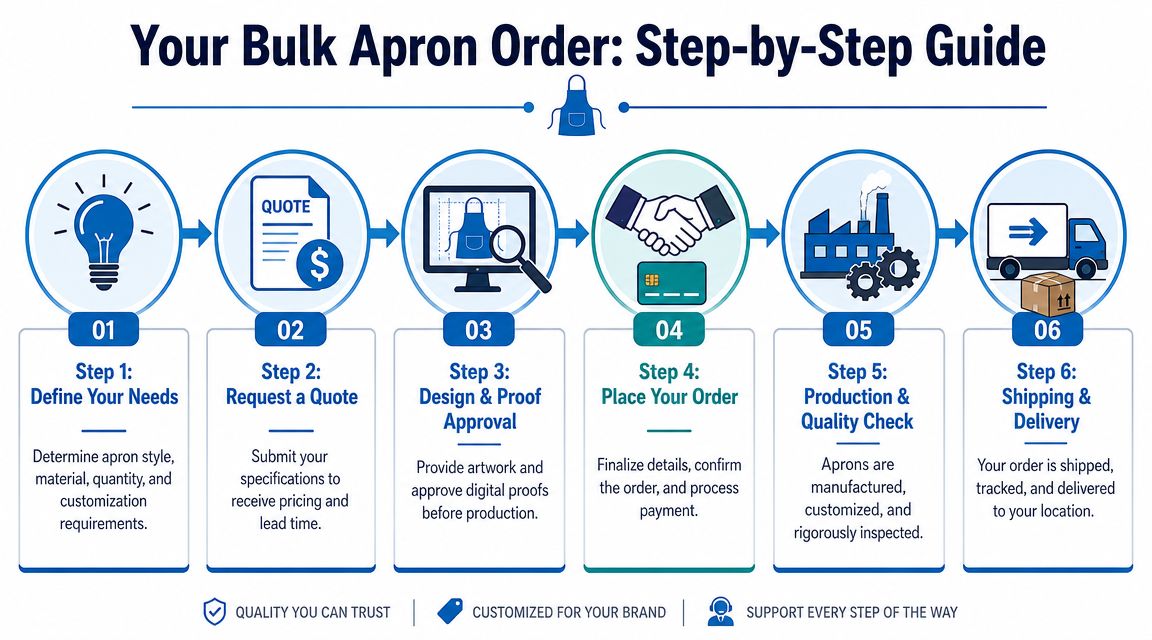
The first useful step is defining the order in plain language. Not “we need some branded aprons,” but “we need bib aprons in black, adjustable neck, chest logo, for kitchen staff, with extras for new hires.” That level of clarity prevents half the back-and-forth that slows down first orders.
Then comes the quote request. A strong request includes style, quantity, color, logo file, decoration preference if known, and in-hands date. If you're working on broader purchasing workflows too, this overview on mastering e-commerce procurement is useful because it frames how approval flow, vendor communication, and fulfillment expectations affect buying decisions beyond apparel alone.
Before moving further, it helps to see a live production-related example:
What to watch during proofing and delivery
The digital proof is the checkpoint that matters most. At this stage, you confirm logo size, placement, thread or print color, and the final relationship between artwork and garment. Approving too quickly is one of the most common buyer mistakes.
Use this short proof-review checklist before you sign off:
- Check placement carefully. A logo that sits too high, too low, or too large can make the whole garment feel off.
- Review artwork readability. Small text and fine details should still read cleanly at actual size.
- Confirm garment details. Color, style, and strap configuration should match the intended role.
- Ask about replacements and reorders. Future consistency starts with documentation on the first run.
Treat the proof like the final exam for the order. If something feels slightly wrong on screen, it usually feels more wrong in hand.
After approval, production begins, then quality checks, then shipment. When the cartons arrive, inspect a sample immediately. Confirm decoration consistency, garment count, and any role-based sorting before distributing the order to staff.
Apron Use Cases Sizing and Care
The easiest way to choose correctly is to picture the apron in a real shift, not on a product page. Different jobs stress an apron in different ways. Heat, motion, pocket use, spills, and wash frequency all change what “good” looks like.
Real-world apron choices by role
A line cook usually needs a bib apron with enough coverage to handle splatter and repeated laundering. This is a function-first environment. Decoration should stay clean without becoming the most delicate part of the garment.
A barista or cafe lead may care just as much about presentation as coverage. That's where denim, crossback styling, or a cleaner front-of-house silhouette can work well. The brand often wants a crafted, modern look, but the apron still has to survive milk, syrups, constant wiping, and regular wash cycles.
Event staff are different again. They may wear the apron for a shorter window, and the apron may function more as visual branding than protective workwear. In that case, speed, logo visibility, and easy sizing often matter more than premium construction.
A practical shorthand:
- Chef or prep team: Favor coverage, durability, and decoration that handles repeated wear.
- Cafe or tasting room: Balance style with comfort and easy care.
- Retail demo staff: Keep branding visible and movement easy.
- Event crews: Prioritize fast fit, clear logo placement, and simple ordering.
Sizing and care that reduce headaches later
Sizing gets easier when you choose adjustable styles. One-size-fits-most bib aprons with adjustable necks or crossback structures simplify large mixed-team orders and reduce the chance of staff rejecting the garment for comfort reasons.
Still, don't treat “one size” as automatic. Strap length, apron width, and body coverage can vary a lot by style. If your team is broad in height or build, get a sample first and test it on more than one person. For organizations building more disciplined fit guidance, this resource on how to maximize size chart effectiveness is worth reviewing because it shows how better sizing communication reduces friction and waste.
Care matters just as much as purchase choice. If the laundry routine is harsh, decoration and fabric choice need to account for that from day one.
- Wash for the decoration type: Follow the supplier's care guidance for stitched or printed logos.
- Avoid careless sorting: Heavy utility items can abrade decorated aprons during laundering.
- Reorder before the set looks mixed: Uniform programs look strongest when replacements match the existing group.
Good apron programs don't just start well. They stay visually consistent after months of use.
FAQ and a Final Checklist for Placing Your Order
The last questions usually show up when the buyer is close to approval. They're not small questions either. They affect whether the order works operationally after it arrives.
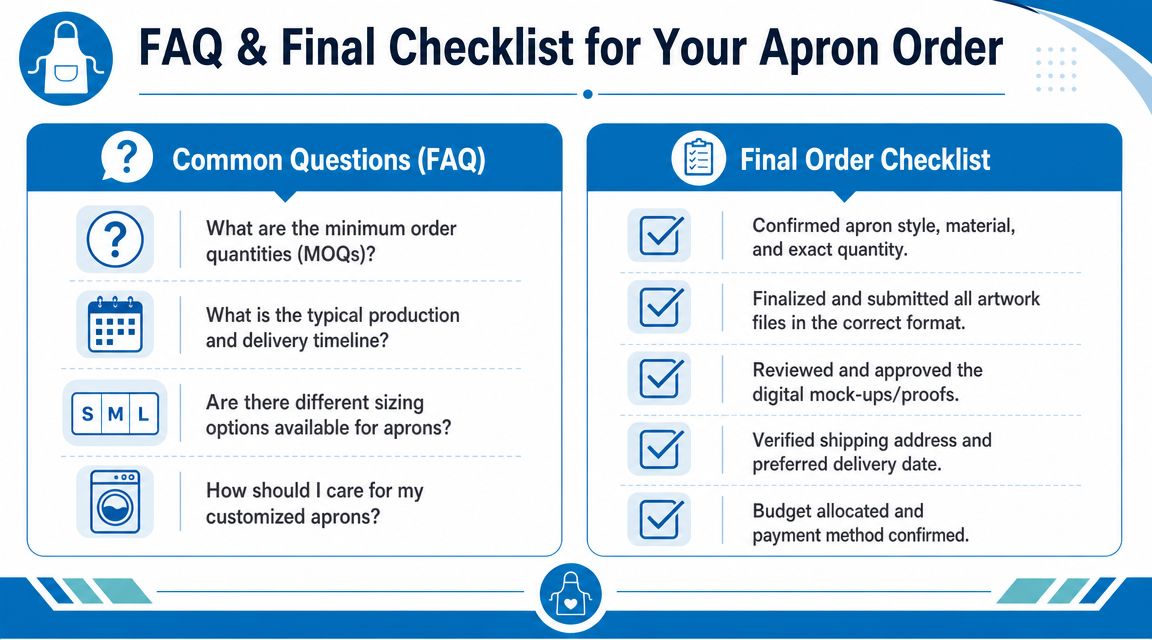
Common questions buyers ask late in the process
What's the right quantity for a first order?
Enough to cover current staff, near-term hires, and replacements. If the apron is central to the uniform, running too tight creates avoidable rush reorders.
Should I choose reusable or disposable aprons?
That depends on the work environment. For foodservice, janitorial, or medical-adjacent settings, this is a real procurement decision, not a side note. Prism Pak highlights that disposable aprons, often marketed as FDA-compliant, are a separate bulk-buying path for operations where sanitation, laundering burden, or cross-contamination risk outweigh branded presentation. That distinction is outlined on Prism Pak's aprons, gloves, and caps page.
Can I use the same artwork across different apron styles?
Usually yes, but placement may need adjustment. A logo that works on a broad bib panel may feel cramped on a narrower or pocket-heavy apron.
What should I ask before approving the proof?
Confirm logo size, exact placement, garment color, and whether future reorders can match the approved setup.
The best reorder is the one that doesn't require you to reinvent the original decision.
Final checklist before you approve the order
Use this list before you commit:
- Style is tied to the job: Bib, waist, bistro, or crossback should match the daily work, not just the look.
- Fabric matches the decoration: Stable fabrics support cleaner embroidery and more consistent long-term branding.
- Logo method fits the environment: Kitchens, events, retail floors, and hospitality teams don't all need the same treatment.
- Quantity includes a buffer: Replacement planning matters in any real uniform program.
- Artwork is production-ready: Clean files reduce revisions and avoid preventable setup problems.
- Proof details are fully reviewed: Placement, scale, and color need a final check before production.
- Care expectations are realistic: A garment that needs delicate treatment may not survive a rough-use workplace.
- Reorder notes are saved: Keep specs organized so the next order stays consistent.
A strong bulk apron order is simple in concept. Pick the right style for the role, the right fabric for the decoration, and the right branding method for the way the apron will be used. Do that well, and aprons in bulk stop being a commodity purchase and start becoming a reliable part of your uniform system.
If you're ready to turn those decisions into a clean, professional order, Dirt Cheap Product, Inc. can help you source and decorate aprons and other branded apparel with fast proofs, responsive support, and decoration options that match how your team works.