
More Than Words: Turning Slogans into Action
What makes anti bullying slogans work. The words themselves, or what people do after they read them? That's the gap most slogan roundups miss. A phrase on a shirt or tote only matters if it's clear, visible, and tied to behavior people can repeat.
That matters because bullying is not a niche issue. In the United States, 19.2% of students in grades 6-12 reported experiencing bullying during the 2021-2022 school year, according to StopBullying.gov bullying facts. A short slogan can't solve that on its own, but it can help a school, youth program, or workplace keep the same message in front of people every day.
Good anti bullying slogans do three jobs at once. They signal values, give people simple language to repeat, and turn custom apparel or promotional items into something more useful than decoration. The strongest campaigns don't stop at posters. They put the message on T-shirts, hoodies, hats, tote bags, wristbands, and staff gear so the wording stays visible in hallways, events, and public spaces.
If you're building a wider awareness program, these mental health campaign concepts can complement an anti-bullying message well.
Table of Contents
- 1. Choose Kindness Campaign Slogan
- 2. Stand Up, Speak Up Action-Oriented Slogan
- 3. Everyone Deserves Respect Universal Rights Slogan
- 4. Be the Difference Empowerment Slogan
- 5. No Bullies Here Zero-Tolerance Slogan
- 6. Lift Others Up Peer Support Slogan
- 7. Different is Beautiful Diversity & Inclusion Slogan
- 8. Report It, Stop It Accountability Slogan
- 8-Point Comparison of Anti-Bullying Slogans
- From Slogan to Statement A Practical Guide
1. Choose Kindness Campaign Slogan
“Choose Kindness” lasts because it's simple, positive, and easy to wear. It doesn't label kids, and it doesn't force the message into a scolding tone. That matters when you want broad buy-in from students, teachers, parents, volunteers, and staff.
It also follows a practical rule for anti bullying slogans. The strongest options are short, plainspoken, and easy for young students to read, while positive wording tends to work better than negative commands, as discussed in Custom Ink's anti-bullying slogan guidance. On a shirt, bag, or cap, that kind of language reads fast and sticks.

Why it works on apparel
This slogan works best when the print looks open and friendly. A heavy block font can make even a kind message feel harsh. Softer sans serif type, rounded lettering, or a handwritten style usually fits better, especially on youth tees and hoodies.
Use supporting art carefully. Hearts, joined hands, stars, or simple smile graphics help, but don't crowd the words. If the slogan is the hero, the visual should frame it, not compete with it.
Practical rule: If someone can't read the slogan from a few steps away, the design is too busy.
Best product choices
For school campaigns, I'd put “Choose Kindness” on products people reuse:
- T-shirts: Front chest prints work well for daily wear and awareness days.
- Tote bags: Good for books, event handouts, and repeat visibility in hallways.
- Hats: Best when the slogan is shortened or stacked into two lines.
- Wristbands: Useful as low-cost add-ons when you want the same message repeated across a whole group.
A smart upgrade is to add a small QR code on the sleeve, hem tag area, or bag corner that points to school resources or support contacts. Keep it secondary. The slogan should still be readable at a glance.
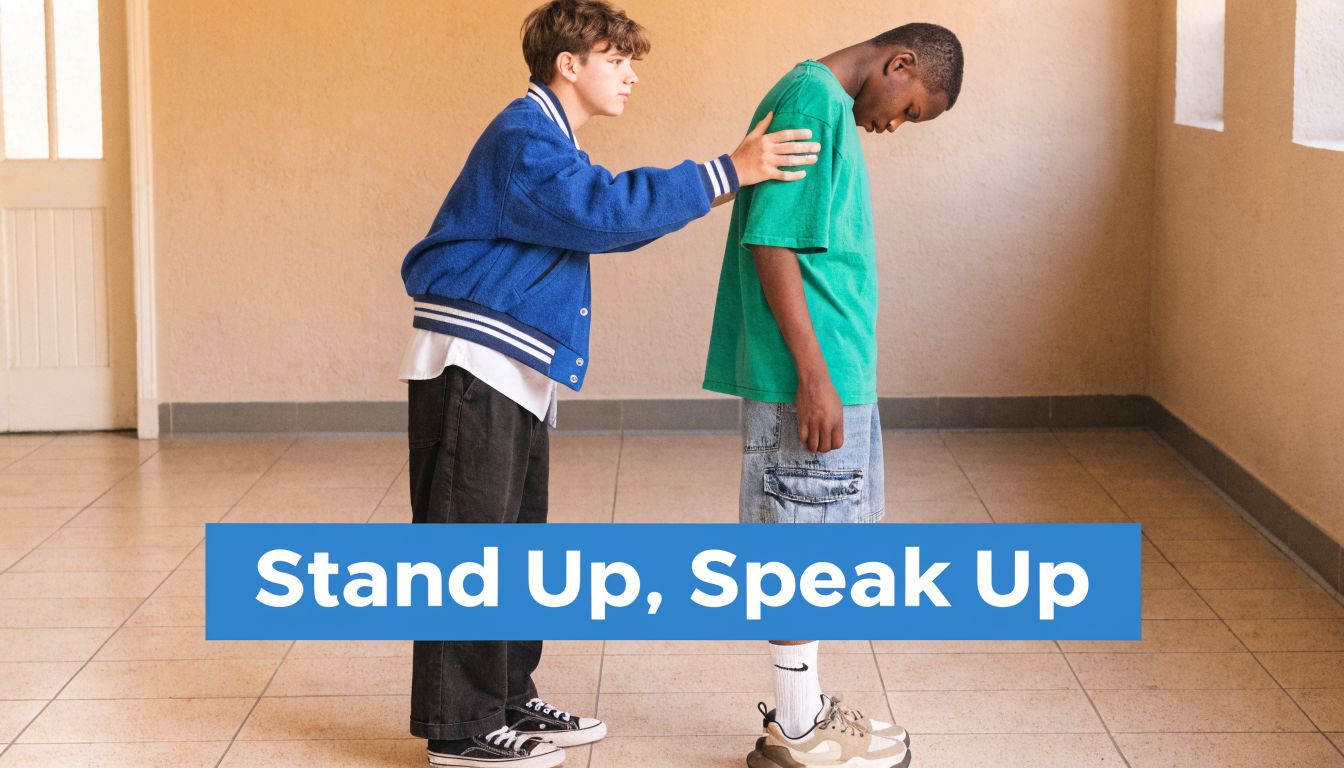
2. Stand Up, Speak Up Action-Oriented Slogan
Some anti bullying slogans comfort people. This one tells them what to do. “Stand Up, Speak Up” works because it turns passive agreement into visible responsibility.
That's important in real settings where witnesses often decide whether a situation keeps going. One cited statistic says bullying stops within 10 seconds in 57% of cases when a bystander steps in to defend or support the person being targeted, as summarized in Nimco's bullying facts and statistics article. A slogan that points people toward intervention has a stronger practical role than a message that only says bullying is bad.
Why action language matters
“Stand Up, Speak Up” works best for middle schools, high schools, youth groups, and staff training because it names two clear behaviors. It also splits well across a design. You can put “Stand Up” on the front and “Speak Up” on the back, or run the two phrases in contrasting colors on the same chest print.
That split treatment matters on merchandise. People remember short paired phrases faster than long copy blocks, especially on moving surfaces like shirts and hoodies.
Good anti bullying slogans don't just describe values. They prompt a next step.
Production tips that help
For this slogan, durability matters. It's ideal for items used over a long season, not just one assembly.
- Embroidered hats: Great for staff, mentors, and student leaders because the phrase stays sharp with repeated wear.
- Hoodies and jackets: Better than thin event tees if you want long-term visibility through a semester.
- Wristbands with reporting info: Useful if your school or organization has a real reporting process in place.
- Back prints for events: Large lettering on the back is easier to read in crowds than a small left-chest mark.
The weak version of this campaign is all message and no mechanism. If you print “Speak Up,” give people a safe reporting route too. Add a counselor office label, student support email, or a QR code tied to a real response path.
3. Everyone Deserves Respect Universal Rights Slogan
“Everyone Deserves Respect” has a different tone from the first two. It's steadier, broader, and less campaign-like. That makes it useful when the audience includes both students and adults, or when the message needs to fit a school, nonprofit, workplace, or community setting without sounding juvenile.
It also avoids a common problem with anti bullying slogans. Some lines are catchy but too narrow. This one gives you room to address teasing, exclusion, online harassment, and general conduct under one message.
Where this slogan fits best
This phrase works well on polos, quarter-zips, hoodies, and event shirts where the message can sit beside an organization name or logo. It's especially practical for staff teams, peer mentors, front desk teams, and volunteers who need a calm, credible message rather than a trendy one.
If your group serves multilingual families or mixed-age audiences, this slogan is one of the easiest to adapt into multiple languages on the same design. Keep the layout clean. One primary language on the front and a secondary translation on the back usually reads better than cramming both into one lockup.
Design choices that support it
Because the line is longer, spacing matters. Don't squeeze it into one tiny line across the chest. Break it into two or three balanced lines with clear hierarchy.
A few combinations work particularly well:
- Respect-first stack: Put “Respect” in the largest type and the surrounding words smaller.
- Tone-on-tone print: Good for staff hoodies or workplace apparel where subtle branding fits better.
- Inclusive icon set: Small symbols can help, but choose simple marks that won't date quickly.
- Left chest plus full back: This is one of the best formats for longer anti bullying slogans.
This slogan usually performs best when the garment quality feels slightly better. A cheap shirt can make a serious message feel disposable. A midweight tee, polo, or fleece gives it more credibility.
4. Be the Difference Empowerment Slogan
“Be the Difference” is a strong choice when you want energy without sounding moralizing. It feels active, but it doesn't lecture. Students often respond well to that balance because the phrase suggests influence, not obedience.
This is one of the more flexible anti bullying slogans for student leadership groups, volunteer programs, and peer ambassador teams. It also works well when you want custom merch to feel aspirational instead of institutional.
What it says without sounding preachy
The phrase invites ownership. That's useful in programs where you want students or employees to see themselves as part of the culture shift, not just recipients of rules.
On apparel, this slogan tends to work best with bolder styling than “Choose Kindness.” You can use stronger type, bigger back graphics, and a more modern layout without losing the message.
How to make it feel personal
This is a good candidate for limited-run or group-customized apparel. A plain slogan shirt is fine, but a slightly personalized version carries more weight.
- Add club or team names: “Be the Difference” over a leadership group name creates identity.
- Use names or graduation years: This works well for student council, peer leaders, or orientation crews.
- Invite student artwork: The slogan can stay fixed while the surrounding design changes each year.
- Offer multiple garment styles: Some students will wear a tee. Others will only wear a hoodie or cap.
I like this phrase on heavyweight tees, relaxed hoodies, and hat fronts with larger embroidery. It also works well on tote bags because the wording still reads clearly when the bag folds or swings.
If the audience wants merch they'd wear outside the event, choose a slogan that sounds like identity, not a lecture.
5. No Bullies Here Zero-Tolerance Slogan
This one is blunt. That's both the strength and the risk.
“No Bullies Here” sets a hard boundary fast. It works at entrances, events, staff checkpoints, and supervised youth spaces where the message needs to be immediate. If a school wants a phrase for a welcome table, check-in station, hallway supervision gear, or event signage, this can do the job.
When firm language helps
Use this slogan when the goal is space-setting, not broad inspiration. It's best for specific environments: field days, orientation stations, club events, camp check-ins, staff lanyards, or volunteer apparel that marks behavioral standards clearly.
It also fits merchandise that acts almost like signage. Hats worn by event staff, large tote bags for team leads, and visible badge accessories can all carry this kind of direct wording.
How to avoid the common mistake
The mistake is using only hard language. A firm slogan can define the standard, but if the whole campaign sounds punitive, people may shut down or reduce the issue to simple labeling.
One anti-bullying resource cautions that kids who bully are still kids and that slogans shouldn't dehumanize them. Constructive messaging should promote behavior change and respect, as discussed in Jef Menguin's anti-bullying slogan discussion. That's why I wouldn't build an entire campaign around “No Bullies Here” alone.
Pair it with a more constructive companion line somewhere else in the program. For example, use the firm phrase on staff-facing gear and event checkpoints, then use a positive line on student apparel.
- Best use: Entrance gear, volunteer shirts, hall-monitor hats, event check-in apparel.
- Avoid: Making it the only message across every item.
- Best pairing: Add a back print or secondary mark that reinforces belonging or respect.
- Keep the look clean: Direct slogans need clean type and high contrast, not decorative fonts.
6. Lift Others Up Peer Support Slogan
Some anti bullying slogans work because they oppose harm directly. “Lift Others Up” works because it gives people a better social script. Instead of just saying what not to do, it tells peers what support looks like.
That distinction matters in group settings. Students often know bullying is wrong. What they don't always know is how to act differently in the moment. This phrase points toward encouragement, inclusion, and visible support.

Why peer culture matters
This slogan is especially strong for teams, clubs, mentoring groups, and athletic programs. It doesn't sound like school administration language. It sounds like a team standard.
That makes it a natural fit for group orders. Matching shirts for peer leaders, warm-up hoodies for athletes, or mentor tote bags all reinforce the same shared message without feeling forced.
Merch that supports group identity
The product choice should reflect the kind of group carrying the message.
- Athletic hoodies: Great for team leaders and captains who set the tone in public.
- Mentor shirts: Good for peer helpers during orientation or campus events.
- Canvas totes: Useful for counseling teams, student ambassadors, and event volunteers.
- Beanies or caps: Good for recurring wear in programs where students choose casual gear.
A visual metaphor can help here. Upward arrows, open hands, growth icons, or simple line art can reinforce the wording. Keep it subtle. Over-illustrating this slogan can make it feel childish.
This is also one of the best choices for group backs and individual front personalization. A front-left name plus a larger “Lift Others Up” back print gives the item both identity and message.
7. Different is Beautiful Diversity & Inclusion Slogan
“Different is Beautiful” does a specific job that many anti bullying slogans don't. It addresses one of the roots of bullying by rejecting the idea that being different makes someone a target.
That's why it works well in inclusion campaigns, identity-affirming programs, and school communities trying to support students across differences in ability, background, expression, and personality. It also pairs naturally with broader belonging work, including find autism support in Kelowna when families or organizers are looking for support beyond awareness merchandise.
Use it carefully and deliberately
This slogan needs authenticity. If the visuals only show one type of person, or if the campaign ignores actual inclusion practices, the phrase can feel hollow.
The better approach is to make the design reflect real diversity in art direction, casting, color choice, and fit options. Offer more than one shirt cut if possible. Let people choose styles they'll wear.
Visual design matters more here
This is a slogan where the artwork carries real weight. A plain text print can work, but thoughtful supporting design usually makes the message stronger.
One practical reason to use this style now is that bullying also shows up in digital environments. CDC school surveillance notes that 37% of middle schools, 25% of high schools, and 6% of elementary schools reported cyberbullying at least once a week, according to the CDC overview on bullying and youth violence. In other words, students encounter pressure around difference both in person and online, so a visible inclusion message still has real value.
A diversity slogan works best when the people wearing it can recognize themselves in the design.
For products, I'd lean toward highly visible everyday items: soft tees, hoodies, tote bags, and sticker-style giveaway items that feel expressive rather than official. This slogan should feel personal, not bureaucratic.
8. Report It, Stop It Accountability Slogan
If your organization already has a reporting system, this may be the most useful slogan on the list. “Report It, Stop It” creates a direct link between seeing harm and taking action.
That's important because awareness without a reporting path can leave people stuck. This slogan works best in schools, youth sports, camps, and workplaces where somebody has already decided who receives reports, how they're handled, and what happens next.
The strongest slogan for systems
This phrase is practical because it doesn't pretend everyone can solve bullying alone. It tells observers to hand the issue into a system.
That lines up with the reality of digital bullying too. Only 44% of social media bullying victims report incidents to platforms, and just 29% of those who report say platforms take meaningful action, according to the Tyler Clementi Foundation bullying statistics summary. A printed slogan can't fix platform response, but it can remind students and staff to use the reporting channels they do control locally.
What to print with it
This slogan should almost never appear by itself. It needs companion information.
- Lanyards: Good for staff, mentors, and student leaders when reporting contacts can sit on the reverse side or attached card.
- Badges: Useful for events, campus teams, or support staff who need visible accountability language.
- Wristbands: Effective if they include a short hotline label, office name, or QR code.
- Back-of-shirt print blocks: Best for awareness days when you can add a reporting instruction under the slogan.
Train people before you hand the merch out. If a student scans a code or reads a reporting message and no one knows what happens next, the campaign loses credibility fast.
8-Point Comparison of Anti-Bullying Slogans
| Slogan | 🔄 Implementation complexity | ⚡ Resource requirements | 📊 Expected outcomes | 💡 Ideal use cases | ⭐ Key advantages |
|---|---|---|---|---|---|
| "Choose Kindness" Campaign Slogan | Low, simple phrase; needs supporting context | Low, inexpensive bulk printing, simple artwork | Moderate awareness & inclusivity; indirect behavior change | Schools, community merch, wellness programs | Versatile, inclusive, highly merchandisable |
| "Stand Up, Speak Up" Action-Oriented Slogan | Medium, requires safety guidance and training | Medium, training, durable branded items, support resources | Higher bystander intervention when supported; possible anxiety risks | Assemblies, bystander training, activism campaigns | Mobilizes bystanders with clear call-to-action |
| "Everyone Deserves Respect" Universal Rights Slogan | Low–Medium, principle-based; needs educational framing | Medium, multilingual materials, larger-format prints | Long-term values alignment and cultural shift | D&I initiatives, corporate codes, international schools | Universal, low controversy, value-driven longevity |
| "Be the Difference" Empowerment Slogan | Low, motivational; benefits from examples and personalization | Low–Medium, custom designs, social media content | Strong youth engagement and peer sharing; limited systemic impact | Youth leadership, student merch, social campaigns | Inspires individuals; highly customizable and shareable |
| "No Bullies Here" Zero-Tolerance Slogan | Medium, requires enforcement and clear policies | Medium–High, signage, staff training, enforcement measures | Clear deterrence and behavioral boundaries; can seem punitive | School entrances, workplace policies, events with codes | Direct, unambiguous messaging with high visibility |
| "Lift Others Up" Peer Support Slogan | Medium, needs program structures and cultural commitment | Medium, mentoring programs, group apparel, training | Improves peer support and community cohesion over time | Peer mentoring, team building, athletic programs | Builds supportive culture; pairs well with mentorship |
| "Different is Beautiful" Diversity & Inclusion Slogan | Medium, requires authentic representation and policy backing | Medium–High, inclusive design, stakeholder collaboration | Reduces identity-based stigma; fosters inclusion and visibility | LGBTQ+ initiatives, disability awareness, multicultural programs | Addresses root causes; strongly resonates with marginalized groups |
| "Report It, Stop It" Accountability Slogan | High, depends on reliable reporting and response systems | High, hotlines/QRs, staff, follow-up protocols and training | Increases reporting and enables interventions if systems respond | Schools/workplaces with formal reporting, safety programs | Creates clear accountability and actionable response pathway |
From Slogan to Statement A Practical Guide
What makes an anti bullying slogan work once it leaves the page and goes onto a shirt, hoodie, tote, or cap?
The answer is use, not just wording. A slogan has to fit the audience, the item, and the action behind it. Third-grade field day shirts need fast, positive language. Staff polos for training need phrasing that reads professional. Event totes and giveaway items need shorter copy because the print area and viewing time are limited.
Short slogans usually carry best on apparel. Long slogans often read fine in a document but lose force once they are curved across a chest, stitched onto a cap, or reduced for a sleeve print. If a phrase cannot be understood in about two seconds, tighten it before approving art.
Production choices decide whether the message stays readable after repeated wear and washing.
Screen printing is usually the safest option for bold text on tees and hoodies because letterforms stay clean at a distance. Embroidery suits polos, jackets, and hats, but dense stitching can make small text harder to read, especially on textured fabric. DTF and sublimation are useful for multicolor graphics or campaign art that mixes text with illustration. They still need disciplined layout. Too many effects, outlines, or color shifts make a slogan harder to catch.
Placement matters just as much. A left chest print works for staff apparel and conversation-starting designs. A full front or full back print works better for assemblies, walkathons, school entrances, and any setting where people need to read the message across a room. I usually advise clients to choose placement based on viewing distance first, then build the artwork to that scale. That avoids a common mistake: treating a shirt like a flyer reduced to fabric size.
Good campaign merch also needs a next step. If the message asks students to report bullying, include a QR code, contact point, or program name somewhere practical, such as a back print, hang tag, card insert, or companion sign. If the slogan centers on peer support, match it with student ambassadors, mentor groups, or event staff who can model the behavior. Apparel reinforces a program. It does not replace one.
Keep the visual system consistent across products. Use the same type choices, print colors, logo treatment, and message hierarchy on shirts, hoodies, hats, bags, and signage so the campaign feels organized rather than pieced together. Before ordering in volume, also verify that the slogan is clear to use and not tied to a protected campaign mark.
Dirt Cheap Product, Inc. produces custom apparel and promo items using screen printing, embroidery, DTF, sublimation, and patches on products such as T-shirts, polos, hoodies, hats, and bags. Match the decoration method to slogan length, garment type, budget, and expected wear, then review a proof at actual size before approving the run.