You're probably dealing with one of two situations right now. Either your team uniforms don't match well enough, or they match, but they still don't look like a real uniform program. The shirts are close, the colors are mostly right, and then someone stands at the counter, front desk, jobsite, or event entrance and the whole thing feels inconsistent.
That's where custom patches for uniforms usually solve a real problem. A good patch gives you one repeatable brand mark that can go across polos, jackets, hats, work shirts, aprons, and outerwear without reinventing the look every time. What's more, the right patch holds up through wear, washing, staff turnover, and reorders. That part gets missed in a lot of patch guides.
Most first-time buyers focus on the artwork. Production people usually focus on something else first. How the patch will be used, how often the garment will be washed, what fabric it's going on, and whether the patch needs to stay permanent or be replaced later. If you get those decisions right early, the design part gets much easier.
Table of Contents
- Why Custom Patches Are Essential for Professional Uniforms
- Choosing the Right Patch Type for Your Brand
- Selecting the Best Attachment Method
- Preparing Your Artwork for Perfect Patches
- A Practical Guide to Patch Sizing and Placement
- Ensuring Long-Term Value and Uniform Maintenance
- Your Simple Ordering Workflow with Dirt Cheap Product Inc
Why Custom Patches Are Essential for Professional Uniforms
A uniform has to do more than look tidy. It has to identify the person wearing it, connect them to your company, and make that connection easy for customers, visitors, or other staff to recognize fast.
That's why patches have stayed relevant for so long. Modern sewn-on service patches became widespread in the 19th and 20th centuries as armies, police forces, fire departments, and other organizations used them to identify rank, unit, and affiliation on standardized uniforms, according to this history of uniform patches. That legacy still shapes how professional uniforms work today.
Custom patches are also used widely for staff identification, company logos, and team morale across corporate uniforms, event crews, and service teams. In those settings, a 3 to 5 inch patch size is commonly used to keep branding visible and professional, as noted in this guide to patch uses and goals.
Uniforms need one visual standard
When a business grows, inconsistency shows up fast. One employee wears a polo, another wears a work shirt, a supervisor wears a jacket, and the logo looks different on all of them if decoration isn't standardized. A patch fixes that by creating one consistent badge that can travel across multiple garments.
That matters in customer-facing roles. A front-of-house team, field crew, maintenance staff, or event team all benefit when people can identify who works there without hesitation.
Practical rule: If the garment mix changes often, patches usually give you more consistency than decorating each item from scratch.
Patches solve problems beyond appearance
A patch isn't just decoration. It's a durable marker for names, departments, roles, and logos that has to survive repeated wear and washing. That's one reason embroidered patches remain common in uniform programs. They can carry logos, names, departments, and badge-style elements in a format built for repeated use, as described in the earlier history reference.
A lot of first-time buyers think of patches as an add-on. In practice, they often become the foundation of the uniform system. Once the size, style, border, and attachment method are right, reorders get easier and replacements stay consistent.
Choosing the Right Patch Type for Your Brand
The patch type changes the entire feel of the uniform. Two logos can use the same artwork and look completely different depending on whether they're embroidered, woven, PVC, chenille, or sublimated.
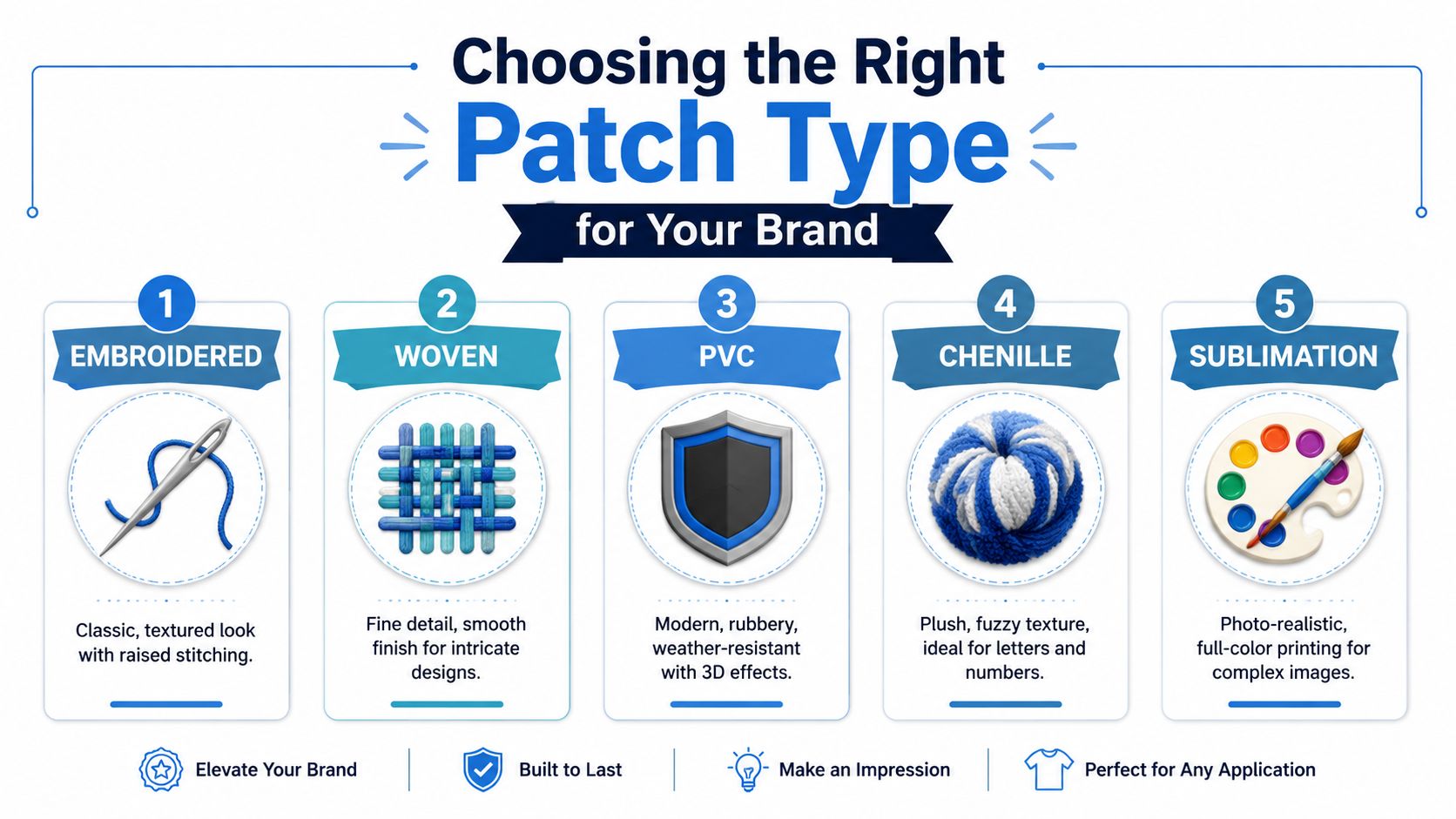
How each patch type actually looks on a uniform
Embroidered patches are the classic uniform option. They have raised stitching and visible thread texture. If your logo is bold, simple, and built around solid shapes, embroidered patches usually look right at home on work shirts, jackets, hats, and public-facing uniforms.
Woven patches look flatter and cleaner. Instead of a chunky stitched texture, they give you a tighter surface that handles finer lines and smaller details better. If your logo has thin type, small icons, or tighter curves, woven is often the easier path.
PVC patches have a rubber-like feel and a more modern appearance. They work well when the environment is rough, damp, dirty, or outdoors. On outerwear, bags, and field gear, PVC can make sense because it feels structured and tough.
Chenille patches are plush and fuzzy. They're best for letters, numbers, and bold badge styling rather than tiny details. They can work on varsity-inspired uniforms, team apparel, or branded outerwear, but they usually aren't the first choice for a fine corporate logo.
Sublimated patches are the pick when the artwork depends on gradients, photo-like color changes, or highly complex printed detail. They don't give the same stitched texture as embroidery, but they can reproduce artwork that thread can't.
A lot of disappointing patch orders come from picking a style for appearance alone. Start with the logo detail, then the work environment, then the brand mood.
Custom Patch Type Comparison
| Patch Type | Best For | Texture | Level of Detail |
|---|---|---|---|
| Embroidered | Classic uniforms, bold logos, department badges | Raised and stitched | Moderate |
| Woven | Detailed logos, small text, cleaner corporate marks | Smooth and flat | High |
| PVC | Outdoor gear, workwear, bags, modern branding | Rubbery and dimensional | Moderate |
| Chenille | Letters, numbers, heritage looks, team apparel | Soft and fuzzy | Low |
| Sublimation | Full-color art, gradients, complex images | Smooth printed surface | Very high |
A simple way to decide is to match the patch to the brand voice. Traditional service businesses usually look strong with embroidered patches. Sleeker brands often prefer woven. Utility-heavy uniforms and outerwear can benefit from PVC. Chenille is a niche look. Sublimation is a technical solution when color complexity matters more than texture.
Selecting the Best Attachment Method
A patch can look right on the sample table and still become a headache six months into a uniform program. The attachment method decides whether the patch survives weekly wash cycles, whether replacements are easy to handle, and how much labor you take on later.
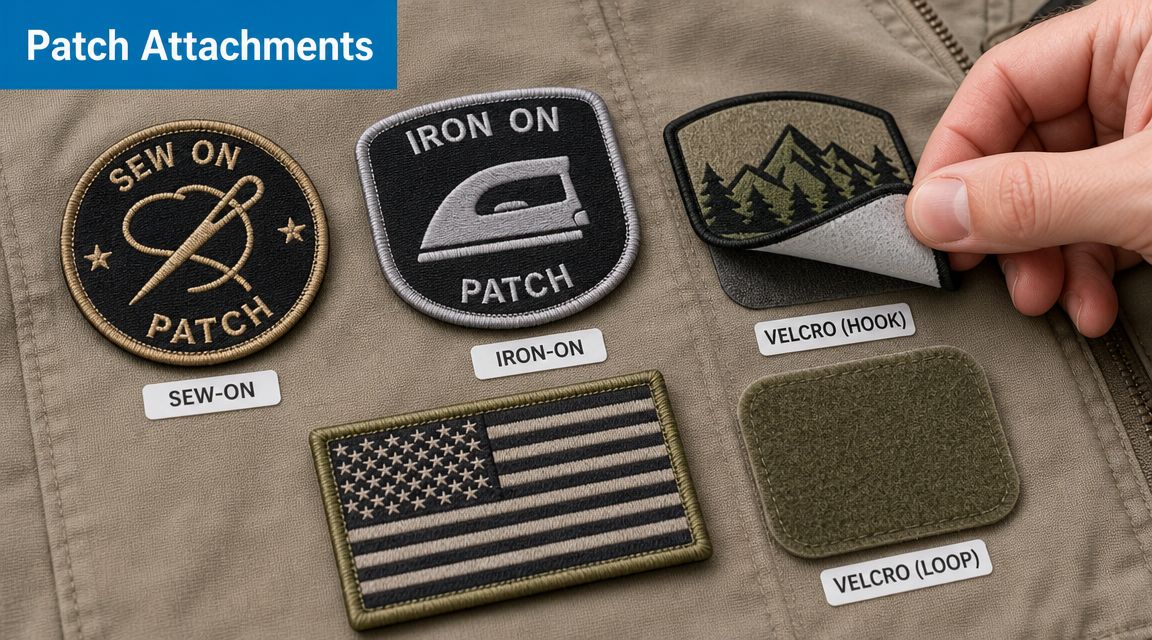
The first question I ask is simple: should this patch stay on the garment for its full service life, or will names, roles, or departments change? That one decision shapes everything after it, from install cost to replacement planning.
Permanent options for daily uniforms
Sew-on backing is the safest choice for uniforms that get washed often and worn hard. It holds up better through commercial laundering, repeated motion, and fabric flex because the patch is physically stitched to the garment. For shop shirts, service uniforms, outerwear, and work jackets, this is usually the method that creates the fewest long-term problems.
Iron-on backing has a narrower lane. It can save time during application and helps keep the patch in place before final stitching, but heat seal alone is not my first choice for heavy-use uniforms. Fabric content matters. Wash temperature matters. Dryer heat matters. If the garment will see frequent laundering, sew-on usually gives you a longer service life and fewer reattachment issues.
Thread color also affects how clean a sewn border looks once the patch is attached, especially on dark uniforms or high-contrast logos. It helps to review embroidery thread color options for uniform patches before approving the final build.
Removable options for changing roles and events
Hook-and-loop backing works well when the patch needs to be swapped out. Security teams, event crews, field staff, and seasonal programs often use it because titles and assignments can change without replacing the whole garment. The trade-off is added thickness, visible edge lift on some garments, and the need to maintain both the patch and the sewn panel on the uniform.
Adhesive backing is for short-term use. It helps with mockups, temporary events, and sample approvals, but it is not a serious long-term answer for a uniform program.
If the garment will be washed regularly and the logo is meant to stay put, sew-on is usually the better long-term choice.
Here's a quick visual if you want to see common attachment styles in action.
The buying mistake I see most often is choosing attachment based only on unit cost. A cheaper backing can cost more later if patches peel, corners lift, or the team has to replace garments early. The better question is how the patch will behave after repeated washing, drying, storage, and reassignment.
That same practical mindset shows up in other branded products too. Teams that already design custom automotive stickers usually understand that surface, environment, and wear conditions matter as much as appearance. Uniform patches follow the same rule. Match the backing to the actual job, not just the first day the garment is issued.
Preparing Your Artwork for Perfect Patches
Good patch production starts with artwork that matches the decoration method. Most delays happen before the first stitch or sample because the file doesn't translate well into thread, edge shape, or patch size.
Files that save time instead of creating delays
Vector files such as AI or EPS are usually the easiest format to work with because they scale cleanly. The lines stay crisp when the design is resized for a chest patch, shoulder patch, or back patch. JPG and PNG files can still be useful as references, but if they're low resolution, fuzzy edges and unclear lettering often show up during proofing.
If you've ever prepared logo files for other branded items, the same basic discipline applies. Teams that already design custom automotive stickers usually understand why clean outlines, readable text, and separated colors matter before production starts.
A simple preflight checklist helps:
- Send the original logo file: Don't screenshot your website logo if the actual design file exists.
- Include brand colors: If your logo uses specific thread or print colors, note them clearly.
- State the final use: A patch for a hat, sleeve, or shop shirt may need different simplification.
Artwork details that affect the final stitch-out
Small text is the first thing to fail. If a logo depends on tiny wording, fine outlines, or crowded layers, it may need to be simplified. That isn't a design compromise. It's production discipline. A strong patch reads clearly from normal viewing distance.
Border style matters too. A merrowed border gives you that traditional stitched edge and works well on common shapes like circles, ovals, rectangles, and shields. A hot-cut border is better when the patch has corners, custom contours, or tighter silhouette control.
Thread selection also changes the result. Matte, bright, and specialty thread choices can shift how the logo reads under indoor lighting or outside on the job. A practical place to compare options is this embroidery thread color reference.
A patch proof should answer three questions before approval. Is the text readable, is the border right for the shape, and does the color contrast still work on the actual garment.
A Practical Guide to Patch Sizing and Placement
Patch sizing should start with the garment, not the artwork. Buyers often try to scale the logo until every detail fits, but a patch still has to sit correctly on a pocket area, sleeve curve, chest panel, or jacket back.
For uniform applications, garment geometry sets real limits. Standard name patches are typically about 1"×3" to 1.5"×4", logo patches about 2"×2" to 2.5"×2.5", shoulder or sleeve patches about 3"×3" to 4"×4", and back patches around 10"×12", according to this patch sizing and backing guide. Those ranges exist because text has to remain readable on curved or narrow garment panels.
Use the garment to set the patch size
A chest name patch above a pocket has very little room to hide mistakes. If the patch is too tall, it crowds the pocket seam. If it's too wide, it starts to look awkward across the shirt front.
For chest logos and name areas, smaller usually looks more professional. Sleeve and shoulder placements can handle more visual weight, which is why they often carry unit, department, or role identification. Large back patches are a different category entirely. They're for distance visibility, not subtle branding.
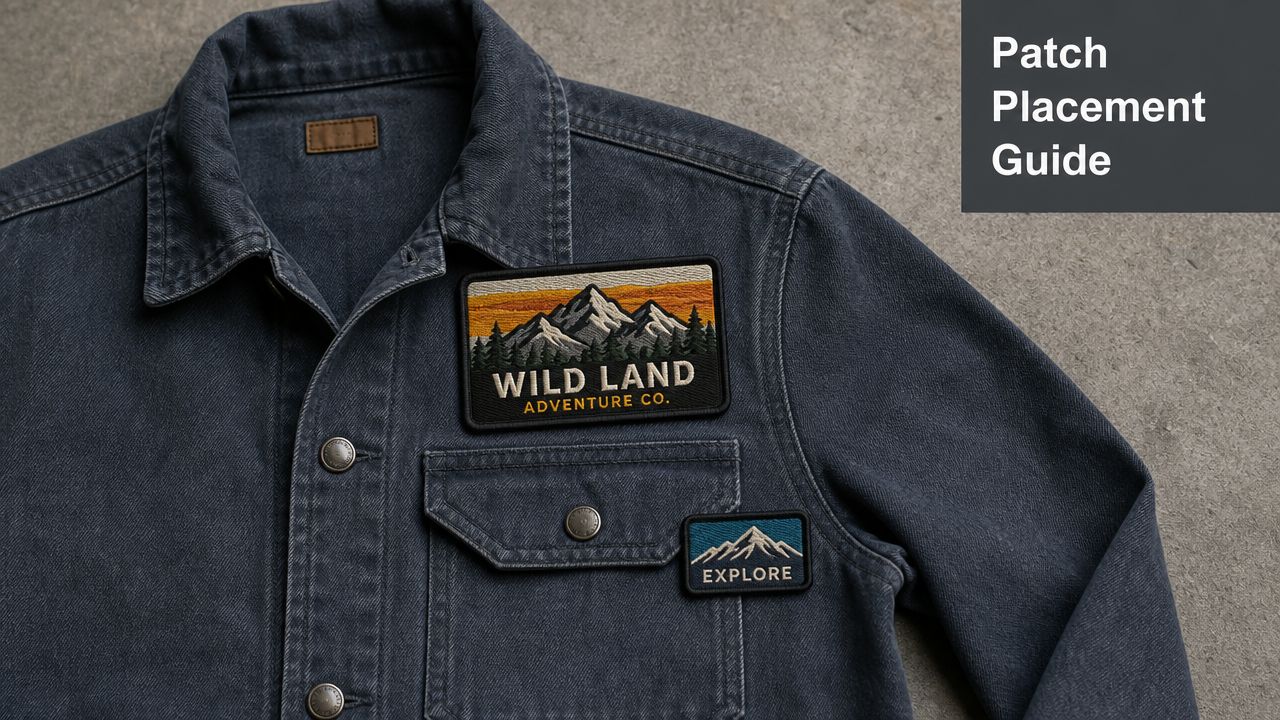
Placement mistakes that make uniforms look off
The most common placement issue isn't bad sewing. It's bad planning. A patch can be centered perfectly and still look wrong if it ignores plackets, pockets, seams, zippers, yokes, or panel breaks.
A few habits help:
- Measure the actual garment: Don't size from a digital mockup alone.
- Check all garment sizes: A patch that looks balanced on a large shirt can overpower a small.
- Respect structural lines: Pockets, seams, and jacket panels should frame the patch, not fight it.
For placement standards on decorated apparel, this embroidery placement guide is useful when you're comparing left chest, sleeve, back, and hat positions.
Professional uniforms settled into these placement conventions for a reason. They support quick recognition, keep the garment clean-looking, and avoid the cluttered effect that makes a uniform feel promotional instead of official.
Ensuring Long-Term Value and Uniform Maintenance
Six months after a uniform rollout, the artwork is rarely the problem. Failures usually show up in the wash. Borders start to fuzz, corners lift, adhesive loosens, or a replacement run comes back looking slightly different from the first order. That is why patch value should be judged over the life of the garment, not by unit price alone.
Cheap patches often create expensive maintenance. If a patch has to be reapplied, replaced early, or removed from a damaged shirt, the added cost is labor, garment loss, and inconsistency across the team. I usually tell first-time buyers to price the patch program in two parts: what it costs to install, and what it costs to keep presentable through normal wear.
A better way to evaluate long-term value is to look at the full uniform cycle:
- Initial attachment: How much shop time does the chosen method require?
- Laundry exposure: Will home wash, industrial wash, dry cleaning, heat, or chemicals stress the patch?
- Repair and replacement: Can a worn patch be removed cleanly and replaced without ruining the garment?
- Reorder consistency: Can later runs match the original thread colors, border, size, and finish closely enough?
That last point matters more than many buyers expect. Uniform programs rarely end with one order. New hires come in, garments wear out, departments split, and logos get refreshed. A patch that is easy to reproduce cleanly saves trouble later.
Build maintenance into the order, not after it
Different patch constructions age differently. Embroidered patches usually hold up well in everyday uniform use, but dense stitching on a stiff base can pucker lighter shirts over time. Woven patches give finer detail and less bulk, but they can show edge wear sooner if the border and attachment method are not chosen carefully. PVC handles wet and dirty environments well, yet it adds weight and does not belong on every shirt fabric.
Attachment method affects service life just as much as patch type. Sew-on patches take more labor up front, but they are usually the safest choice for repeated laundering and long uniform cycles. Heat seal can work for the right garment and care routine, though I would not treat it as the default for heavy wash programs unless the patch is also sewn down. Hook-and-loop has a real place for roles that change often, but the trade-off is extra bulk, edge wear, and a base piece that still has to survive washing.
Care instructions should match the actual workplace, not the ideal one. If staff sends garments through commercial laundry, specify patches for that environment from day one. If uniforms are issued for events, light hospitality use, or occasional outerwear, you can accept more flexibility. The wrong specification usually shows up later as curling, fraying, color shift, or premature replacement.
For teams building a full uniform program, this ordering guide for embroidered uniforms is a useful reference for documenting decoration details clearly before production starts.
Small maintenance habits prevent messy reorders
Set one care standard for the whole staff. Mixed washing habits produce mixed results, and then it becomes hard to tell whether the patch failed because of construction or because half the garments were cleaned more aggressively than the rest.
Keep a sample from the approved run. Save the thread callouts, finished size, border type, and attachment method with the uniform records. That gives purchasing a clean reference when replacements are needed a year later.
The shops that get the best long-term results are not the ones chasing the lowest patch price. They are the ones ordering for the garment's full service life, then making replacement easy when that life ends.
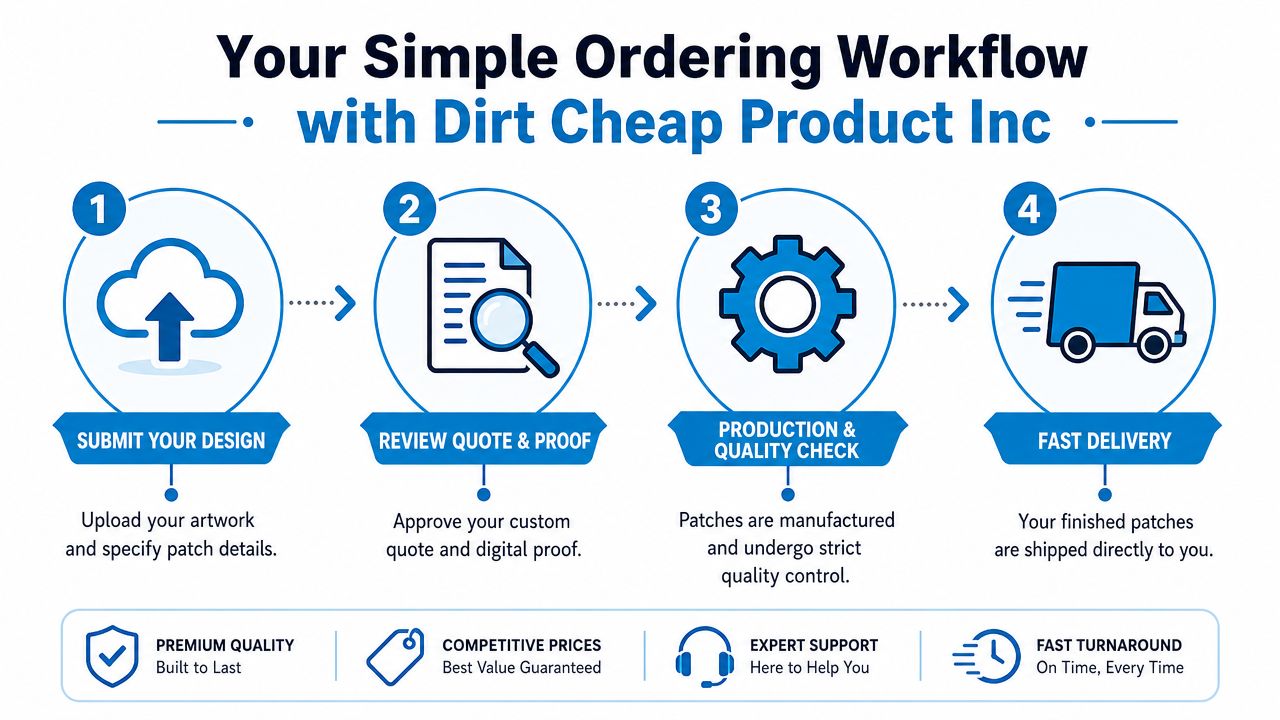
Your Simple Ordering Workflow with Dirt Cheap Product Inc
A smooth patch order comes from clear inputs and a disciplined proof process. The production side is usually straightforward when the artwork, size, backing, and placement have already been decided.
What to send before production starts
Start with the logo file, the intended garment, and the exact use case. Say whether the patch is for polos, work shirts, hats, jackets, bags, or mixed garments. Then specify the patch type, border style, backing, and target placement.
If you need a process reference, how to order embroidered uniforms shows the kind of information that helps move branded apparel projects forward cleanly. For patch work, the same principle applies. Better inputs usually mean fewer revisions.
Dirt Cheap Product, Inc. offers custom patches for uniforms as part of its branded apparel services, which can help when a client needs patches coordinated with shirts, outerwear, hats, or other decorated items in one program.
What approval should actually cover
Don't approve a proof by looking only at the logo shape. Check the stitch style, border finish, thread colors, backing choice, final dimensions, and garment placement notes. Those details are what determine whether the patch looks right after production, not just on a screen.
A strong approval process is simple:
- Confirm the artwork is simplified enough for the chosen patch type.
- Confirm the dimensions fit the garment area.
- Confirm the attachment method matches the uniform's wash and wear conditions.
- Confirm the reorder standard is documented.
That last point matters more than people expect. If your first order looks right but nobody records the exact specs, the second order becomes a guessing game.
If you're planning a uniform patch order and want help sorting out patch type, sizing, artwork, or attachment method, Dirt Cheap Product, Inc. can help you turn a logo into a repeatable patch program that fits your garments, budget, and day-to-day wear requirements.