
You're probably sorting through the same promo-product problem a lot of teams hit. You need something people will keep, use in public, and associate with your brand for more than a week. Pens disappear. Cheap tote bags pile up. Small desk items rarely leave the office.
A custom camping chair sits in a different category. It's useful, visible, and tied to real-world moments where people relax, stay longer, and bring gear with them. That changes how your logo gets seen. At a tailgate, youth sports game, beach day, outdoor fundraiser, festival, or company picnic, the chair isn't just a giveaway. It becomes part of the setting.
If you're ordering for the first time, the smart question isn't just which chair to buy. It's whether a custom camping chair is the right fit for your event, your audience, and the kind of brand impression you want to make.
Table of Contents
- Why a Custom Camping Chair is Your Next Best Promotional Item
- Anatomy of a Great Custom Camping Chair
- Bringing Your Brand to Life Decoration Methods
- Design and Artwork Tips for Maximum Impact
- Custom Camping Chairs in Action Inspiring Use Cases
- How to Order With Dirt Cheap Product Inc
- Frequently Asked Questions About Custom Chairs
Why a Custom Camping Chair is Your Next Best Promotional Item
A lot of branded merchandise gets handed out once and forgotten. A custom camping chair is different because it solves a real need. People use portable seating when they're staying in one place for hours, and that usually happens in public.
That makes the chair more than a gift. It becomes a mobile branding surface that shows up at soccer fields, parking lots before games, campgrounds, fishing trips, school events, and backyard gatherings. Unlike many giveaway products, it's used at eye level and often in groups, which gives your logo repeated exposure without feeling forced.
There's also a practical market signal behind this category. The global camping chair market was valued at USD 128.16 million in 2024 and is projected to reach USD 210.53 million by 2032, with a projected 6.4% CAGR from 2025 to 2032, according to Data Bridge Market Research's camping chair market report. For buyers, that matters because it shows camping chairs are part of a growing product category, not a novelty item.
Why buyers keep coming back to this format
- It feels substantial: A chair has perceived value. Recipients usually treat it as gear, not swag.
- It travels well: People bring it to events where your brand can be seen by others.
- It supports longer engagement: If your audience sits comfortably, they stay longer at the event.
- It fits many brand types: Schools, breweries, contractors, nonprofits, sports programs, and corporate teams can all use it without stretching the concept.
Practical rule: If your audience already spends time outdoors, at community events, or on sidelines, a custom camping chair often gets more real use than lower-cost giveaway items.
The key is choosing it for the right reason. If your goal is broad, low-cost distribution, this may not be the fit. If your goal is stronger retention, higher perceived value, and repeat visibility, it's a smart piece of branded equipment.
Anatomy of a Great Custom Camping Chair
Most first-time buyers focus on the imprint area. Experienced buyers start with the chair itself. If the frame flexes, the feet sink, or the fabric tears after a short season, the logo won't save it.
Start with the frame, not the logo
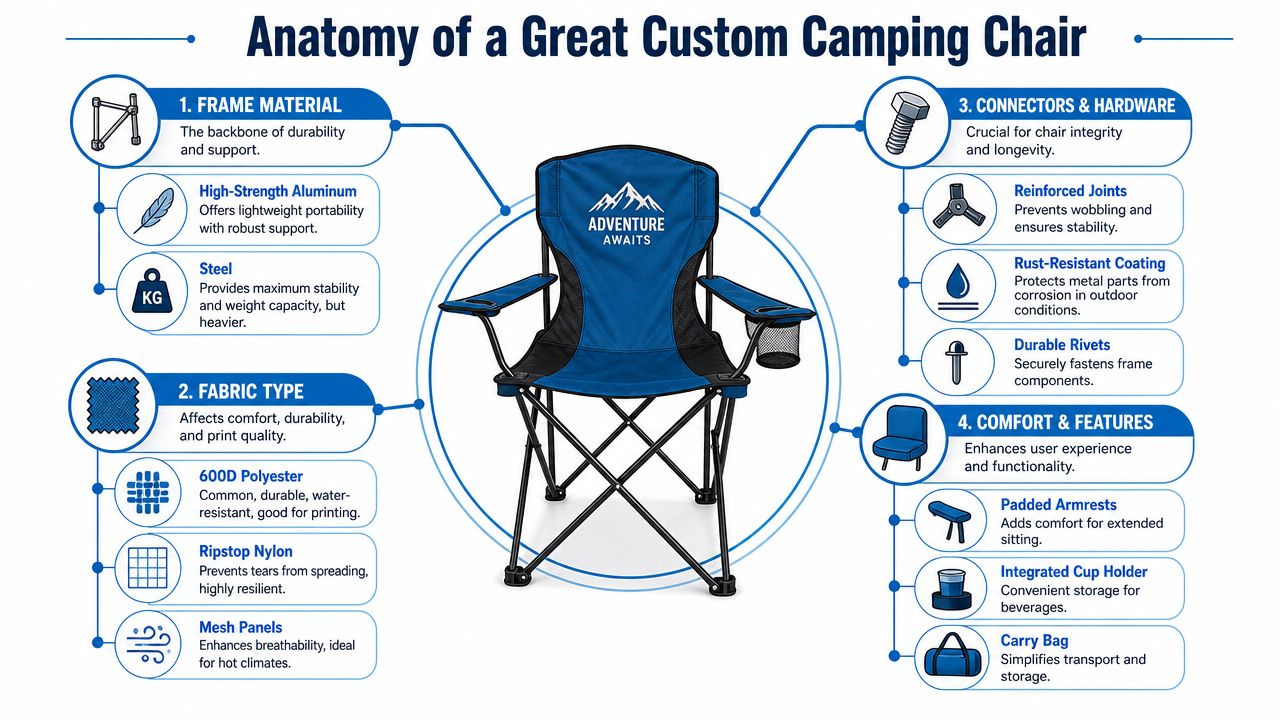
A technically sound chair usually relies on four core build choices: an aluminum frame, anti-sink feet, ripstop polyester fabric, and premium bar-tack stitching, as described in TravelChair's build-a-chair overview. Those details matter because they address the usual failure points in portable seating.
Aluminum frame is often the better call when portability matters. It keeps weight down and makes the chair easier to carry, load, and hand out at events. Steel can feel sturdy, but it usually adds bulk. If your recipients will move the chair from the car to the field or beach, lighter is usually better.
Ripstop polyester is one of the most practical fabrics for this product type. It handles outdoor use well and gives you a stable print surface. If the fabric gets nicked, the ripstop weave helps limit how far a tear can spread.
If you're still comparing styles, this guide to choosing a camping chair is useful for thinking through comfort, portability, and use setting before you ever get to decoration.
The small details decide whether the chair lasts
A chair may look fine in a product photo and still fail in the field. The weak points usually show up where the user doesn't look first.
| Chair component | What to look for | Why it matters |
|---|---|---|
| Feet | Anti-sink feet | Helps the chair stay usable on sand, grass, or soft ground |
| Stitching | Bar-tack reinforcement | Strengthens stress points that take repeated folding strain |
| Joints and hardware | Reinforced connectors | Reduces wobble and frame fatigue over time |
| Fabric tension areas | Clean seam construction | Helps the seat hold shape and resist pull stress |
A few buying habits help avoid bad surprises:
- Ask where the stress points are: Seat corners, arm attachments, and carry points deserve attention.
- Check folding frequency: A chair for occasional giveaways can be simpler than one for recurring event crews.
- Think about terrain: Soft ground changes what kind of feet and frame stability you need.
- Review the carry method: A chair with a decent bag or strap is more likely to be used again.
A custom camping chair should still be a good chair after the novelty of the logo wears off.
Comfort extras like cup holders, padded arms, and carry bags matter too, but they should come after the structural basics. Buyers who skip the hardware review often end up paying for reorders sooner than expected.
Bringing Your Brand to Life Decoration Methods
A logo on a chair has to survive folding, friction, sun, transport, and storage. That's why decoration method matters more here than it does on many flat promo items.
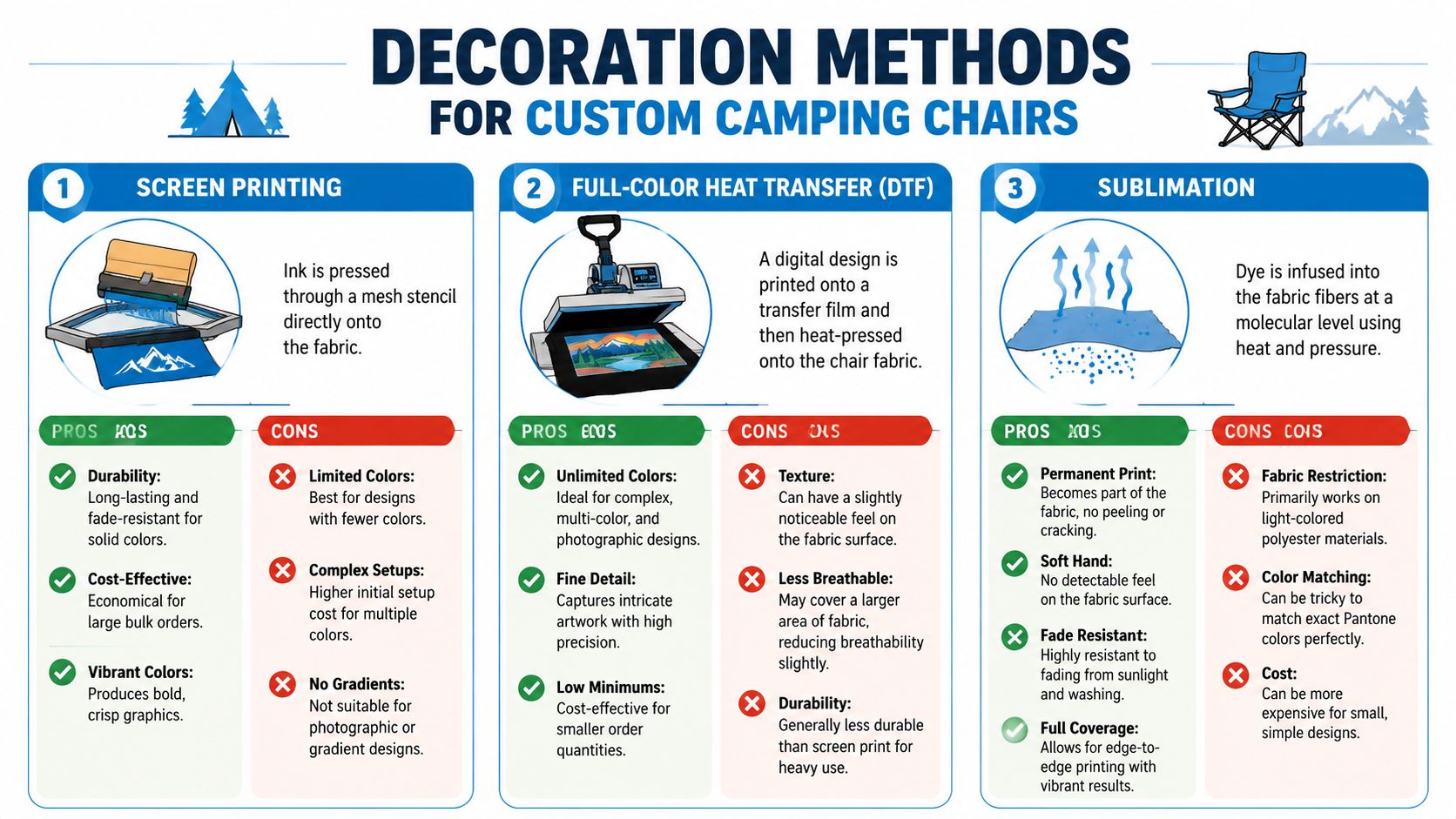
One of the biggest mistakes buyers make is choosing the print style based only on how the artwork looks on screen. Chair fabric, chair shape, and actual use matter just as much. As noted in this guide to personalizing a camp chair, heat-transfer methods can work on some materials but require careful temperature control, and the right choice depends on the fabric and intended use.
How the main decoration methods compare
Here's the practical version of the comparison most buyers need:
| Method | Best for | Trade-off |
|---|---|---|
| Screen printing | Simple logos, fewer colors, repeat orders | Less suitable for highly detailed or photographic art |
| Full-color heat transfer | Complex graphics, short runs, multi-color art | Can add surface feel and may wear differently under heavy folding |
| Sublimation | Polyester-based materials and all-over graphics | Material restrictions can limit where it works |
Screen printing works well when the design is bold and simple. It's often the cleanest option for one-color or two-color branding on the chair back. If your logo relies on strong shapes more than tiny details, this is usually a safe choice.
Full-color heat transfer helps when the artwork includes gradients, small design elements, or a multicolor brand mark. It can be a good fit for event graphics, sponsor marks, or designs that don't convert nicely to spot colors. The caution is practical: large transfer areas can change fabric feel, and poorly matched heat settings can affect the substrate.
Sublimation is the cleanest-looking option when the fabric supports it. Because the dye becomes part of the material, the result usually feels softer than a surface-applied decoration. But material compatibility is not optional. If the chair style isn't built around the right polyester setup, sublimation may not be available.
For buyers who want a broader primer on imprint options across products, this article on how to choose a logo decoration method is a useful starting point.
Placement matters as much as print method
The same logo can perform very differently depending on where you place it.
- Chair back exterior: Usually the strongest branding position for visibility when someone is seated.
- Seat panel: Better for ownership feel than public visibility. It can also affect comfort if the decoration adds texture.
- Carry bag: Good secondary branding. People see it in transit, storage, and setup.
- Headrest area: Useful on some high-back models, but placement needs to account for fold lines.
Buyer check: Ask what the logo looks like when the chair is occupied. Some placements disappear the moment someone sits down.
If the event is brand-first, prioritize visibility. If the chair is more of a premium gift, a subtler location can work. The right answer depends on whether you want the chair to act like signage or like a branded personal item.
Design and Artwork Tips for Maximum Impact
Good artwork on the wrong product layout can still fail. Chairs aren't flat posters. They fold, wrinkle, flex, and get viewed from a distance.

Design for distance, not for a computer screen
Viewers won't inspect your chair from two feet away. They'll see it from a parking lot, across a sideline, or while walking past a booth. That means simple usually wins.
A few design choices work reliably on portable seating:
- Use strong contrast: Dark logo on light fabric, or light logo on dark fabric.
- Trim unnecessary detail: Fine outlines and tiny text tend to disappear on textured fabric.
- Choose one message: Logo, team name, or campaign line. Not all three at equal size.
- Respect seams and folds: Important artwork should stay away from tension points and stitched edges.
A common failure is trying to fit too much. Sponsors, web addresses, taglines, social icons, and product marks can all make sense individually. On a chair, they often compete.
If a person can't understand the design in a quick glance, the artwork is doing too much.
Send production-ready artwork
The cleaner your files are, the fewer problems you'll hit during proofing. Non-designers don't need to overcomplicate this, but they do need the basics right.
| File element | What helps |
|---|---|
| Logo format | Vector art is usually preferred for clean scaling |
| Resolution | High-resolution artwork avoids fuzzy edges |
| Colors | Brand colors should be identified clearly before proof approval |
| Fonts | Convert fonts to outlines, or provide the font files if requested |
If you need a basic reference for preparing printable artwork, this guide on how to print a design on a shirt covers file quality concepts that also apply to chair graphics.
A good preflight checklist looks like this:
- Confirm the final logo version.
- Remove tiny copy that won't read at distance.
- Match artwork to the actual chair color, not a generic mockup.
- Review the proof with folds, seams, and print location in mind.
The strongest chair designs usually feel a little restrained. Big mark. Clear message. Enough open space to let the logo breathe.
Custom Camping Chairs in Action Inspiring Use Cases
The best custom camping chair orders usually come from buyers who know exactly how the chair will be used. The product makes more sense when there's a clear setting, a clear audience, and a reason the recipient would bring it back out.
Where a custom camping chair makes sense
A corporate golf event is a strong example. Not every guest is playing every minute, and comfort matters over several hours. A chair with a clean back logo works as both hospitality gear and a takeaway item.
A nonprofit outdoor fundraiser is another good fit. Branded chairs can support volunteers, VIP guests, or sponsor areas, then continue working after the event as long-term recognition items.
A client gift program also makes sense when the relationship is worth more than a low-cost giveaway. A custom camping chair feels more intentional than a desk trinket, especially for clients who spend time at sports fields, campgrounds, or community events.
For families, teams, and outdoor-oriented audiences, broader buying behavior often overlaps with other event and recreation gear. This roundup on choosing the right camping gear is helpful for seeing how portable seating fits into the larger outdoor-use mindset.
When another chair format may fit better
Not every event calls for a camping chair. Buyers should weigh it against other seating options. As noted in Crestline's comparison of folding chair options, the choice can depend on comfort level, event duration, and the brand image you want to project.
Here's the practical way to consider this:
- Choose a camping chair when portability, comfort, and personal ownership matter.
- Choose a standard folding chair when you need cleaner rows, more formal setup, or easier venue stacking.
- Choose lower-profile seating when the audience is younger, more casual, or headed to beach and music settings.
- Choose padded or premium variants when the gift value matters as much as the logo.
A festival sponsor might want relaxed, portable seating. A registration area at a formal fundraiser may be better served by standard folding chairs. An employee appreciation gift may call for comfort first and branding second.
The smart buy isn't always the most obvious product. It's the one that matches how people will use it after the event ends.
How to Order With Dirt Cheap Product Inc
Ordering a custom camping chair goes more smoothly when you treat it like a product selection and branding project at the same time. The chair style, the imprint method, and the artwork all affect the result.
There's useful context behind why this product category works so well for branding. The modern folding chair format that influenced many portable chair designs is commonly traced to Frederic Arnold in 1947, when aluminum construction made foldable seating more practical for production and transport, as noted in this history of custom logo folding chairs. That manufacturing consistency is part of what makes branded portable seating viable today.
A simple ordering flow
Most chair orders follow a straightforward path:
- Pick the chair style
Decide on the use case first. Sideline chair, premium giveaway, event seating, or staff support chair. - Submit the logo and project details
If you're ready to start, use the custom order form and include artwork, quantity, desired chair color, and any deadline notes. - Review decoration options
The artwork may work better with one method than another depending on fabric and complexity. - Approve the digital proof
You confirm logo size, placement, and overall layout before production starts.
One option buyers use for this process is Dirt Cheap Product, Inc., which handles custom-branded products with proofing support and logo submission through its ordering workflow.
What to confirm before approval
The proof stage is where most preventable errors get caught. Slow down here.
- Check scale: A logo that looked large on screen may print smaller than expected on the actual panel.
- Check placement: Fold lines, arm supports, and seams can affect how the logo reads.
- Check chair color: Fabric color changes how print colors appear.
- Check intended use: A chair for recurring event staff use may need different build choices than a client gift.
Approving the proof means approving the real-world outcome, not just the artwork file.
If you're ordering on a hard deadline, send complete details up front. The more back-and-forth required on missing files or unclear placement notes, the harder it is to keep production moving cleanly.
Frequently Asked Questions About Custom Chairs
Most last-minute questions come down to durability, decoration, and logistics. Those are the right questions to ask.
Common buyer questions
What's the typical minimum order quantity for custom camping chairs?
That varies by chair style and decoration method. Some projects are better suited to larger runs, while certain decoration approaches can be more practical for smaller quantities. Ask for the minimum based on the exact chair and print method you want.
Can I get a sample before placing the full order?
In many cases, you can request a sample or review a proof before committing to production. If the project is high-stakes, asking for a sample is smart, especially when chair comfort and fabric feel matter to the decision.
What's the best logo placement?
For most campaigns, the outside chair back gives the strongest visibility. If the chair is meant more as a premium gift than a public branding piece, a secondary location like the carry bag may be enough.
Care and long-term use
How should printed chairs be cleaned?
Use gentle cleaning methods that match the fabric and decoration type. Harsh scrubbing, excessive heat, and rough storage habits tend to shorten the life of the imprint.
Will repeated folding damage the logo?
It can, depending on the decoration method, placement, and how the chair is used. That's why print method and material compatibility matter so much on this product.
What usually goes wrong with first orders?
The common issues are choosing by price alone, overloading the artwork, ignoring where the chair folds, and assuming every fabric handles every imprint method the same way.
A good custom camping chair order is less about chasing the flashiest option and more about matching the chair to the job. If the product fits the event, the build quality is sound, and the logo is placed where people will see it, the chair keeps working long after the event is over.
If you're planning a branded chair project and want help narrowing down style, imprint method, or artwork setup, Dirt Cheap Product, Inc. can be a practical place to start. Upload your logo, outline the event or campaign, and get guidance on building a custom camping chair order that fits the way your audience will really use it.