You're probably in one of two spots right now. You need apparel that won't disappear into a rack of basic tees, or you already bought tie-dye blanks and are realizing the main question isn't the dye pattern. It's what happens after the shirts arrive.
That's where most wholesale advice falls short. Buyers get plenty of opinions about colorways and trends, but far less guidance on whether a given blank will take a screen print cleanly, whether a DTF logo will look intentional on a busy background, or whether a “cheap” shirt turns expensive once decoration, spoilage, and delays hit the job.
Buying tie dye shirts wholesale works best when you treat the blank as a production decision, not just a style choice. The right shirt shortens setup, makes artwork easier to place, and gives you a finished product you can sell or hand out with confidence. The wrong one creates reprints, muddy logos, and wasted time.
Table of Contents
- Why Wholesale Tie-Dye Is Your Next Big Opportunity
- Hand-Dyed vs Printed Tie-Dye The First Big Choice
- Choosing the Right Canvas Materials and Construction
- From Blank to Brand Customizing Your Tie-Dye Shirts
- Decoding the Numbers Pricing MOQs and Lead Times
- Ensuring Quality and Consistency in Your Order
- The Final Mile Packaging Fulfillment and Resale
- Your Wholesale Tie-Dye Ordering Checklist
Why Wholesale Tie-Dye Is Your Next Big Opportunity
A new business owner usually starts with the same thought: “I need shirts people will notice.” Standard solids are safe, but safe doesn't always move merch or create event energy. Tie-dye gives you built-in visual interest before you add a logo, a left chest hit, or a back print.
That matters for retail capsules, fundraiser apparel, music merch, summer promotions, school spirit drops, and hospitality teams that want something more memorable than another plain cotton tee. A tie-dye shirt already has personality. Your brand just needs to be placed in a way that works with it.
The demand side is strong too. The tie-dye apparel market was valued at $1.8 billion in 2025 and is projected to reach $3.4 billion by 2034, growing at a CAGR of 7.2%, according to Market Intelo's tie-dye apparel market report. For buyers, that doesn't just signal trendiness. It signals staying power.
Where buyers make the wrong call
Most mistakes happen before decoration starts.
Some buyers pick tie-dye because it looks exciting in a product photo, then discover the swirl runs straight through the logo area. Others choose the lowest-cost blank without thinking about how the shirt will handle print ink, transfer adhesion, or embroidery puckering. The issue isn't tie-dye itself. The issue is buying it like a fashion impulse instead of a production substrate.
Practical rule: If the shirt is hard to decorate, it's hard to profit from.
Where tie-dye works best
Tie-dye tends to perform well when you need one of these outcomes:
- Retail appeal: A decorated tie-dye tee feels more like merch than giveaway apparel.
- Event visibility: Staff and volunteers are easier to spot in a patterned shirt than in a standard solid.
- Perceived value: Buyers often accept a stronger price point when the garment already looks distinctive.
- Short creative runway: The dye pattern does part of the design work before you ever print the logo.
That's why tie dye shirts wholesale can be a smart category. But the opportunity only pays off when you match the right blank to the right decoration method.
Hand-Dyed vs Printed Tie-Dye The First Big Choice
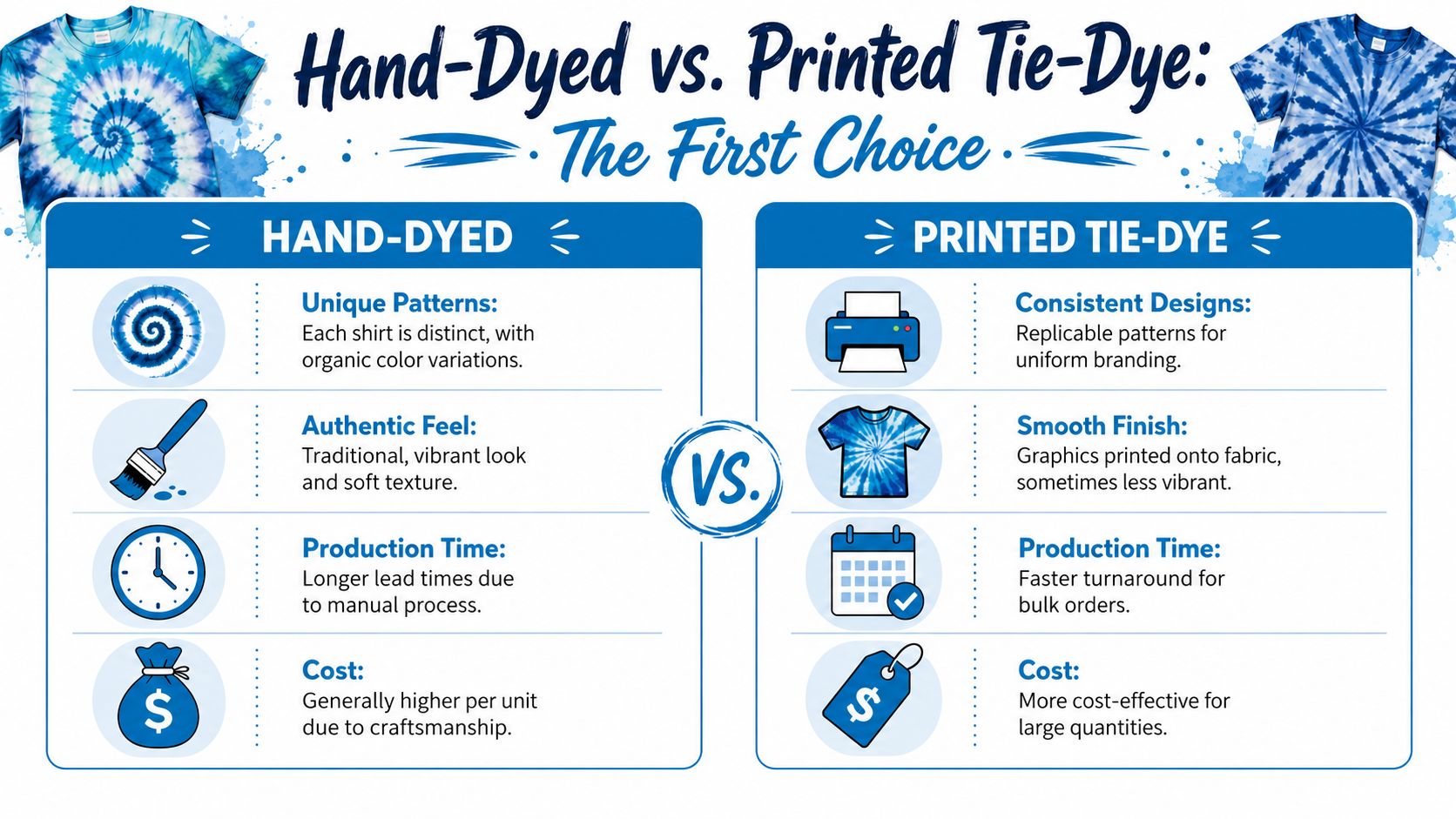
This is the first fork in the road, and it affects everything after it. A shirt can look tie-dyed without being dyed in the traditional sense. That difference changes feel, consistency, lead time, and decoration behavior.
What hand-dyed gives you
Hand-dyed shirts have the irregularity buyers often want. Color breaks aren't identical. Spirals shift. White space moves. That's a strength when you're building boutique-style merch or a premium casual line.
They also tend to look more organic in person. The shirt feels like the pattern belongs in the fabric rather than sitting on top of it. For certain brands, that authenticity matters more than perfect repeatability.
The trade-off is consistency. One shirt may have a cleaner center burst. Another may push more color into the print zone. If your design relies on precise artwork placement against a predictable background, hand-dyed can create more decisions on press.
What printed tie-dye gives you
Printed tie-dye is the opposite proposition. You get control. The visual can be repeated across units, which helps when a brand wants every shirt to present the same front-facing look on a table, in a campaign photo, or across a team order.
That consistency is useful for large runs and for jobs where branding has to land in exactly the same visual environment from shirt to shirt. If your decoration partner is producing wholesale screen printed T-shirts, that repeatability can simplify setup and approval.
Side-by-side trade-offs
| Factor | Hand-dyed | Printed tie-dye |
|---|---|---|
| Pattern variation | Each shirt differs | Design repeats more consistently |
| Visual feel | Organic and traditional | Controlled and uniform |
| Decoration planning | Requires more art flexibility | Easier to standardize |
| Best fit | Boutique merch, premium casual, limited runs | Team apparel, campaigns, larger uniform-looking orders |
Buyers usually regret choosing hand-dyed when they needed consistency. They regret choosing printed tie-dye when they needed character.
How to choose without overthinking it
Pick hand-dyed if the product itself is part of the story. Retail racks, small branded collections, and casual lifestyle merch usually benefit from that one-off look.
Pick printed tie-dye if your priority is repeatability. Team orders, larger event programs, and brand systems with strict logo presentation usually run more smoothly on a consistent background.
Neither is automatically better. The better choice is the one that creates fewer decoration problems after the shirts hit production.
Choosing the Right Canvas Materials and Construction
Tie-dye buyers often focus on color pattern first. Fabric should come first. The shirt body decides how the dye behaves, how the print sits, how the garment shrinks, and whether the finished piece feels like something people want to wear again.
For traditional fiber-reactive dyeing, 100% cotton remains the safest bet. Cotton accepts reactive dye well, and it usually gives the clearest, brightest result when the dye process is done correctly. Blends can work, but they change the look. Many buyers like that softer, faded effect. Others order a blend expecting bright contrast and end up disappointed.
Why cotton matters in tie-dye production
The chemistry is simple enough. Cotton contains cellulose, and fiber-reactive dyes bond to that cellulose when the prep is right. That's why untreated or poorly treated shirts often produce weak, washed-out color.
According to The Art of Education's tie-dye guide, soaking garments in 0.5 to 1 cup of soda ash per gallon of warm water for 5 to 15 minutes before dyeing enables permanent bonding between fiber-reactive dye molecules and cotton fibers. That pre-treatment step isn't a craft detail. It's a quality-control step.
What works and what fails
Use this as a buying filter:
- 100% cotton blanks: Best choice when you want stronger traditional tie-dye color and a familiar print surface.
- Cotton-poly blends: Better when you want a softer, more muted result and you're comfortable with less dye intensity.
- Poorly pre-treated shirts: High risk for bleeding, dull color, and inconsistent appearance.
- Overly wet garments after soak: The dye can run too far and muddy the pattern, which causes problems before decoration even begins.
A tie-dye blank that looks good online can still be a bad production blank if the fabric prep was rushed.
Construction details buyers skip
Fabric content is only part of the canvas. Construction affects decoration too.
A shirt with stable seams, a smooth face, and reliable sizing is easier to print and easier to reorder. Thin or loosely built blanks can twist after washing. Side seams can pull graphics off-center. Rib collars can vary from batch to batch enough to make left chest placements look inconsistent on a retail fold.
If you're comparing brands, a broad guide to popular shirt brands can help you narrow the field before you test a tie-dye option. Brand familiarity matters because tie-dye isn't forgiving. Any inconsistency in body shape or fabric feel becomes more obvious once the shirt is both dyed and decorated.
Material decisions by decoration goal
| Your goal | Better blank choice |
|---|---|
| Bright tie-dye look with classic print feel | 100% cotton |
| Softer vintage-style visual | Cotton blend |
| Premium embroidery finish | More stable, better-built shirt body |
| Easier repeat orders | Established brand with consistent specs |
If you only remember one rule here, remember this: buy the blank for the final decorated result, not for the dye pattern alone.
From Blank to Brand Customizing Your Tie-Dye Shirts
Decoration is where tie-dye stops being a blank and starts becoming a product. This is also where buyers discover whether they chose the right shirt.
A busy background changes artwork decisions. Small details get lost. Thin lines disappear. Low-contrast logos don't read. The tie-dye pattern can help the shirt look premium, but it can also fight your branding if you treat it like a flat white tee.
Screen printing on tie-dye
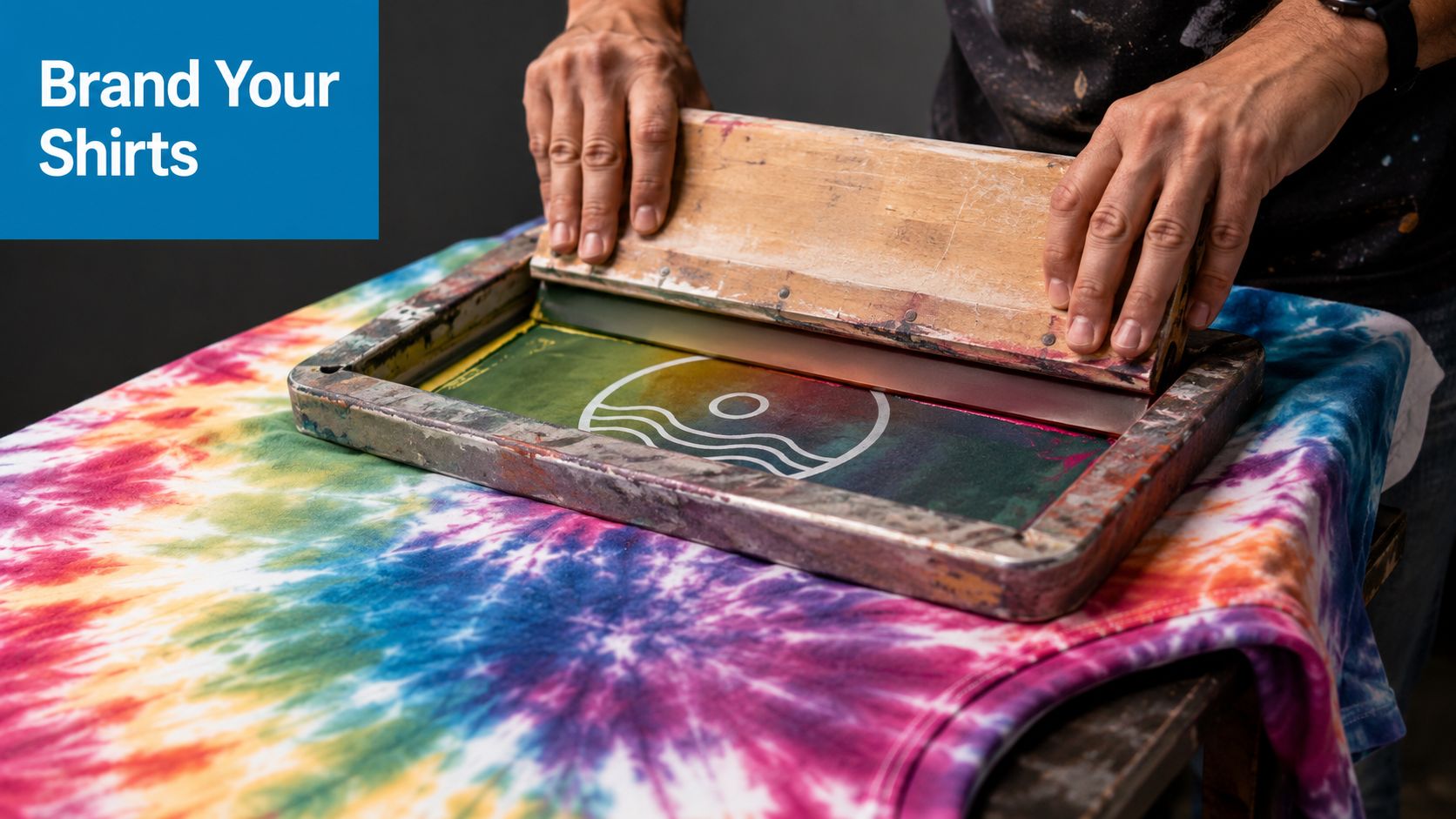
Screen printing still works well on tie-dye, but the art has to be disciplined. Bold shapes, heavier fonts, and strong contrast perform better than delicate graphics. White underbases often help logos stand apart from the background, especially when the dye pattern is dark or highly varied.
The downside is that tie-dye can make registration and visual consistency feel more demanding. The print may be technically correct on every shirt, but the surrounding pattern can make one logo look louder and another look quieter. That's normal. You need to approve the print with the shirt pattern in mind, not in isolation.
DTF for complex logos
DTF is often the easier answer when the logo contains multiple colors, gradients, or finer detail. It gives more freedom on artwork without forcing a full screen print setup for every color.
For small runs, DTF can also simplify production planning. You can place a detailed brand mark on a tie-dye blank without redesigning the whole graphic package around spot-color constraints. The key is placement. On a loud shirt, the transfer still needs contrast and breathing room.
Embroidery for a premium finish
Embroidery can look excellent on tie-dye when the design is compact and the garment is stable enough to support stitching. Left chest logos, sleeve hits, and hat-style mark adaptations usually work better than oversized embroidered concepts.
But embroidery isn't the answer for everything. Dense stitch counts on lightweight tees can distort the fabric. If the tie-dye pattern is already doing visual heavy lifting, a clean embroidered logo often looks better than a large stitched design trying to dominate the entire front.
Keep the decoration simple enough that the shirt and the logo can both be seen.
The blank versus pre-patterned decision
A lot of new buyers assume plain blanks are more flexible because they can dye them exactly how they want. In practice, DIY tie-dye introduces labor, inconsistency, and delays that hit the decoration schedule.
A 2025 industry survey found that 62% of small business buyers waste 3 to 5 days on uneven dye application when using plain blanks, while pre-patterned tie-dyes can reduce production time by 40% and lower error rates by 55%, according to Tie Dye Wholesaler's bulk tie-dye article. That gap matters if you're trying to launch quickly or keep event deadlines intact.
Decoration method quick guide
- Choose screen printing when your artwork is bold, limited in color, and built for high visibility.
- Choose DTF when your logo has detail that would be cumbersome to simplify.
- Choose embroidery when you want a smaller, premium branded finish and the garment can support stitching.
- Choose pre-patterned tie-dye when speed and consistency matter more than controlling the dye process yourself.
A wholesale tie-dye shirt is only a good buy if the decoration method still makes financial and visual sense after the shirt is in hand.
Decoding the Numbers Pricing MOQs and Lead Times
A tie-dye order can look affordable until you price it as a finished unit. That means the blank, decoration, spoilage risk, approvals, freight, and timeline all need to be considered together.
Start with the blank cost, but don't stop there. A shirt that saves money upfront can cost more later if the pattern makes decoration harder, the sizing runs unpredictably, or the supplier can't maintain a steady replenishment cycle.
What the current pricing tells you
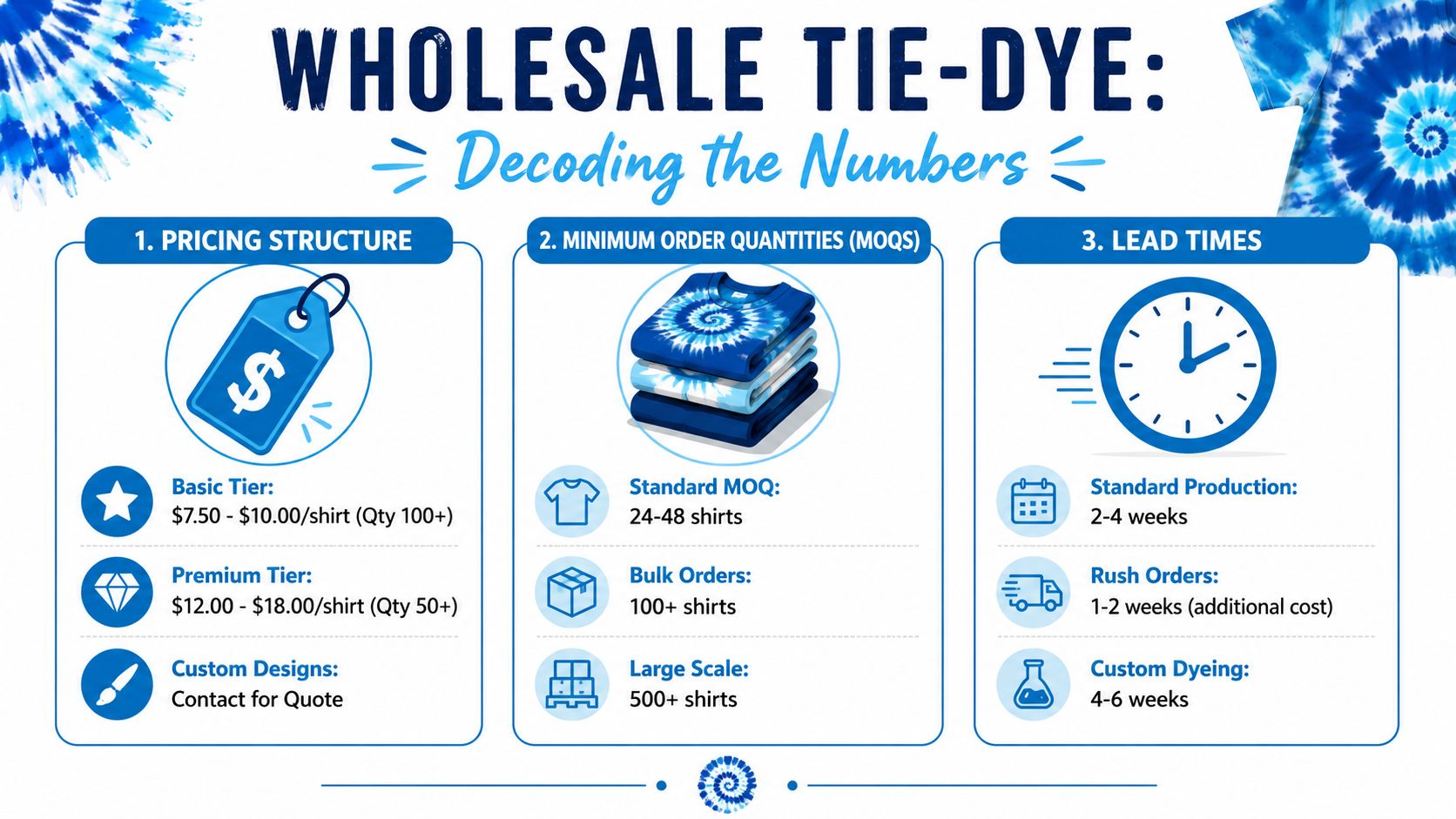
On the sourcing side, Wordans' tie-dye T-shirt listings show that 100% cotton tie-dye T-shirts can start at $6.83 per unit with discounts on orders of 100+ units. That gives buyers a practical benchmark for entry-level blank pricing.
On the resale side, SaleHoo's tie-dye trend page notes that wholesale tie-dye products typically sell in the $11 to $23 range and showed 40.3% growth over the past 24 months. That spread is useful because it shows there's room in the category, but only if you build your margin from the fully decorated unit, not just the blank.
How to read a wholesale quote correctly
Use a simple decision lens:
- Blank cost: Your starting point, not your final cost.
- Decoration compatibility: A cheaper shirt that needs design revisions may not be cheaper in practice.
- Order size breaks: Larger quantities often improve unit economics, but only if you can move the inventory.
- Deadline pressure: Rush timelines can erase margin fast.
If you're new to apparel buying, a practical bulk order custom apparel guide can help you organize quote comparisons before you commit.
Key takeaway: The best-priced shirt is the one that survives production cleanly and sells without discounting.
MOQs aren't as rigid as many buyers think
Suppliers use minimums for good reasons. Setup time, packing labor, and production planning all become harder on tiny runs. But buyers still make a mistake when they assume every order needs a massive commitment.
The better question is this: what minimum gives you the best balance between price and risk? For a test launch, a smaller run can be smarter than chasing a lower unit price and getting stuck with slow-moving sizes. For a fundraiser or staff uniform job with a defined audience, a larger commitment can work well.
If you import decorated garments or manage cross-border shipments, classification matters too. A clear Canadian apparel classification guide is useful when you need to verify how clothing categories are handled in customs paperwork.
Lead times need two separate answers
When you ask for lead time, separate the response into two parts:
| Question | Why it matters |
|---|---|
| How long is production? | Tells you when the goods can leave the facility |
| How long is shipping? | Tells you when they can actually reach your event or warehouse |
| When does proof approval lock the schedule? | Prevents avoidable delays |
| What happens if stock sells out mid-order? | Exposes replenishment risk |
A supplier that says “fast turnaround” without defining production and transit separately isn't giving you enough to plan against. Good buyers pin down both numbers before they approve artwork.
Ensuring Quality and Consistency in Your Order
A sample is cheaper than a bad bulk order. That's the whole argument.
Buyers sometimes skip samples because they want to save time or shave cost. Then the shipment arrives and one of three problems shows up immediately: the pattern is flatter than expected, the logo disappears into the shirt, or the sizing doesn't match the brand standard they assumed they were getting.
What to check in a sample first
Don't look at the sample like a shopper. Look at it like the person responsible for reorder quality.
Check the print zone first. Is there enough calm space on the shirt for the logo to read? A tie-dye pattern can be beautiful and still be wrong for your artwork.
Then check hand feel and structure. Does the fabric feel stable enough for the decoration method you chose? A shirt that drapes nicely on a hanger may still be too unstable for dense embroidery or too irregular for the look you want in screen printing.
Build clear QC standards before production
A lot of wholesale problems come from vague expectations. “Looks good” is not a specification.
Use a short written approval list before the order goes live:
- Pattern tolerance: State whether broad variation is acceptable or whether the print zone must stay relatively open.
- Color expectation: Confirm whether you accept natural variation or need the batch to stay close to the approved sample.
- Decoration placement: Define exact location and orientation based on the garment, not just the art file.
- Construction checks: Call out stitching issues, collar shape, seam alignment, and other obvious reject points.
- Size labeling: Make sure size tags and physical measurements match what you intend to sell or distribute.
If you don't define acceptable variation before production, you'll end up arguing about it after delivery.
Sizing is where many orders go sideways
Tie-dye buyers often forget that the blank is still a shirt subject to brand variance. One manufacturer's medium won't always feel like another's. Even when the style name sounds similar, body width, length, sleeve opening, and shrink behavior can differ enough to affect fit complaints.
For event orders, collect size counts early and build in some buffer for the most common sizes. For retail, fit-test the sample on real people instead of trusting a spec sheet alone. If the shirt misses on fit, the dye pattern won't save it.
Common failure points worth catching early
A few issues come up again and again:
| Failure point | Why it hurts |
|---|---|
| Logo placed over a chaotic dye break | Branding becomes hard to read |
| Batch-to-batch color drift | Reorders don't match earlier drops |
| Inconsistent shirt body sizing | Customers lose confidence in fit |
| Weak seam or collar construction | Product feels cheap even if decoration looks good |
Why the QC process pays for itself
Sampling and QC slow the order down slightly at the front end, but they protect speed later. They reduce reprints, customer complaints, awkward event-day surprises, and excess stock that nobody wants to wear twice.
That matters even more with tie dye shirts wholesale because the product has two variables instead of one. You're managing the garment and the decoration together. If either side is weak, the finished item looks careless.
The Final Mile Packaging Fulfillment and Resale
Once the shirts are approved and produced, the job still isn't done. Packaging and fulfillment decide how the customer experiences the product, and those choices can either preserve margin or eat into it.
For simple event distribution, basic protective packing often does the job. For resale, presentation matters more. Clean folding, size visibility, and branded inserts can make the same shirt feel more retail-ready without changing the garment itself.
Fulfillment choices that affect the customer experience
Think through distribution before production wraps.
- Single-location delivery: Best when one team will sort, hand out, or stock the order.
- Individual shipment handling: Useful when units need to go to separate recipients after decoration.
- Retail prep: Important if the shirts are headed to shelves, pop-ups, or online order fulfillment.
If you sell multiple colors, sizes, and decoration versions, inventory tracking can get messy fast. A practical resource on solving apparel inventory variant chaos can help you think through SKU control before orders start stacking up.
Don't ignore resale setup
If you plan to resell tie-dye apparel, handle the tax side early. A resale certificate can make a meaningful difference in how you buy inventory and protect your margin. Get your paperwork in place before the first reorder, not after the first accounting headache.
One more practical note. Keep your product bundle focused. Shirts, tags, folding, and fulfillment options are enough decisions on one job. We do not create business cards or fliers, and mixing unrelated print collateral into an apparel workflow usually complicates timing anyway.
Your Wholesale Tie-Dye Ordering Checklist
A good tie-dye order isn't built from one smart decision. It's built from a chain of smaller correct ones. This checklist keeps the order grounded in use, decoration, and operational reality.
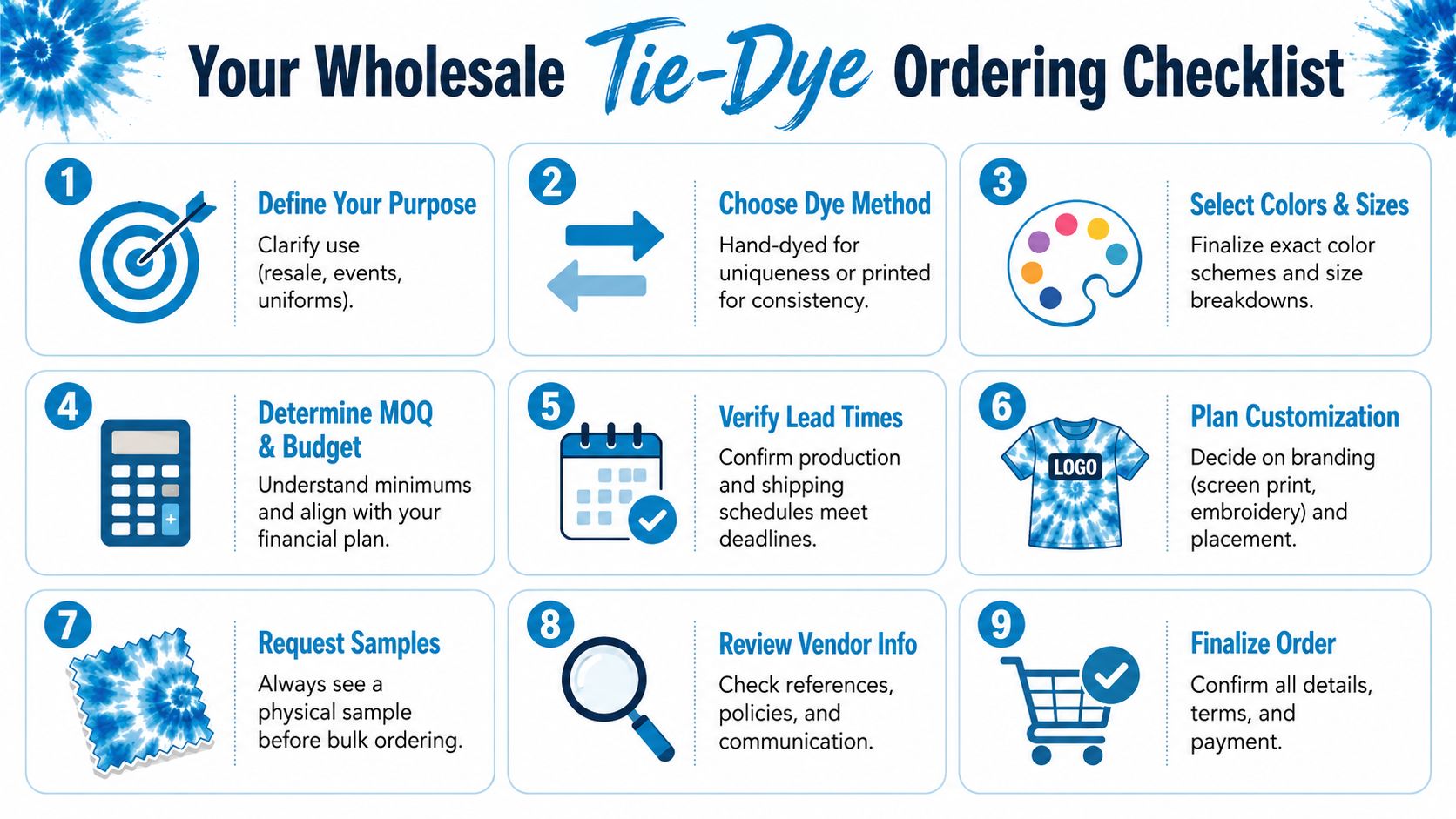
Run through these before you place the PO:
- Define the purpose. Retail, event staff, fundraiser, merch drop, or team apparel all need different blank choices.
- Choose hand-dyed or printed. Decide whether uniqueness or repeatability matters more.
- Match the fabric to the decoration. Don't choose the shirt before you know how you'll brand it.
- Set the size mix early. Guessing late usually creates leftovers in the wrong sizes.
- Price the finished unit. Blank cost alone doesn't tell you margin.
- Confirm production and shipping separately. A deadline only matters if both are covered.
- Approve a real sample. Photos won't tell you enough about print readability and fabric feel.
- Write your QC standards down. Pattern tolerance, placement, and construction should be explicit.
- Plan fulfillment before delivery. Packaging, labeling, and resale readiness should already be decided.
If you're building an online storefront around wholesale apparel, this Shopify store wholesale guide is a useful companion for thinking through purchasing flow and product setup.
If you need a partner to source, decorate, and turn tie-dye apparel into a finished branded product without the usual guesswork, Dirt Cheap Product, Inc. can help. They handle fast-turnaround custom apparel and decoration services for businesses, events, retailers, and brands that need clean execution on screen printing, embroidery, DTF, and more.