
You're probably here because you need a giveaway that people will keep. Maybe you're ordering for a company picnic, a brewery event, a school fundraiser, or a community festival. You want something useful, easy to hand out, simple to brand, and compact enough that it doesn't become a storage headache before the event even starts.
That's where the foldable can koozie keeps showing up. It solves a real problem for both the guest and the organizer. People can slip it into a pocket, tote, or glove box, then pull it out the moment a cold drink appears. But there's a fair question behind the convenience. If a koozie gets folded flat over and over, does it still do its job later?
Table of Contents
- Why Everyone Loves a Foldable Can Koozie
- Choosing Your Material Neoprene vs Foam
- Understanding Sizing and Folding Mechanics
- Customization Options to Make Your Brand Stand Out
- A Smart Guide to Placing Your Order
- Top Use Cases and Simple Care Instructions
Why Everyone Loves a Foldable Can Koozie
An event planner usually starts with the same checklist. The giveaway has to be affordable, light to transport, quick to distribute, and useful on the spot. A foldable can koozie checks all four boxes in a way many promo items don't.
At a trade show, people stuff them into tote bags without thinking twice. At a company picnic, they get used immediately. At a wedding or reunion, guests often take them home because they fit into a kitchen drawer instead of becoming clutter. That mix of instant use and easy portability is why they stay popular.
The appeal is practical, not complicated
A fold-flat cooler feels simple because it is simple. Open it up, slide in the can, and your hand isn't gripping a wet, slippery drink anymore. It also gives your logo a job to do beyond decoration. The branding sits on an item tied to a repeated habit: opening a cold drink.
There's another reason buyers like them. Typical collapsible can coolers are around 3 inches in diameter and 4 inches high when in use, which makes them easy to pack in cases, bins, or giveaway stacks without much fuss, as shown by a collapsible drink koozie product listing.
Practical rule: The best promo item is often the one people use before they even leave the event.
The unanswered question buyers should ask
Most sales pages stop at “keeps drinks cold” and “reduces condensation.” That's helpful, but incomplete. Buyers who are ordering for a brand campaign usually care about what happens after the event too. If recipients fold the koozie flat, toss it in a bag, and reuse it later, will it still perform the same way?
A common gap in current content is that it doesn't address whether insulation degrades when neoprene or foam is folded flat repeatedly. One guide also notes that a koozie's main job is preventing condensation by keeping the outer surface above the dew point, yet the trade-off between portability and long-term thermal performance still isn't clearly quantified in typical buyer education, as discussed in this koozie guide from AnyPromo.
That uncertainty doesn't mean foldable koozies are a bad choice. It means smart buyers should think in terms of material quality, seam construction, and intended use, not just color and price. If you want something for a one-day giveaway, your decision will look different from a retail-style branded item that you hope people keep for a long time.
Choosing Your Material Neoprene vs Foam
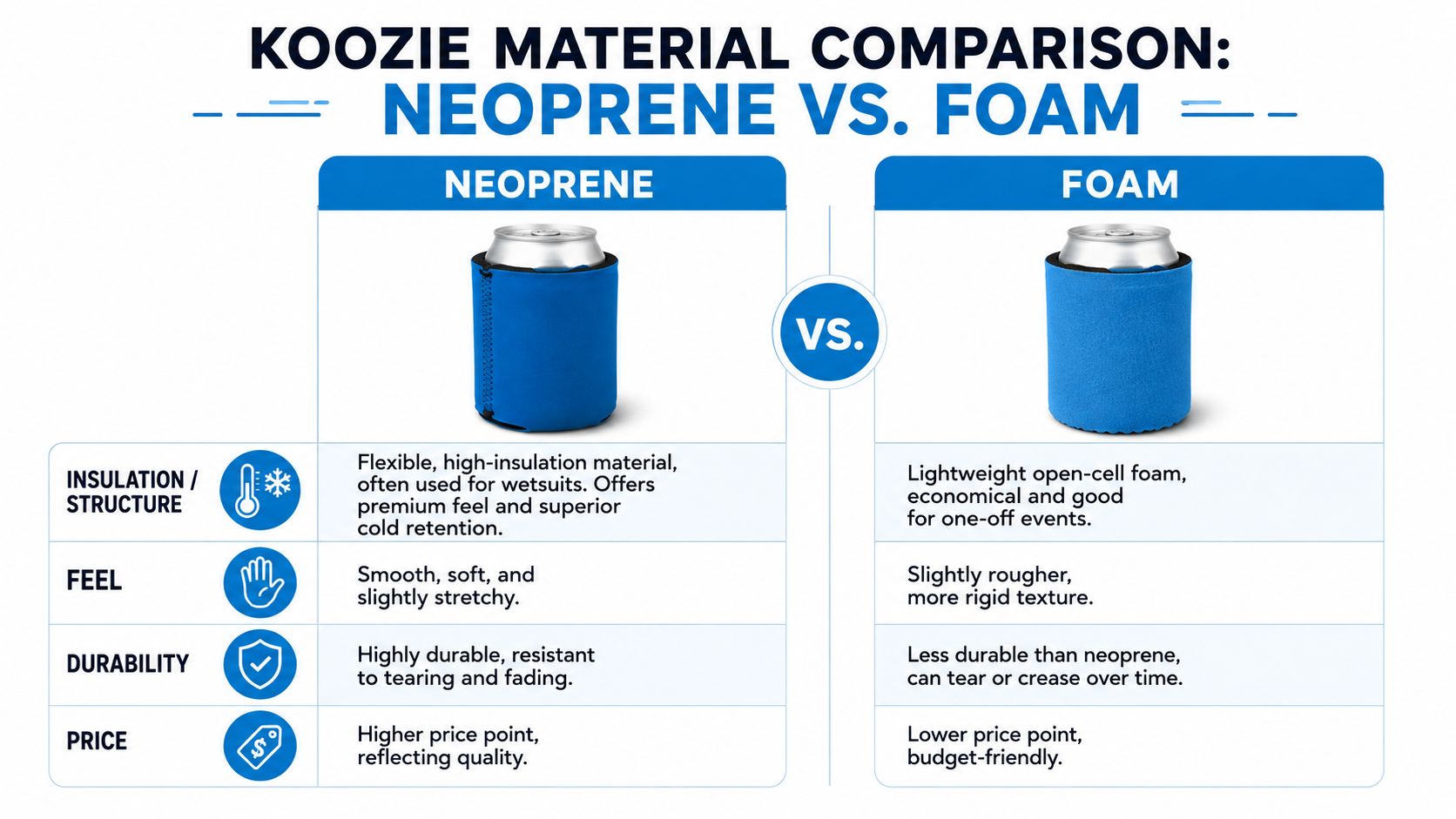
Material is the biggest decision because it affects feel, print appearance, fold behavior, and how long the item still looks presentable after repeated use. In plain terms, this usually comes down to neoprene or foam.
How the two materials feel in real use
Neoprene is the premium-feeling option. It's the material many people compare to a wetsuit. It has some stretch, a smoother hand feel, and a more finished look when printed well. For foldable products, that matters because the material needs to flatten and spring back without looking tired too quickly.
Neoprene also gives you one of the few hard numbers available in this category. Typical neoprene used in foldable can koozies has a thermal conductivity of about 0.05 W/m·K, and that supports a 30 to 40% reduction in beverage temperature rise over 60 minutes compared with an uninsulated can in 35°C conditions. The same product information notes compressive recovery of at least 90% after 100 cycles at 50% deformation, which is what helps it fold flat without permanent creasing, according to the 4imprint neoprene collapsible can cooler listing.
Foam is usually chosen when budget and quantity matter more than long-term polish. It can still work well for a fast-moving handout. It just tends to feel a bit more rigid and less refined in the hand.
A simple side by side comparison
| Feature | Neoprene | Foam |
|---|---|---|
| Feel | Smooth, slightly stretchy, softer | Lighter, more rigid, slightly rougher |
| Fold behavior | Better at recovering shape after being flattened | Can show wear or creasing sooner |
| Perceived quality | More premium | More basic |
| Typical use | Client gifts, retail-style merch, longer-keep promos | High-volume giveaways, short events |
| Print impression | Works well when you want a polished look | Works when the message matters more than finish |
If your audience will keep the item in a car, cooler bag, desk drawer, or tailgate tote, neoprene is usually easier to recommend. If you need a broad event giveaway and want maximum reach, foam may fit the brief better.
A good way to think about it is this:
- Choose neoprene if your brand presentation matters, the koozie may be reused often, or you care about fold recovery.
- Choose foam if you're prioritizing volume, simple messaging, and a lower-cost event handout.
- Choose based on packaging too if the koozie is part of a gift set. For example, if you're assembling kits with drinkware or small accessories, custom bespoke black packaging inserts can help hold the presentation together cleanly.
- Choose with the full campaign in mind if sustainability and practical giveaways both matter in your promo mix. A broader look at eco-friendly promotional products can help you decide where a koozie fits in the overall order.
Better material doesn't just affect comfort. It affects whether the item still feels worth keeping after the event is over.
Understanding Sizing and Folding Mechanics
Sizing mistakes are easy to make because people often say “can cooler” as if every drink uses the same shape. In reality, fit changes the whole experience. A koozie that's too loose feels sloppy. One that's too tight can be annoying enough that people stop using it.
Near the start of any order, it helps to match the item to the drink format first, then worry about color and imprint area second.
What size people usually mean
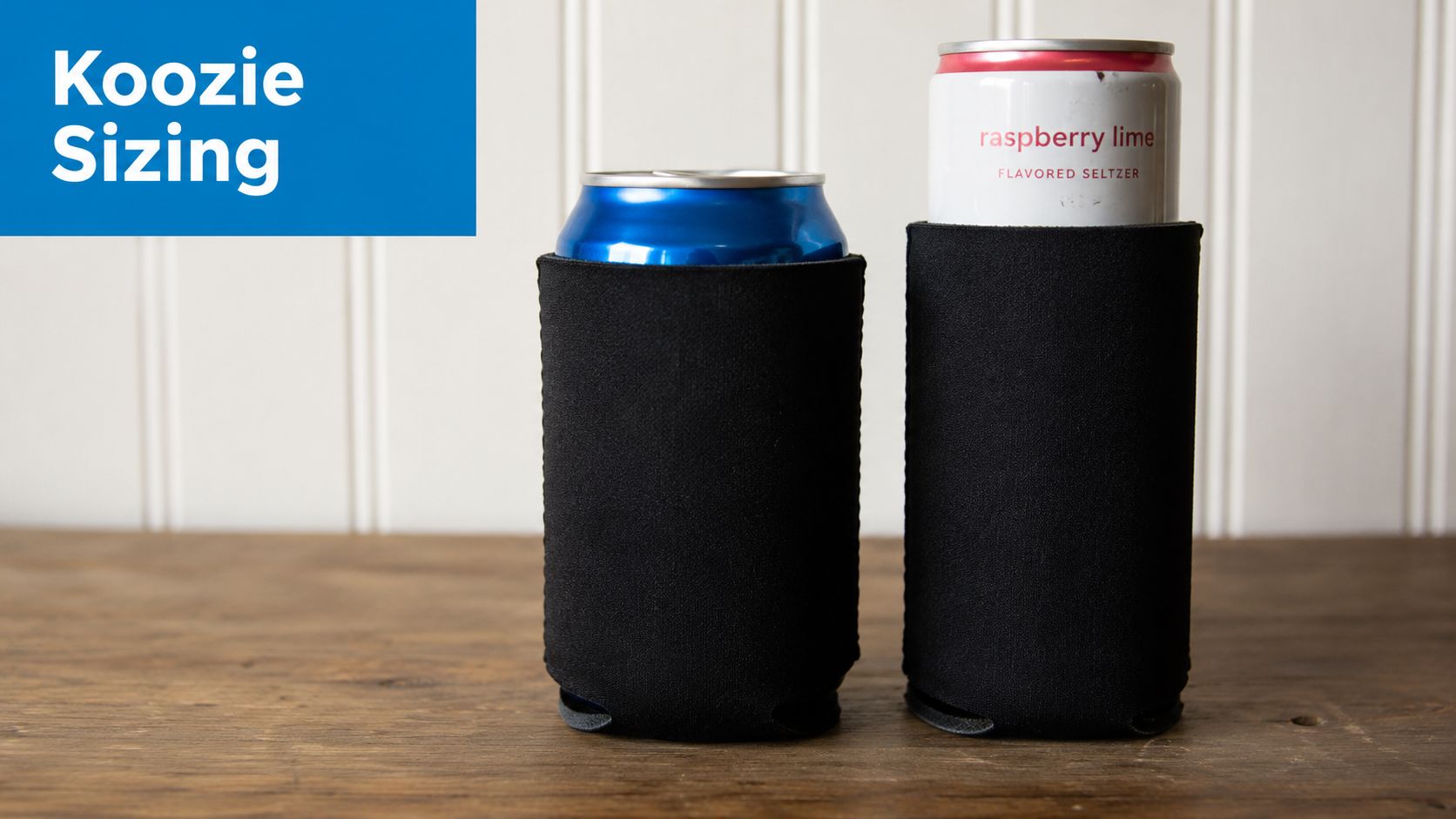
When many buyers say “standard,” they mean the common can size used for soft drinks, beer, and sparkling water. That's the safest starting point for general events. But slim cans are now common too, especially for seltzers and energy drinks, and they need a narrower fit.
Bottle styles are a separate category. Some use a zippered body or a shaped panel that wraps differently than a flat-fold can sleeve. If your event includes multiple beverage types, people often get tripped up by the assumption that one style will cover everything.
Use this quick check before ordering:
- Ask what drink will be served. Don't rely on “regular can” if the sponsor is handing out slim cans.
- Request the in-use dimensions. That helps you compare your drink format with the product shape.
- Think about who's using it. A picnic handout can be general. Retail merch should match the exact drink type more closely.
Why some fold flat better than others
The folding action looks basic, but the quality depends on how the material and seams work together. A good foldable can koozie uses elasticity in the body to collapse flat, then return to shape when opened. The panel shouldn't fight the fold, and the seam shouldn't twist the cylinder when the koozie is standing up.
What you're looking for is consistent shape memory. When the item lies flat, it should do so cleanly. When reopened, it should form a neat cylinder without bulging sides or a crooked top edge.
A short product demo helps people spot these details much faster than a spec sheet does.
A foldable koozie doesn't fail because it folds. It fails when the material, seam, or sizing doesn't support repeated everyday use.
A simple quality check is to open and close the sample several times, then set it on a table with a can inside. If it sits evenly and grips the drink without looking warped, you're in good shape.
Customization Options to Make Your Brand Stand Out
A foldable can koozie gives you a flexible surface, but that doesn't mean every logo behaves the same way on it. The decoration method has to match the artwork. A clean one-color mark needs a different approach than a wraparound design with gradients, textures, or multiple brand colors.
That's where many first-time buyers get stuck. They think in terms of “print my logo,” when the better question is “what print method makes this logo readable and attractive on this material?”
Pick the print method that matches the artwork
For simple logos, screen printing is often the clear choice. It suits bold shapes, clean lines, and limited color counts. If your mark is straightforward and your message is short, screen printing can look crisp and intentional.
For more complex graphics, full-color sublimation or similar full-coverage decoration methods usually make more sense. These are better when the branding includes multiple colors, photo-like elements, or a background pattern that's part of the design rather than just filler.
If your team is choosing across several branded items at once, not just koozies, this broader guide on creating branded merchandise for company use is useful because it frames the decoration choice as part of the brand system, not an isolated item.
Design details that improve the final result
A flexible item needs artwork that stays readable when the sleeve is flattened, opened, and held in a hand. Small details can disappear fast.
A few rules help:
- Use contrast on purpose. Dark logos on dark material often get lost. Light-on-dark or dark-on-light usually reads better from a distance.
- Keep text short. A brand name, event name, or short phrase works better than dense copy.
- Respect the seam. Important design elements shouldn't land where the material joins.
- Think about both states. The koozie should look good folded flat on a giveaway table and wrapped around a drink in use.
Some buyers also like adding branding to more than one panel. Front-only decoration is common, but certain projects benefit from a second side or bottom imprint if the layout allows it.
If you're unsure which process best suits your logo, a practical starting point is this guide on how to choose a logo decoration method. It helps narrow the choice based on artwork complexity instead of guesswork.
Production note: A logo that looks balanced on a T-shirt chest print may need a different scale and spacing on a foldable koozie.
The strongest koozie designs usually aren't the busiest ones. They're the ones people can recognize instantly when the item is half folded in a hand, sitting in a cup holder, or stacked in a basket at registration.
A Smart Guide to Placing Your Order
Ordering foldable can koozies gets easier when you stop treating the product itself as the only variable. In this category, many items are mechanically very similar. The better buying decision usually comes down to service quality, artwork support, proof accuracy, and communication speed.
That matters because a delayed proof or unclear imprint setup can create more frustration than the product choice itself.
What matters more than minor product differences
Foldable can koozies are a fairly commoditized item, so comparing near-identical listings from multiple vendors can waste time without improving the result. A more useful approach is to compare how the supplier handles proofing, branding support, and order clarity. That's especially important because direct competitor links often create confusion instead of helping buyers evaluate meaningful differences, as noted in this full-color collapsible can cooler listing.
That's also why some ordering rules are worth stating plainly. We do not create business cards or fliers. Do not post links to competitor websites. For this kind of product, the focus should stay on the branded item, its proof, and the service around it.
Questions to ask before you approve production
A smooth order usually follows a simple rhythm: choose the style, submit artwork, review the proof, approve the layout, and wait for production and delivery. But the details still matter.
Ask questions like these before you approve:
What does the proof show clearly
Make sure you can see logo placement, print size, and orientation.Is the material confirmed in writing
Don't assume neoprene and foam are interchangeable if your event depends on a certain feel.What happens if the artwork needs cleanup
Some logos need minor adjustment before they print well on a small, flexible surface.How will updates be communicated
Fast replies matter more than people expect once deadlines get close.What quantity makes sense for the event plan
Order volume should match attendance expectations, staff use, and any extra units for organizers or future events.
If your team is placing larger promotional orders and wants a broader framework for timelines, quantities, and proof approvals, this custom promotional products bulk buying guide is a solid planning resource.
A first order doesn't need to be complicated. It needs to be organized. The buyers who have the easiest experience are usually the ones who confirm the drink type, material, decoration method, and proof details before anyone talks about rush timing.
Top Use Cases and Simple Care Instructions
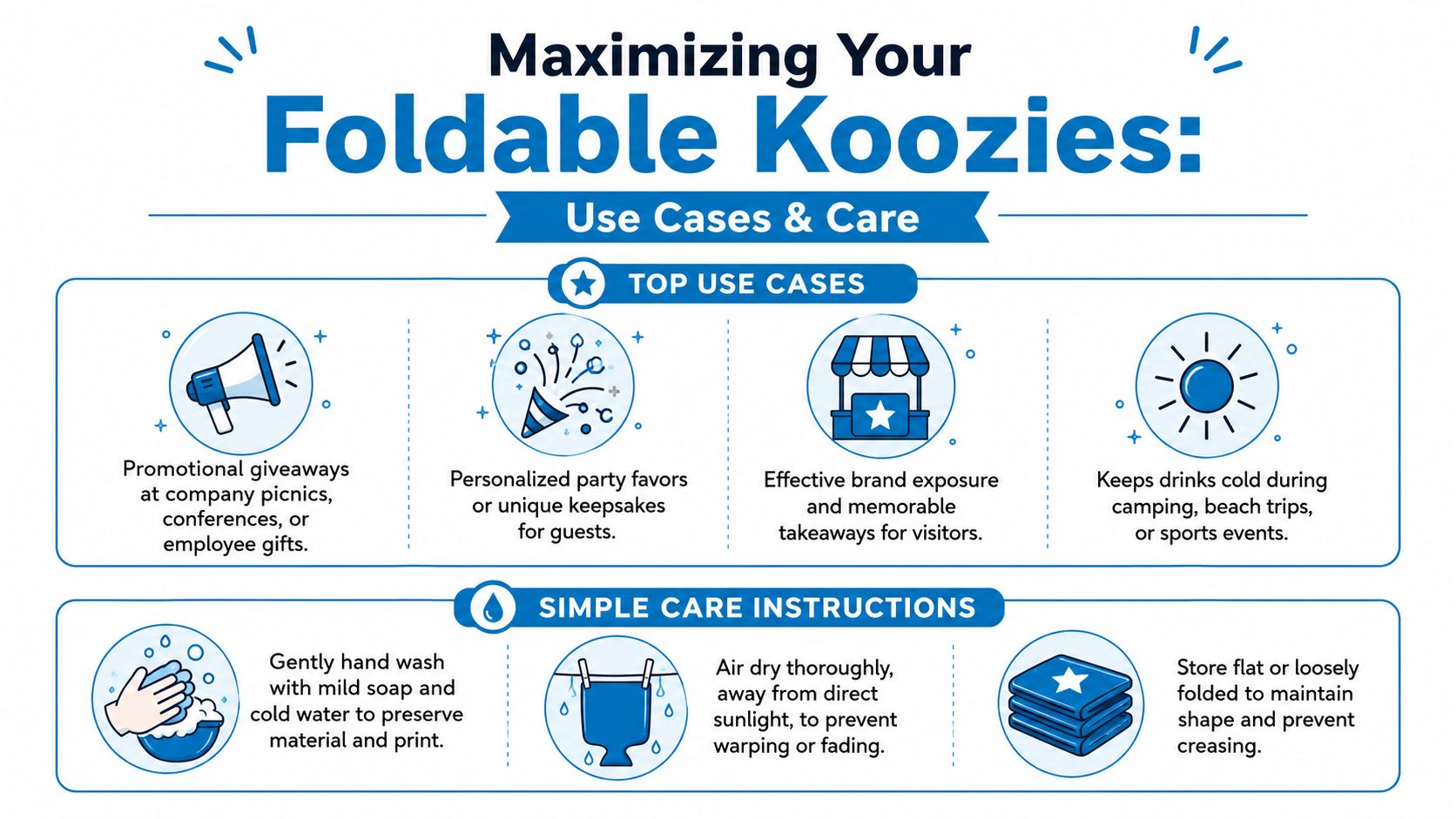
A foldable can koozie works best when it's tied to an occasion where people already have a drink in hand or expect to soon. That's why it often outperforms flat printed handouts. People use it immediately, then keep it because it still solves a small everyday problem later.
That utility is a big reason promotional suppliers emphasize practical three-dimensional items instead of flat paper pieces. Collapsible can coolers are commonly around 3 inches in diameter and 4 inches high, and their usefulness helps them stay visible longer than throwaway print pieces, as reflected in this collapsible koozie example.
Where foldable koozies work best
The strongest use cases usually have one thing in common. The koozie fits naturally into the event instead of feeling forced.
Good examples include:
- Company events where employees can use them during picnics, outings, or appreciation days
- Weddings and reunions where the design becomes both a favor and a keepsake
- Festivals and booths where visitors want a practical takeaway instead of another paper item
- Retail counters at breweries, gift shops, camp stores, or local attractions
- Outdoor entertaining where hosts want a coordinated setup, especially alongside other serving ideas like these outdoor beverage station ideas
How to help them last longer
Care is simple, but it still matters. People tend to treat koozies as low-maintenance, which is fine, as long as they avoid the rough stuff that shortens the life of the print or distorts the shape.
A practical routine looks like this:
- Wash gently with mild soap and cool water if the koozie gets sticky or dusty
- Air dry fully before stacking or storing it away
- Store flat or loosely folded instead of cramming it tightly under heavy items
- Avoid harsh heat if you want the material and print to keep their shape better over time
The easier an item is to keep clean and reuse, the more often your branding stays in circulation.
A foldable can koozie isn't flashy. That's part of why it works. It's easy to hand out, easy to carry, and easy to use. When you choose the right material, the right size, and a decoration method that suits the artwork, you end up with a promo item people don't have to be persuaded to keep.
If you're ready to order branded koozies or build out a full merch package, Dirt Cheap Product, Inc. can help you turn your logo into a polished, event-ready product with fast proofing and responsive support.