
You're probably in one of two spots right now. Either you've outgrown plain white tissue and your packaging feels a little too generic, or you're placing your first custom order and trying to avoid an expensive mistake. Both are common. Small brands often know they want a better unboxing moment, but they don't always know what matters most once quotes, paper options, print limits, and eco claims start piling up.
Branded tissue paper looks simple. It isn't complicated, but it does involve real trade-offs. The right sheet weight helps your logo print cleanly. The right material supports your brand values without making the package feel cheap. The right design makes the inside of a box feel intentional instead of busy. If you get those decisions right, tissue paper stops being filler and starts doing a job.
Table of Contents
- The First Impression That Lasts
- Why Branded Tissue Paper Is a Smart Investment
- Choosing Your Paper Materials and Finishes
- Printing Methods and Artwork Essentials
- Designing Tissue Paper That Wows Customers
- Your Order Process with Dirt Cheap Product Inc
- Frequently Asked Questions About Custom Tissue Paper
The First Impression That Lasts
A customer cuts open a shipping box, folds back the flaps, and sees your color first. Before they touch the product, they touch the paper. That small rustle matters more than most owners expect. It slows the moment down and makes the order feel packaged, not packed.
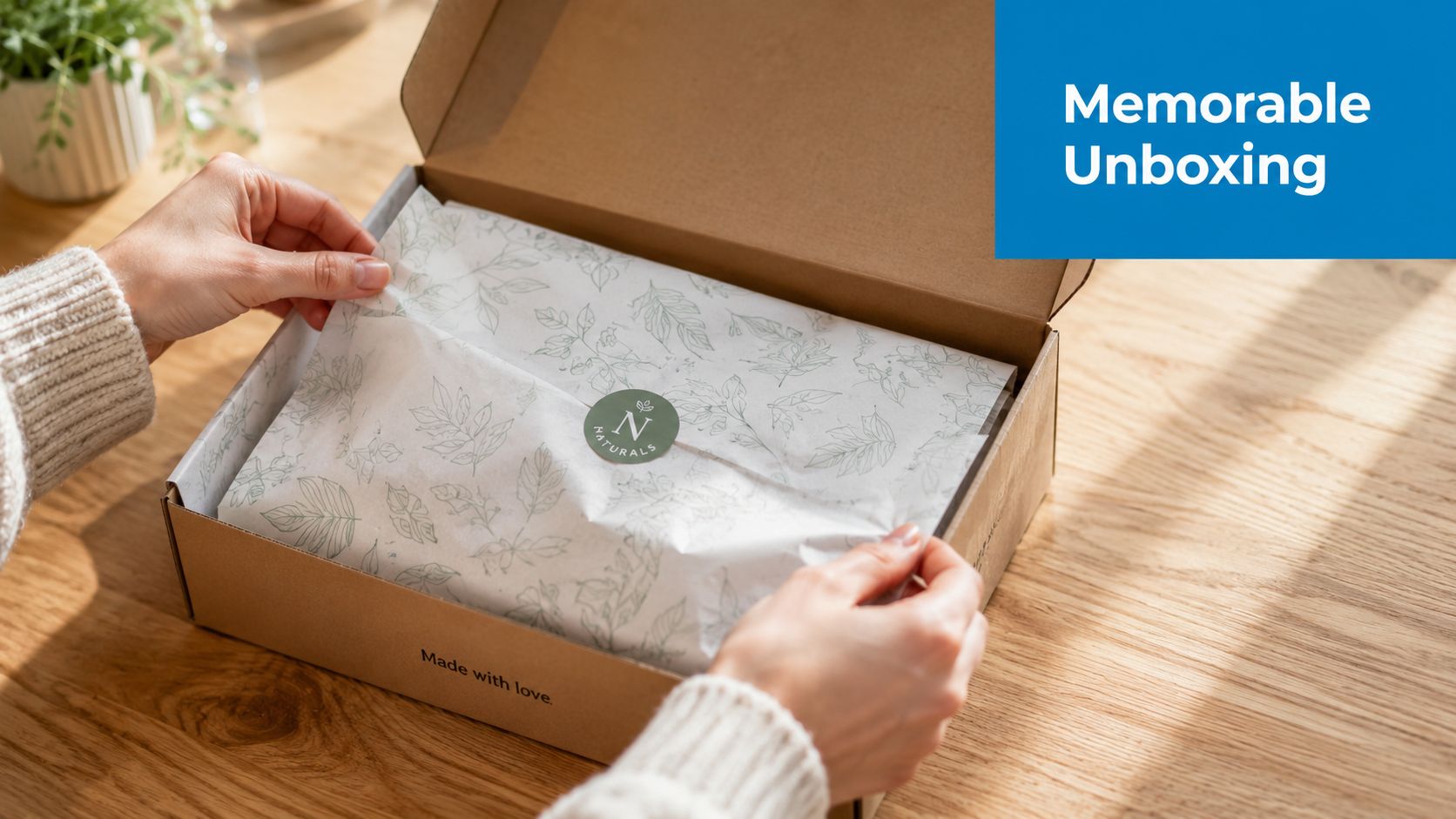
That's why branded tissue paper works so well for boutiques, gift brands, apparel sellers, candle makers, and event-driven businesses. It creates a visual pause before the reveal. Seaman Paper's industry analysis notes that custom branded tissue paper significantly enhances the unboxing experience by turning a standard delivery into a curated brand moment.
A good example is gift packaging. If you look at how curated gift sets are presented by shops like Online Gifts Canada, the wrapping layer does more than protect items. It frames the contents and signals care before the first product is even lifted out. That same principle applies to ecommerce shipments, retail bags, and event kits.
Why the paper changes the feeling
Plain tissue says the seller needed a wrap. Custom tissue says the seller planned the experience.
That distinction affects how the whole order is read. A simple logo repeat can make a handmade soap set feel more polished. A branded pattern can make a T-shirt order feel retail-ready. Even a single-color print on soft white stock can make a low-cost package feel considered.
A customer rarely separates the packaging decision from the product decision. They read both as one brand experience.
The best results come from using tissue paper as a first impression tool, not as decoration for its own sake. When the paper, print, and folding style all support the product inside, the package feels coherent. That's what lasts.
Why Branded Tissue Paper Is a Smart Investment
Many small businesses hesitate here because tissue paper feels optional. On a spreadsheet, that's fair. It isn't the product, and it doesn't solve shipping problems on its own. But in practice, branded tissue paper often carries a marketing role that cheaper interior packaging can't.
The strongest case for it is emotional response. According to EcoEnclose's study on the psychology of custom tissue paper, 77% of consumers reported feeling joy or surprise upon seeing branded tissue paper in a package, while 86% said it positively influenced their impression of the brand. For a small business, that matters because you usually don't get many physical brand touchpoints after checkout.
Where the value really comes from
The paper itself isn't the investment. The impression is.
Branded tissue paper helps in a few practical ways:
- It raises perceived quality. A product wrapped well often feels more premium, even when the item itself hasn't changed.
- It reinforces memory. Customers remember a repeated logo, pattern, or message better than a plain interior.
- It supports gifting. If customers ship directly to someone else, the presentation has to do branding work without your help.
- It gives social content a cleaner backdrop. When people photograph purchases, the branded wrap becomes part of the image.
That last point matters more than people think. Small brands don't always need dramatic packaging. They need packaging that photographs cleanly on a kitchen counter, boutique checkout table, or office desk.
What works and what doesn't
A smart tissue order is usually modest, focused, and easy to repeat. A weak one usually tries to do too much.
| Choice | What works | What usually fails |
|---|---|---|
| Logo use | Simple repeat pattern | Oversized art that gets cut awkwardly |
| Color strategy | One or two strong brand colors | Too many colors on thin stock |
| Message | Short slogan or subtle brand cue | Paragraphs of copy nobody reads |
| Budget use | Better paper and cleaner print | Fancy concept on low-grade material |
Practical rule: If your packaging budget is tight, spend it on paper quality and print clarity before you spend it on complexity.
There's also a timing advantage. A product might take weeks or months to develop. Tissue paper can be one of the fastest ways to make your packaging feel more branded without redesigning the entire box or bag. For businesses that need a better presentation now, it's often the easiest upgrade to justify.
Choosing Your Paper Materials and Finishes
Most first-time buyers focus on the logo. Experienced buyers start with the sheet. If the paper is wrong, even a strong design will print poorly, tear during packing, or feel stiff in the customer's hand.
Start with the paper itself
For premium branding applications, 17 to 20 GSM is the industry benchmark because it provides enough surface for high-resolution logo reproduction. Below 17 GSM, the paper risks tearing and ink bleed. Above 25 GSM, it loses some of the translucency and softness people expect from tissue, according to Seaman Paper's custom tissue paper specifications.
That range gives small businesses a useful decision point. If you want the paper to feel delicate but still survive folding, stuffing, and handling, stay near that benchmark. Going thinner to save money can create hidden costs if the sheet wrinkles badly or breaks at the fold line.
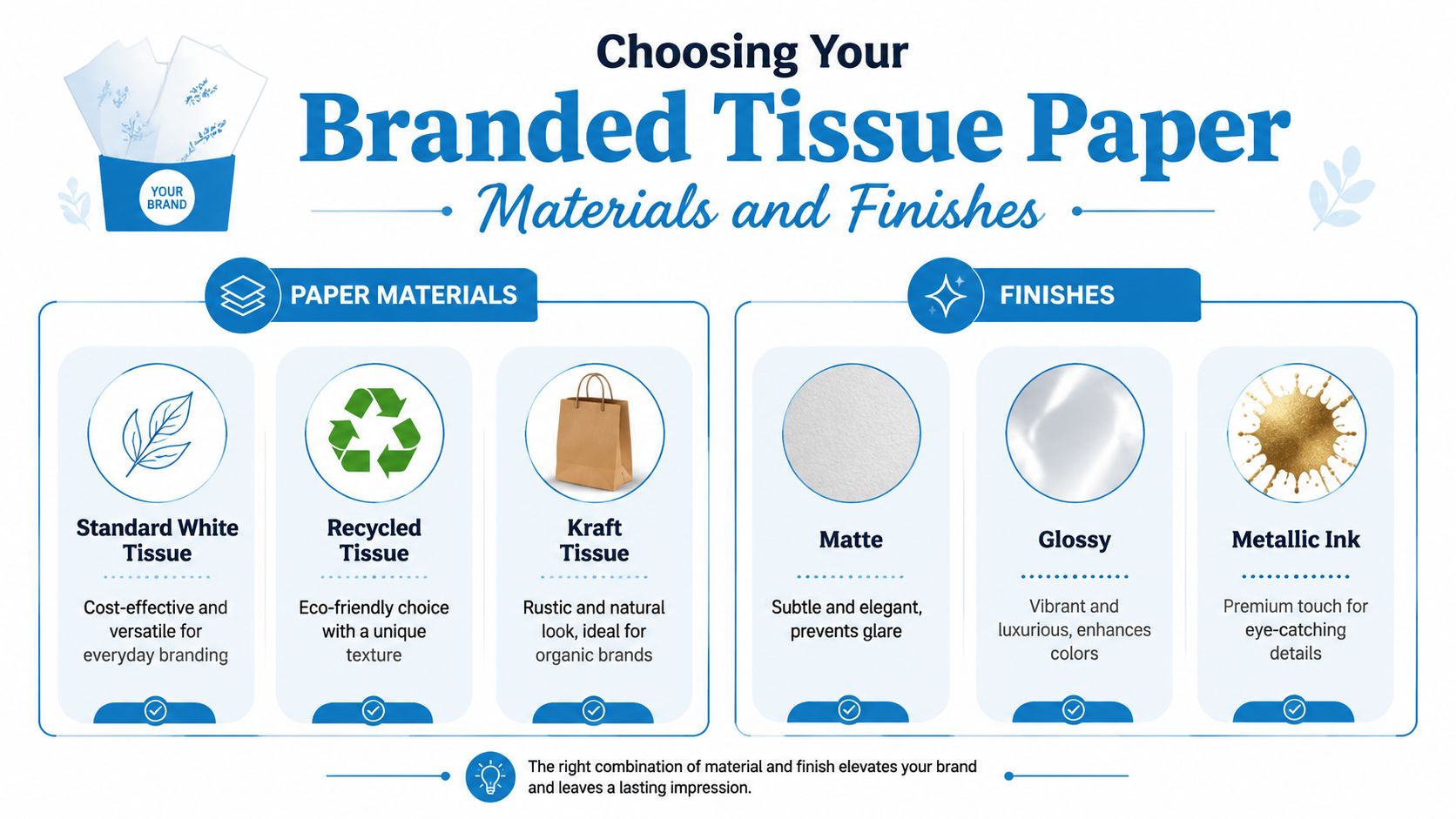
A second choice is fiber composition. Some projects benefit from a smoother, cleaner surface. Others need a more natural or recycled look. Recycled content can support a brand's environmental positioning, but the key question is whether the stock still accepts the print well and feels right in use.
Here's a simple way to think about material direction:
- White tissue works for clean color reproduction and broad brand compatibility.
- Recycled tissue fits brands that want a softer, more natural presentation.
- Kraft tissue gives a rustic tone and works well for artisanal or earth-toned packaging.
If your broader packaging plan includes specialty print effects beyond tissue, a good overview of packaging and embellishment services can help you see how finishes behave across different branded materials.
For brands comparing thicker printed pieces with lightweight wraps, this overview of heavy cardstock paper options is useful context because it shows how paper weight changes both feel and print behavior in a very different format.
Then choose a finish that fits the brand
Finish choices should support the message, not compete with it. Matte often suits understated brands because it appears subtle and keeps glare down. Glossier effects can make color feel more vivid, but they aren't always the best fit for tissue because softness matters as much as shine.
A premium look usually comes from restraint. Clean registration, a readable logo, and a paper that folds well will beat a flashy effect printed on the wrong stock.
This short video gives a useful visual reference for how tissue behaves in real packaging workflows:
Ask one simple question before approving a stock: does this paper still look good when it's crumpled, folded, and opened quickly? Tissue is handled, not displayed flat.
That's the standard that matters in the field.
Printing Methods and Artwork Essentials
Most production delays don't happen because the print shop can't print the job. They happen because the artwork arrives in the wrong format, the color expectations are unclear, or the design was built without thinking about how tissue folds and repeats.
What the printer needs from you
The single most helpful file type is a vector file. The easiest way to explain it is this: a photo is like a snapshot of your logo at one size, while a vector file is like the recipe for rebuilding it at any size. The printer can scale it up or down without making edges fuzzy.
That matters on tissue because logos are often repeated across the sheet. If the original artwork is low quality, every repeat exposes the problem. Fine lines break up. Type gets muddy. Small icons fill in.
A clean order usually starts with these assets:
- Vector logo files such as AI, EPS, or print-ready PDF
- Approved brand colors so the printer isn't guessing
- Clear size intent for the logo repeat or pattern spacing
- Any wording or slogan typed out in final form to avoid copy errors
If you're ordering other branded items at the same time, it helps to keep your files centralized. A page like custom printing options is useful for understanding how artwork standards stay consistent across apparel, accessories, and packaging.
A simple prepress checklist
Many small businesses overdesign tissue paper because they're used to digital graphics on screens. Tissue isn't a website banner. It's a thin printed surface that wrinkles, folds, and overlaps. Good artwork respects that.
Use this checklist before submitting:
- Simplify the mark. If your logo has a tagline, tiny registration mark, and multiple thin rules, ask whether all of that needs to appear on tissue.
- Decide on repeat style. A step-and-repeat pattern is the safest choice for most brands because the sheet still looks intentional when folded differently.
- Check contrast. Light ink on light tissue can look refined, but if the contrast is too low, the brand disappears.
- Remove tiny details. Intricate illustration can work, but only when the line weight is strong enough for the substrate.
- Review the proof at actual scale. A design can look balanced on a monitor and feel crowded once it repeats across a physical sheet.
Thin paper is unforgiving. If a detail is borderline readable in the proof, it usually gets worse in production, not better.
Color expectations also need a reality check. Tissue paper won't behave like coated marketing paper. Ink interacts with fiber, softness, and absorbency. That doesn't mean the result can't look excellent. It means your artwork should be built for the material instead of fighting it.
The brands that get the smoothest results usually treat the printer like a production partner, not just a vendor. They ask what line weight is safe, what repeat size prints cleanly, and what changes will prevent waste before the run starts.
Designing Tissue Paper That Wows Customers
Good tissue design isn't about filling every inch. It's about creating a branded surface that still looks polished after folding, crinkling, and opening. The customer won't see the sheet flat on a proofing table. They'll see parts of it, in motion, inside a box.
Patterns that work in the real world
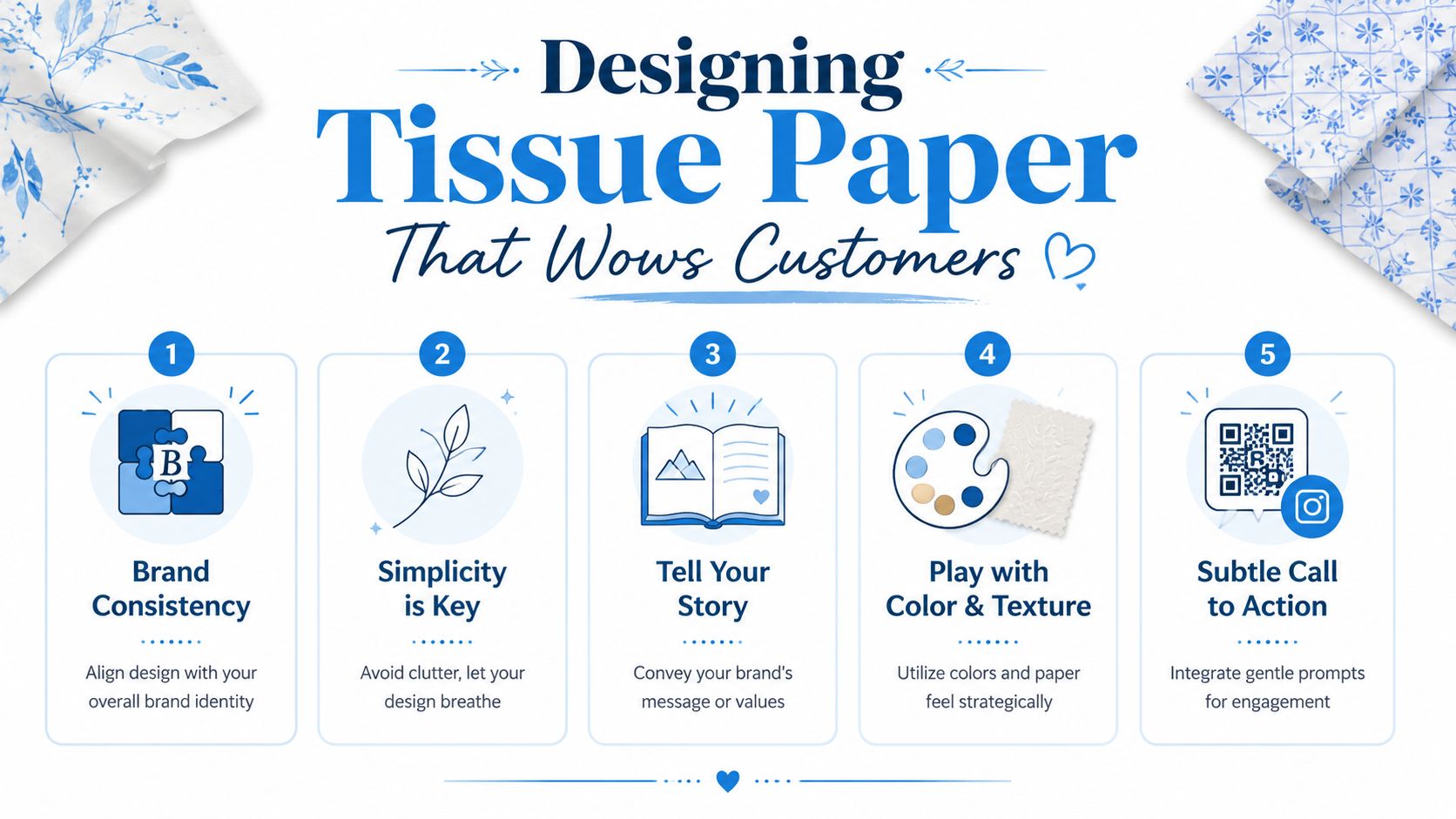
The most reliable option is a small to medium step-and-repeat logo pattern. It gives enough brand presence without depending on perfect fold placement. If the customer only sees one corner of the sheet at first, the branding still reads.
A second strong approach is a sparse pattern with symbols, icons, or a short phrase. Branded tissue paper can carry slogans, heartfelt messages, or artwork that reflects values such as fairness, sustainability, or artistry, as noted by BrillPack's discussion of custom printed tissue paper and brand identity. That works best when the wording is short and the design leaves room for the paper to breathe.
For broader packaging inspiration, this guide on how to build your brand with packaging is a helpful reminder that interior wraps should support the full package, not fight with it.
What makes tissue look premium
Luxury doesn't always mean ornate. In many cases, it means controlled.
A few design directions tend to perform well:
- Minimalist branding works when the logo has strong shape and the product itself has visual appeal.
- Bold graphic repeats fit playful brands, especially in beauty, lifestyle, or event merchandise.
- Message-driven tissue suits gift businesses and mission-led brands that want the packaging to say something specific.
What usually weakens the result is clutter. Too many symbols, too many color ideas, or a logo printed too large can make the sheet feel promotional instead of premium.
Leave empty space on purpose. Negative space is what gives tissue paper elegance once it's folded around a product.
Think about reveal order too. If you seal the tissue with a sticker, a centered logo near the opening can create a clean first read. If the tissue is tucked loosely around apparel, a repeating pattern often performs better because the customer sees several partial views rather than one framed panel.
The strongest branded tissue paper designs don't try to explain the whole brand. They introduce it, clearly and confidently.
Your Order Process with Dirt Cheap Product Inc
A custom tissue order feels easier when the process is visible. Most buyer anxiety comes from uncertainty. People want to know what happens after they send a logo, when they'll see a proof, and what can still change before production begins.
What usually happens after you request a quote
The process is straightforward when the basics are in place.
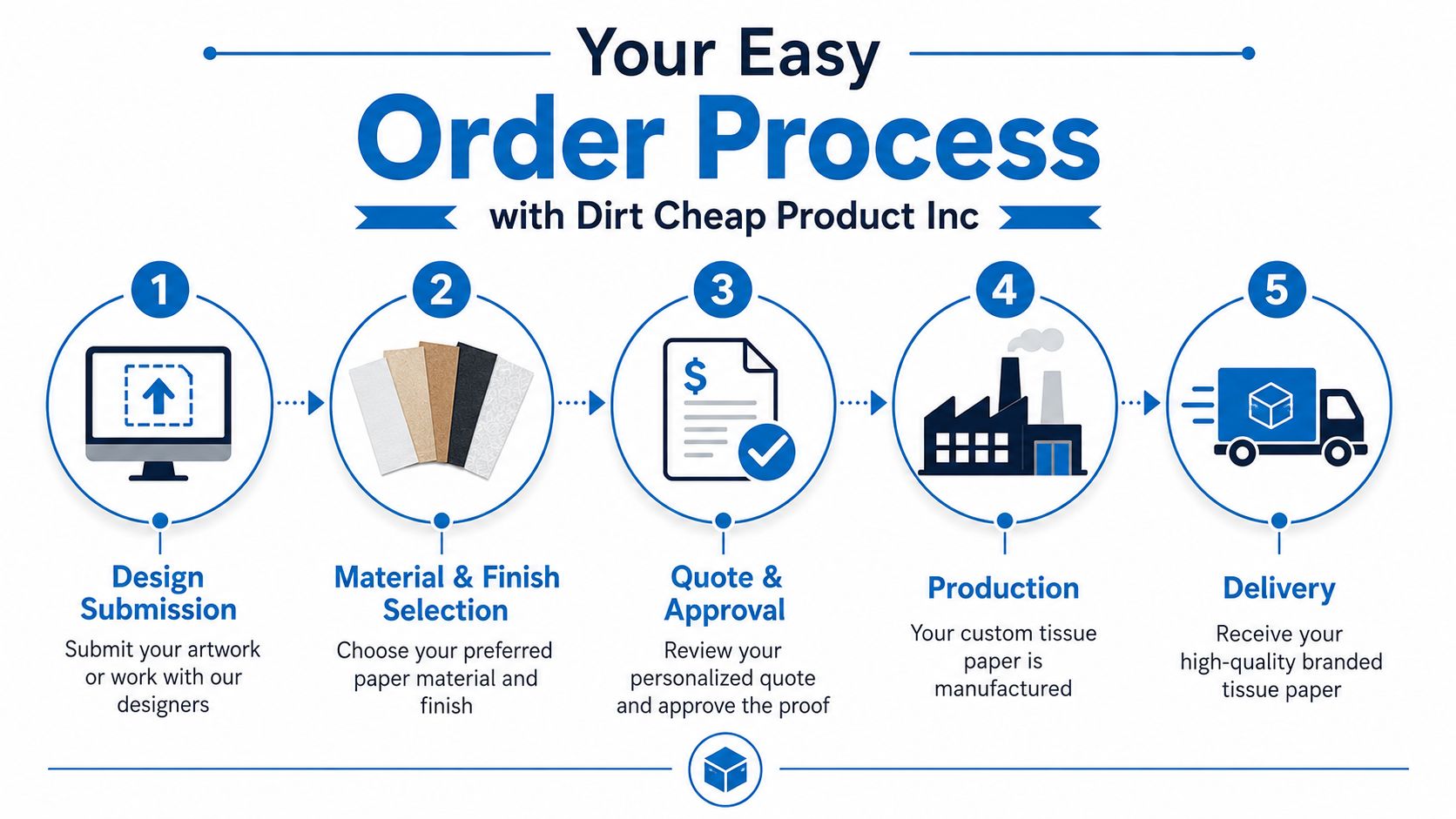
- Submit the artwork through the custom order form. If the logo needs cleanup or file review, that gets identified early.
- Review material and print direction. Paper type, approximate look, and design approach are aligned to prevent wasted time on an incorrect setup.
- Receive a digital proof. This stage matters because it confirms logo scale, spacing, orientation, and placement logic.
- Approve for production. Once the proof is signed off, the job moves forward with fewer surprises.
- Receive the finished order and use it across shipping, retail presentation, or event packaging.
That sounds basic, but it solves the issues that cause most first-order frustration. Clear proofing helps prevent “the logo looked bigger on screen” problems. Material review helps avoid stock that doesn't match the intended feel. Early file checking catches low-resolution artwork before it becomes a print defect.
Where orders slow down
The holdup usually isn't manufacturing. It's indecision.
A project drifts when the customer sends multiple logo versions, changes the color direction after proofing, or asks for a print effect that doesn't fit the chosen stock. The fastest orders usually come from buyers who know three things upfront: the product they're wrapping, the brand tone they want, and whether they care more about cost, texture, or visual impact.
Here's the simplest way to keep the order moving:
- Choose one logo version before requesting the proof
- Decide whether eco appearance matters visually or mainly in sourcing
- Know how the tissue will be used for apparel folds, gift boxing, or order inserts
- Approve quickly once the proof matches what you asked for
A transparent process helps because it removes guesswork. Instead of buying “custom tissue” as an abstract item, you're approving a real production plan with visible choices and a clear sequence.
Frequently Asked Questions About Custom Tissue Paper
First-time buyers usually ask the right questions. They just ask them late. A few answers upfront can save time, revisions, and wasted spend.
How much should a small business order
Order based on packaging rhythm, not excitement. If you're testing a new presentation style, start with a quantity you can use steadily. A large run only makes sense if your branding is stable and your packaging process is already consistent.
This market isn't niche. The global tissue paper market is projected to reach USD 125.9 billion by 2034, and North America held over 28.7% of market share in 2025, according to IMARC Group's tissue paper market projection. That scale means there are many options, but it also means small businesses should buy carefully instead of assuming every vendor handles short runs the same way.
What should you ask a vendor before approving production
Ask practical questions, not just price questions.
A good short list includes:
- What paper weight are you quoting? This affects print quality and feel.
- What file type do you need? That determines whether your artwork will reproduce cleanly.
- Can I review a proof before production starts? You want sign-off on scale and layout.
- What does the stock feel like in hand? Softness matters for apparel and gift packaging.
- Are your eco claims documented clearly? If sustainability matters to your brand, ask for specifics rather than labels.
Is custom tissue safe for clothing and soft goods
It can be, but ask about the stock and printing approach if you're wrapping garments, hats, or delicate items. The right tissue should protect presentation without transferring unwanted residue or feeling rough against the product. If you sell apparel, test one packed order in real conditions before committing to the full run.
Can tissue paper include more than a logo
Yes. Many brands add a pattern, short slogan, or message. The best designs stay readable and repeat well across folds. If the copy is too long or the design depends on one exact viewing angle, the effect weakens quickly.
Keep the approval standard simple: if the tissue still looks good half folded and slightly wrinkled, the design is doing its job.
Is the cheapest quote usually the best value
Usually not. The lowest quote can hide compromises in paper weight, print clarity, proofing support, or consistency. Tissue paper is a small-format product, but bad execution shows immediately. Saving money on the quote only helps if the finished sheet still reflects your brand well.
If you're ready to create branded tissue paper that feels polished, prints cleanly, and fits your budget, Dirt Cheap Product, Inc. is a practical place to start. The team helps businesses move from logo file to proof to finished order with responsive support, clear communication, and a process built for custom branding decisions that need to be made quickly and correctly.