
You've just opened a shipment of custom baseball caps for a team, event, or company promotion. The embroidery looks sharp, the colors match the proof, and then people start trying them on. One cap presses against the temples, another sits high on the head, and several adjustable caps only feel comfortable at the very end of the closure. The order is decorated correctly, but the fit creates the problem.
That situation is avoidable. Baseball cap sizing depends on head circumference, cap construction, material tolerance, crown depth, and head shape. A reliable measurement gives you a starting point, but it doesn't guarantee comfort by itself. The practical goal is to match the wearer and the cap style, then plan the order so a small variation doesn't become a large inventory problem.
Table of Contents
- Why Baseball Cap Sizing Matters More Than You Think
- How to Measure Head Circumference Accurately
- Baseball Cap Size Conversion Charts Explained
- Fitted vs Snapback vs Flexfit vs Adjustable Caps
- Hidden Fit Problems That Size Charts Ignore
- Group Ordering Strategies for Teams and Events
- Your Pre-Order Sizing Checklist
Why Baseball Cap Sizing Matters More Than You Think
A bulk cap order can look perfect in a digital proof and still fail at distribution. The embroidery may match the approved artwork, while fitted caps pinch broader heads, flex-fit bands press at the temples, and “one size” caps sit comfortably only at the last few closure settings. The decoration is correct. The fit is not.
That problem affects whether people wear the cap at all. Unworn promotional merchandise delivers little value, and poor fit can create exchanges, last-minute sorting, and an awkward impression that the business, team, or event organizer overlooked its audience. Standard charts provide a useful starting point, but they do not account for head shape, crown depth, or how much a particular fabric stretches.
Why fitted sizing uses small increments
Fitted caps are ordered by measured circumference rather than a broad small, medium, or large label. A standard chart places common U.S. fitted sizes from 6 5/8 at about 20 1/2 inches, or 53 cm, through 8 1/8 at about 25 5/8 inches, or 65 cm. The ladder advances in approximately 1/8-size steps, with each step representing roughly 0.5 inch or 1 cm of head circumference (standard fitted hat size chart).
A size 7 3/8 cap that slides half an inch on one wearer may sit firmly on another. The label is identical, but head shape, hair volume, sweatband construction, and fabric tolerance change the result. A vendor ordering fitted caps for retail or repeated daily wear should collect actual measurements and verify the exact manufacturer's chart before committing to quantities.
Practical rule: Treat cap sizing as a measurement decision first and a decoration decision second. A perfect logo cannot rescue a cap people will not wear.
The cost of guessing
Choosing one size for an entire group may simplify the purchase order, but it often moves the problem to distribution day. At that point, the vendor cannot easily change the product, and the organizer must identify who needs an exchange or a different style.
Start by matching construction to the audience. Adjustable caps offer the widest tolerance, while flex-fit styles absorb some variation but still depend on the band's stretch and the wearer's head shape. Fitted caps provide the cleanest retail presentation, yet they require a measured size run and careful quantity planning. For custom branded orders, confirm those trade-offs with the manufacturer before approving decoration.
How to Measure Head Circumference Accurately
Head circumference is the most useful starting measurement for baseball cap sizing, but only when everyone measures in the same place. Use a flexible sewing tape if possible. A piece of string and a ruler can work as well, provided the string is marked and then measured carefully.

Place the tape correctly
Start above the eyebrows. Position the tape about 1 inch, or 2.5 cm, above the eyebrows, following the area where the front sweatband will sit. Nike uses this placement in its hat-measuring guidance, which helps create a repeatable circumference standard (Nike measuring convention via a hat size chart).
Wrap around the widest part. Bring the tape around the head just above the ears and across the fullest part of the back. The tape should form a level ring rather than slanting upward or downward. Published conversion guidance uses this same area, above the ears and across the forehead, to match measurements with fitted sizes (head circumference measuring guidance).
Keep it snug, not tight. The tape should touch the head without compressing the skin. Pulling it tight creates an undersized result, while leaving a gap produces a cap that may slip.
Hair can affect the result. Measure over the hair as it will normally be worn, but don't measure over a bun, ponytail, or temporary style that changes the head's actual circumference. If the tape tilts, reposition it and measure again.
Record the result for ordering
Write the measurement in both inches and centimeters. This makes vendor communication easier when a brand chart uses one system and the decoration supplier or purchasing team uses another.
For a group, create a simple sheet with the wearer's name, measurement, preferred cap style, and any fit note such as “usually needs a deeper crown.” Don't rely on people guessing their fitted size from memory. A person may know that a previous size 7 1/4 cap worked, but different brands and constructions can map the same nominal size differently.
Measure twice when the result sits close to a size boundary. If the second measurement differs, check tape placement before averaging anything. Consistent technique is more valuable than false precision.
Baseball Cap Size Conversion Charts Explained
A circumference measurement is only useful when matched to the chart for the exact cap brand and construction. Generic tables help with initial planning, but a fitted cap, flex-fit style, and adjustable cap respond differently to the same head measurement. Bulk orders often go wrong when a buyer treats one conversion chart as universal.
Common tables place adult fitted sizes across metric steps including 54, 55, 56, 57, 58, 59, 60, 61, 62, and 63 cm (standardized head measurement chart). A fitted-cap guide maps 54.9 cm at 21 5/8 inches through 63.5 cm at 25 inches, with intermediate size conversions (New Era fitted cap size guide).
| Head Circumference (inches) | Head Circumference (cm) | U.S. Fitted Size |
|---|---|---|
| 21 5/8 | 54.9 | 7 |
| 22 | 55.8 | 7 1/8 |
| 22 3/8 | 56.8 | 7 1/4 |
| 22 3/4 | 57.7 | 7 3/8 |
| 23 1/8 | 58.7 | 7 1/2 |
| 23 1/2 | 59.6 | 7 5/8 |
| 23 7/8 | 60.6 | 7 3/4 |
| 24 1/4 | 61.5 | 7 7/8 |
| 24 5/8 | 62.5 | 8 |
| 25 | 63.5 | 8 1/8 |
Adjacent sizes are close. Each 1/8-size step corresponds roughly to 0.5 inch or 1 cm, so a difference of only 1 to 2 cm can move a wearer into another size class. Use the measured value for the order rather than a broad label such as large.
What to do between sizes
A measurement between fitted sizes requires a construction decision, not an automatic size-down. Sizing down can create pressure at the forehead or temples. Sizing up may allow movement. Sweatband stretch, fabric, crown depth, head shape, and the preferred close or relaxed fit all affect the result.
For a bulk order, ask the vendor which adjacent size suits that specific cap model. One retailer groups practical fitted ranges such as 21 1/4 to 21 3/4 inches for size 6 3/4, 21 3/4 to 22 1/4 inches for size 7, and 22 1/4 to 22 3/4 inches for size 7 1/4 (baseball cap sizing ranges). These ranges show why a chart is style-specific guidance, not a guarantee. A stiff structured crown may feel tighter than its circumference suggests, while a stretch sweatband may tolerate a small gap.
Graduation-cap sizing uses a different product context, but buy the right cap at Gradshop can provide broader conversion context. For branded baseball caps, confirm the manufacturer's chart for that exact model. If someone falls between sizes, check the vendor's fit recommendation and, when possible, approve a sample before committing to the full order.
Fitted vs Snapback vs Flexfit vs Adjustable Caps
Cap construction changes what “size” means in a bulk order. A fitted cap has a fixed circumference, while an adjustable cap lets the wearer compensate with the closure. Flexfit sits between them. Its sweatband stretches, but the crown shape, base circumference, and material recovery still determine whether that stretch feels comfortable or restrictive.
| Cap type | How sizing works | What usually works | Main trade-off |
|---|---|---|---|
| Fitted | Exact size with no closure | Precise retail or team fit when measurements are reliable | A small sizing error can make the cap uncomfortable |
| Snapback | Plastic closure with discrete settings | Group orders where recipients need adjustment | The available base shape and settings still limit fit |
| Flexfit | Elastic sweatband stretches across a range | Groups wanting a cleaner back and some tolerance | Stretch can't correct every circumference or head-shape mismatch |
| Adjustable | Fabric strap, buckle, or hook-and-loop closure | Mixed audiences and promotional distribution | “One size” still has a practical fit window |
A one-size adjustable cap is built around a practical adult fit range, not unlimited head sizes. It can suit a central portion of the audience, but the wearer may still run out of adjustment or need to tighten the closure enough to change the cap's shape. That distinction matters when a branded order includes people with different head shapes and fit preferences.
Choosing for a bulk order
Fitted caps work well when the group has a known size distribution and the finished product needs a precise retail feel. They are less forgiving when recipients skip measurement. A small error can create pressure at the forehead or temples, and the fixed construction gives the wearer no way to correct it.
Snapbacks and fabric adjustables simplify distribution, but the cap may look uneven when the closure is pulled near its smallest or largest setting. They also do not eliminate crown-shape problems. Flexfit offers a cleaner back and some tolerance, yet the elastic band creates pressure of its own. Stretch helps with circumference, not every head shape, and it may lose recovery after repeated wear.
For a mid-profile option, review the mid-profile cap collection when crown height and logo presentation matter alongside circumference. A lower or taller crown can change perceived fit even when the sweatband measurement is suitable.

For a mixed group, choose the construction that provides adjustment without forcing wearers to use an extreme setting. For a retail line or a broad event audience, offering more than one construction can reduce returns caused by fit preferences that a single size chart cannot capture. Approve samples before production when the cap's stretch tolerance or crown profile is unfamiliar.
Hidden Fit Problems That Size Charts Ignore
Circumference is necessary, but it isn't the whole fit. Two people can measure the same around the head and still need different caps because their heads vary front to back, side to side, and in crown height.
A shallow cap can feel tight even when the sweatband circumference is correct. A deep crown may feel bulky or sit awkwardly on someone with a shorter head profile. A cap can also press at the temples, gap at the back, or perch above the forehead because the panel shape doesn't follow the wearer's head.

Diagnose the shape before changing the size
Don't immediately move up or down a size when the circumference seems right. First check where the discomfort appears.
- Pressure at the temples can indicate a side-to-side shape mismatch or a crown that doesn't provide enough room.
- A gap at the back may point to a crown or panel mismatch rather than excessive circumference.
- A cap that rides upward may be too shallow, especially if the wearer keeps pulling it down.
- A cap that looks oversized can have excessive crown depth even when the sweatband fits properly.
Structured caps hold their intended shape, so they can make a mismatch more noticeable. Unstructured caps generally conform more easily, but they may provide a softer silhouette and less consistent logo presentation.
Match profile and structure to the wearer
Low-profile caps can work well for people who dislike extra crown height, while mid-profile and high-profile designs provide more vertical room. The exact result depends on the manufacturer's pattern, so sample fitting matters more than the profile name alone.
Try the cap in its natural position, level across the head. Check the front panels, the temples, the back edge, and the space above the head. Move around for several minutes rather than judging the fit from a mirror glance. If the cap shifts, creates pressure, or needs constant adjustment, changing the construction may solve the problem more effectively than changing the size.
The public charts don't quantify these shape differences. That's why a sample cap and clear wearer feedback are valuable when a custom order depends on comfort.
Before approving a large run, watch this visual demonstration of cap fit and measuring technique:
Group Ordering Strategies for Teams and Events
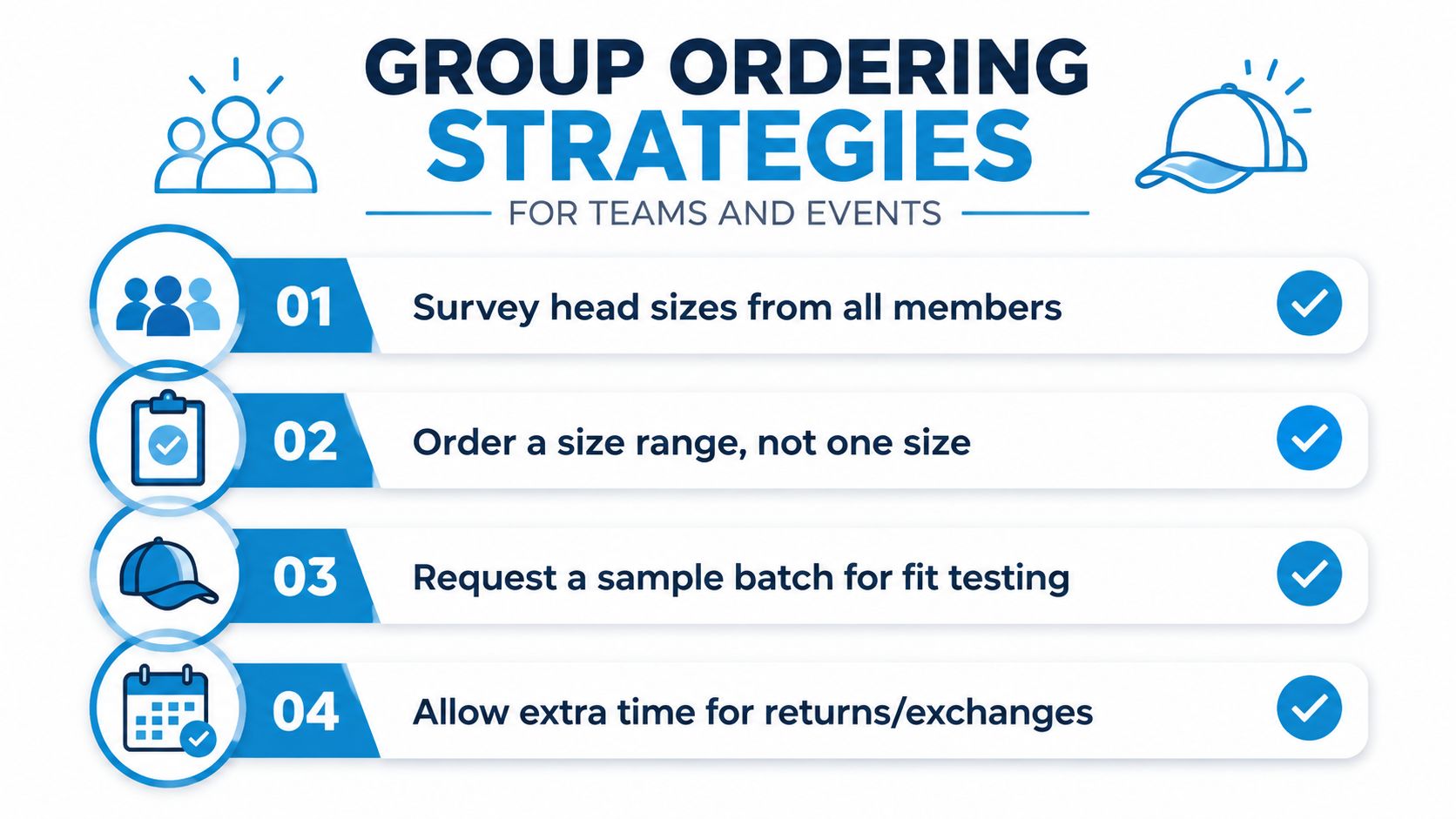
A group order needs a process, not a single guess. Start by collecting each wearer's head circumference using the same instructions, then ask whether they prefer fitted, stretch-fit, or adjustable construction. If an individual won't measure, record that uncertainty instead of assigning a size.
Build a usable size forecast
Separate the list into confirmed measurements, estimated measurements, and edge cases. Confirmed measurements can guide fitted sizing. Estimated measurements may be better served by an adjustable style. Edge cases, including children, unusually small heads, and unusually large heads, deserve individual review rather than being forced into the group's most common option.
A simple size forecast should show:
- Head measurement: Record inches and centimeters.
- Cap construction: Mark fitted, snapback, flex-fit, or adjustable.
- Preferred fit: Note close, standard, or relaxed preferences.
- Exception status: Flag anyone whose measurement is between chart sizes or whose usual cap feels uncomfortable.
- Distribution plan: Identify who will receive each size before decoration begins.
For a team, ordering a size range instead of one universal size usually creates a smoother handout. The exact quantity mix depends on your measurements and audience, so don't copy a generic distribution from another order.
Test the actual cap
Request a sample before approving the full decoration run. Have representatives with different measurements and head shapes wear it, move around, and check the crown, sweatband, closure, and logo position.
This test also protects the artwork. A structured crown may present embroidery cleanly, while a curved or soft front can change how a logo sits. Check whether the decoration remains centered when the cap is adjusted for smaller and larger wearers.
For organizers who also coordinate youth sports logistics, this guide for basketball netball parents offers useful context on keeping group participants informed. The same communication principle applies to apparel. Give people the measurement method, deadline, sample information, and exchange policy in one clear message.
When comparing suppliers for custom hats in bulk, send the size forecast, cap style, color, decoration method, artwork dimensions, and delivery date together. A vendor can then identify fit or production conflicts before the order is finalized.
Your Pre-Order Sizing Checklist
Use this checklist before you approve a custom baseball cap order. It's short enough to share with a purchasing team, but detailed enough to catch the mistakes that usually appear after production.
Measurement and conversion
- Measure the actual wearer: Wrap a flexible tape around the widest part of the head, just above the ears and across the forehead. Keep the tape level and snug, not tight.
- Record both systems: Save inches and centimeters so nobody has to reinterpret the measurement later.
- Confirm the brand chart: Compare the measurement with the exact manufacturer and cap style. Don't assume a fitted size transfers perfectly between brands.
- Flag boundary measurements: If someone falls between sizes, ask the vendor whether sizing up, sizing down, or switching construction is the better choice.
Cap selection
- Choose construction intentionally: Use fitted caps for precision, flex-fit for stretch tolerance, and adjustable styles when the group has uncertain measurements.
- Check crown depth: A correct circumference can still feel wrong if the cap is too shallow or too deep.
- Review the closure: Make sure the intended wearer won't need the smallest or largest setting to make the cap usable.
- Order a sample: Test the actual blank cap on people with different measurements and head shapes before committing to the decorated run.
Decoration and fulfillment
- Approve placement on the physical cap: Confirm the logo's position, width, thread or print treatment, and how the front panels affect visibility.
- Send one complete specification: Include quantities by size, cap construction, colors, artwork, decoration method, packaging, and delivery requirements.
- Plan distribution: Label or separate sizes before the event so recipients aren't sorting through a mixed box.
- Allow for logistics: If the project involves multiple locations or individual deliveries, review practical apparel shipping considerations in this apparel shipping guide for 2026. Treat the year as the guide's stated context, not as a universal shipping rule.
- Keep a reorder record: Save the cap brand, style, color, size mix, artwork, and fit feedback. A successful reorder depends on repeating the same specifications.
If you're sourcing printed baseball caps, request a proof and ask how the selected cap's structure will affect the decoration. We do not create business cards or fliers, so keep the project focused on the apparel and promotional products that need to fit, look consistent, and get worn.
Dirt Cheap Product, Inc. provides custom hats with embroidery, direct-to-film decoration, sublimation, patches, and other branding options, with proofs and responsive support for business, retail, team, and event orders. Send your logo, cap preferences, measurements, and delivery requirements when you visit Dirt Cheap Product, Inc., and ask the team to help match the cap construction to your audience before production.