
You're probably here because you need a promo item that won't disappear the way cheap handouts do. You want something useful, something people keep on a desk or take into a meeting, and something that keeps your brand visible after the event table is packed up.
That's why branding on mugs keeps coming up in real client conversations. A mug is practical, easy to distribute, and flexible enough to work for a budget giveaway, a staff welcome kit, or a more polished client gift. The trick isn't just printing a logo. It's choosing the right mug, the right print method, and the right artwork setup for the job.
Table of Contents
- Why Branded Mugs Are a Smart Marketing Investment
- Comparing the Best Mug Branding Methods
- Choosing the Right Mug Material and Style
- Preparing Your Artwork for a Perfect Print
- Sample Workflows for Common Business Needs
- Your Complete Mug Ordering Checklist
- Frequently Asked Questions About Ordering Mugs
Why Branded Mugs Are a Smart Marketing Investment
A good branded mug keeps working after the first impression. Someone takes it to a desk, fills it every morning, leaves it in a conference room, or uses it at home. That repeated use is what makes the item valuable.
Research summarized by Symphonix on branded drinkware history and performance notes that branded drinkware delivers an average of over 1,400 impressions during its lifetime, with some estimates reaching 3,162 impressions per item, and that the average branded mug is used approximately 2,000 times.

That's the business case in plain terms. A mug stays in circulation longer than many low-cost promo pieces because people use it. If your audience works at desks, commutes, attends meetings, or keeps coffee within arm's reach, mugs fit into routines without effort.
Why mugs hold attention
A mug earns its value in small moments. It sits next to a keyboard during a call. It gets carried from break room to desk. It shows up in shared spaces where other people see it too.
If your company is also investing in workplace hospitality, pairing branded mugs with high-quality office coffee solutions can make the item feel more intentional. The mug stops being just a giveaway and starts feeling like part of the daily office setup.
Practical rule: If the recipient can use the item every weekday without changing their habits, it usually outperforms novelty merch.
Where mugs make the most sense
Branded mugs usually work best for these situations:
- Office-based teams: Staff use them repeatedly at desks, in kitchens, and during meetings.
- Events with a practical angle: A mug feels more useful than many generic giveaways.
- Client gifts on a budget: A well-chosen mug can look thoughtful without requiring a luxury-level spend.
- Internal branding: New hire kits, anniversary gifts, and department swag all benefit from items people keep.
Not every campaign needs a mug. If your audience is constantly mobile, a travel tumbler may make more sense. If your goal is purely wearable visibility, apparel may be stronger. But when clients ask for a promo item with staying power, mugs are often one of the easiest smart decisions.
Comparing the Best Mug Branding Methods
A client ordering 72 mugs for a trade show has a different problem than a company buying 24 gift sets for top accounts. The print method should follow the business goal, not the other way around.
For most mug projects, the actual choice is between sublimation and screen printing. Both work well. The better option depends on four things: your artwork, your quantity, the mug blank, and how the mugs will be used.
Mug branding method comparison
| Method | Best For | Cost Profile | Durability | Color & Detail |
|---|---|---|---|---|
| Sublimation | Full-color artwork, gradients, photos, smaller batches | Lower setup burden for shorter runs | Strong long-term wear because the image bonds into the coating | Excellent detail and full-color range |
| Screen printing | Simple logos, limited-color graphics, larger orders | Better value when quantities increase | Durable when used correctly on the right mug | Best for bold artwork, not intricate photo-style designs |

Sublimation printing
Sublimation is usually the right call when the artwork carries the project. If your logo includes gradients, a lot of color variation, or photo-style elements, screen printing will force compromises that often show up in the final piece.
I recommend sublimation most often for welcome kits, short-run event orders, staff gifts, and client programs where each mug needs a more polished finish. It also makes personalization easier, which matters for named gifts and segmented campaigns.
The trade-off is straightforward. Sublimation performs best on compatible coated blanks, usually light-colored ones, and that narrows your product options. If brand guidelines require a dark exterior mug or a specific specialty finish, the blank can rule sublimation out before pricing even enters the conversation.
Use sublimation when you need:
- Full-color logos or artwork with gradients
- Small to mid-size orders without heavy setup costs
- Individual names, titles, or versioned designs
- A print that looks integrated into the mug surface
If you want a plain-English overview before you choose, this guide on what sublimation printing is explains the process clearly.
Screen printing
Screen printing makes the most sense when the brand mark is simple and the quantity is high enough to spread setup costs across the order. For a one-color logo on a standard office mug, it is often the most cost-efficient choice.
This is the method I steer clients toward for broad distribution. Trade show handouts, company store basics, campus promotions, and large internal orders usually fit screen printing better than sublimation. The artwork stays clear, the repeatability is good, and the unit price usually improves as volume rises.
Screen printing works best with:
- One-color or two-color logos
- Bold shapes and readable text
- Larger orders where setup cost matters less per unit
- Standard promotional mug programs
It is a weaker fit for:
- Photo graphics
- Fine gradients
- Detailed illustrations with many color shifts
- Small design elements that need sharp tonal variation
One common mistake is choosing screen printing for artwork that was built for digital display. A logo may look clean on a laptop screen and still print poorly if it relies on subtle shadows or thin detail. In that case, either simplify the art or change the decoration method.
How to choose based on the job
Start with the campaign goal.
If the mugs are a high-volume giveaway, protect your budget first and keep the design simple. Screen printing is often the better business decision.
If the mugs are going to prospects, executives, or long-term staff, the finish matters more. Sublimation usually gives a better presentation for that kind of order, especially on white ceramic.
If you are still deciding on product direction, looking at retail-style examples can help clarify what finish and style match your brand. Browsing Beans Without Borders drinkware is a useful way to compare the visual feel of different mug types before you finalize decoration.
A practical rule I use with clients is simple. High quantity plus simple art usually points to screen printing. Lower quantity plus detailed art usually points to sublimation. The exceptions usually come from the mug itself, which is why I confirm the blank before I confirm the print method.
Choosing the Right Mug Material and Style
The print method matters, but the mug itself changes how your brand feels in someone's hand. A logo on a basic ceramic mug says one thing. The same logo on a travel tumbler or enamel camp mug says something else entirely.

Match the mug to the setting
Ceramic mugs are the office standard. They feel familiar, stack well in kitchens, and suit front-desk use, staff rooms, conference tables, and welcome kits. If your audience works at a desk, ceramic is usually the safest choice.
Stainless steel tumblers or travel mugs fit a more mobile routine. They work better for commuting, outdoor events, field staff, or clients who spend more time in a car than behind a keyboard. They also create a more modern, lifestyle-focused impression.
Enamel mugs lean casual and giftable. They're often chosen for creative brands, outdoor themes, hospitality projects, and merch collections that want a less corporate feel.
If you want inspiration on product styles people buy for gifting and daily use, browsing curated options like Beans Without Borders drinkware can help you compare the visual feel of different mug types before you lock in a direction.
Think about use before decoration
A mug should match how the recipient will use it. That sounds obvious, but it gets missed all the time.
Ask these questions before you choose the blank:
- Will this live on a desk or travel in a car?
- Is this meant to feel promotional or gift-worthy?
- Do you want a broad crowd-pleaser or something more brand-specific?
- Will the mug be used indoors, outdoors, or both?
Here's a quick visual overview of common mug styles and use cases:
There's also a brand values angle here. If sustainability is part of your message, it helps when the product category supports that story. Buyers who are building larger promo programs often compare mugs with other eco-friendly promotional products so the order feels consistent across the campaign.
The best mug isn't the fanciest one. It's the one your audience will keep because it fits their routine.
Preparing Your Artwork for a Perfect Print
A mug can look right in the proof and still disappoint in hand if the artwork was built for a screen, not for print. I see this happen on rush orders and low-budget projects more than anything else. The print method gets blamed, but the file usually caused the problem.
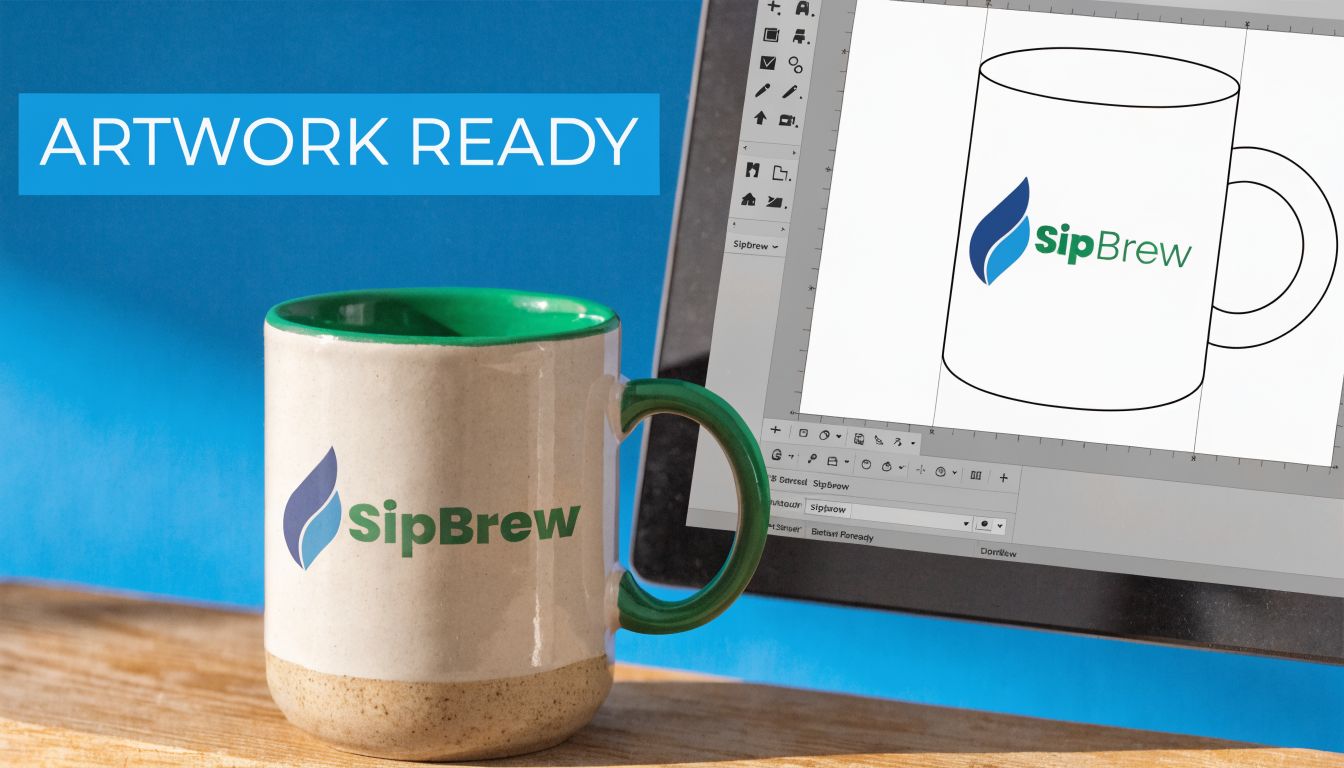
Start with the right file
Send vector artwork first if you have it. AI, EPS, and print-ready PDF files usually give the cleanest result because the logo can scale without turning soft or jagged. If vector art is not available, send the highest-quality PNG or PSD you have and ask for a file check before the order goes into production.
For full-color work, file setup affects the final result more than clients expect. As noted earlier, artwork for this kind of printing is usually prepared at high resolution and in CMYK color mode so gradients, photos, and brand colors reproduce more predictably. RGB files can look brighter on a monitor than they do on the finished mug.
The practical test is simple. If a small line of text is hard to read on your screen at actual mug size, it will be harder to read after printing on a curved surface. The same goes for thin outlines, fine patterns, and low-contrast color combinations.
Use these checks before you approve artwork:
- Keep text readable: Small taglines, URLs, and phone numbers often fail on mugs unless the print area is large and the type is bold.
- Avoid hairline strokes: Thin lines can break up, especially on curved surfaces or textured finishes.
- Build to the confirmed print area: Do not assume every mug prints edge to edge or handle to handle.
- Match the art to the goal: A trade show mug needs quick readability. A client gift can carry a subtler design.
- Review a proof at scale: Ask to see the logo size and placement in relation to the mug, not just as flat artwork.
Placement changes how the mug works for your brand
Placement is not just a design choice. It affects what the recipient sees during daily use.
According to UK Mug Store's discussion of additional branding areas for mugs, logo position relative to the handle can have a measurable effect on visibility during use. That matters more for office programs, reception areas, and employee onboarding kits than for mugs that are mainly handed out in bulk.
Front-center placement is still the standard because it is easy to approve, easy to explain internally, and usually the lowest-risk option. It works well for simple logos and large quantity orders. But if your business goal is repeat visibility at desks or in meetings, handle-side placement or a right-hand/left-hand orientation is often the better decision.
These are the options I usually walk clients through:
- Front-and-center: Best for straightforward branding, event handouts, and conservative brand standards.
- Wrap print: Better for illustrated graphics, campaign slogans, or merch that should feel more retail-ready.
- Handle-side logo: Useful when daily-use visibility matters more than shelf presentation.
- Inside rim or secondary print: Good for gift programs, staff recognition, or a more custom feel without crowding the main design.
- Bottom message: Works for internal culture pieces, limited editions, or surprise copy that appears after purchase or use.
One warning here. Cramming in a logo, website, QR code, phone number, tagline, and social handles usually weakens the piece. A mug has limited space, and curved surfaces make clutter look worse.
A good proof should answer three business questions before you sign off: Is the logo easy to recognize, is the message readable at a glance, and does the layout fit the job this mug is meant to do? If the answer to any one of those is no, fix the art before production starts.
Sample Workflows for Common Business Needs
The easiest way to choose the right mug is to start with the job it needs to do. Below are three common business situations and the combinations that usually work best.
Trade show giveaway
For a trade show table, keep the mug practical and easy to brand. A standard ceramic mug with a simple logo is often the right call because it keeps the message direct and the order manageable.
If you want to measure results instead of handing items out blindly, add a campaign-specific QR code. As described in APAC Packaging Solutions' article on branded coffee cups and ROI tracking, one case study used unique QR codes on mugs and saw trade show sign-ups increase by 15%.
Best fit for this workflow:
- Mug type: Standard ceramic
- Branding approach: Simple logo, easy-to-scan campaign message
- Artwork style: Bold and readable from a short distance
- Success metric: QR scans, sign-ups, or landing-page visits
Client or employee gift
A gift mug needs to feel intentional. Buyers often find greater success with a high-quality ceramic blank or a more premium tumbler and a cleaner design approach. The decoration should feel integrated, not crowded.
Good choices include a subtle front logo, a name personalization, or a secondary message placed inside or underneath. This type of project benefits from higher artwork standards and a better blank because the recipient will judge the whole object, not just the logo.
For gifts, perceived value usually comes from product choice and restraint, not from adding more decoration.
Retail-ready merchandise
Retail-style mugs need to look like something a customer would choose for themselves. That shifts the decision away from pure logo placement and toward design quality, shelf appeal, and consistency with the rest of the brand.
Full-wrap art, illustration, or a strong graphic concept often works better than a standard promo treatment in these instances. If the design is the main selling point, pick the method that preserves detail and color well. Also think about packaging, because retail-ready doesn't stop at the mug itself.
The main mistake in retail projects is choosing a mug purely on unit price. A weak blank can make strong art look ordinary.
Your Complete Mug Ordering Checklist
A smooth mug order usually comes down to one thing. Someone made the key decisions before asking for pricing. That saves time, cuts revisions, and reduces the chances of approving the wrong proof.
Pre-order checklist
Use this list before you place the order:
- Define the job first: Decide whether the mug is for a giveaway, staff use, gifting, or retail sale. That choice affects everything else.
- Set quantity and budget together: The Kingston Branding article on branded mugs and market trends notes that the global cups and mugs market is projected to reach USD 4.03 billion by 2033, and that economy or mass-market tiers account for 46.75% of sales. Budget planning matters because many projects sit in that value-driven range.
- Choose the blank carefully: Confirm material, color, style, and how the mug will be used.
- Send the best artwork you have: Vector if possible. If not, send the highest-quality file available.
- Confirm print method: Match the artwork and order size to the decoration approach.
- Request a proof: Check logo size, placement, orientation, and spelling before production starts.
- Ask about packing and delivery details: Especially if the order is shipping to multiple locations or needs event timing.
- Clarify sourcing expectations early: If your project involves imported components or broad product sourcing, outside reading like expert Yiwu sourcing and shipping advice can help you ask better timeline and logistics questions.
- Review your larger buying plan: If mugs are one part of a broader promo order, this bulk buying guide for custom promotional products is helpful for avoiding piecemeal decisions.
A final proof review should never be rushed. Most expensive mug-order mistakes are visible before production if someone slows down and checks the details.
Frequently Asked Questions About Ordering Mugs
How long does a custom mug order usually take?
Turnaround depends on the mug style, decoration method, artwork readiness, and order size. If the art is incomplete or the blank is still being sourced, the timeline stretches quickly. Ask for a production timeline only after the exact mug and artwork are confirmed.
Should I order a sample first?
If the order is high value, color-sensitive, or tied to a major event, a sample is usually a smart move. It helps you check the mug weight, print placement, color feel, and overall quality before committing to the full run.
How do I get brand colors as close as possible?
Send the cleanest brand files you have and flag any color that matters. Also remember that colors can appear different on screens than on physical drinkware, and the mug material can affect the result. A proof helps with placement. A physical sample helps with expectations.
What are the most common mistakes buyers make?
The biggest ones are predictable:
- Choosing the cheapest mug too early: That can undercut the entire project.
- Sending weak artwork: Low-resolution logos create production problems fast.
- Overloading the design: Too much copy makes the mug look busy.
- Skipping proof review: That's how orientation and sizing errors get approved.
- Ignoring the use case: A desk mug and a commuter tumbler solve different problems.
Is branding on mugs still worth doing?
Yes, when the mug fits the audience and the design is handled well. Mugs work best when they're useful, readable, and matched to a clear purpose. They're less effective when they're treated like a generic leftover item instead of a deliberate branded product.
If you're planning a mug project and want help choosing the right blank, print method, and artwork setup, Dirt Cheap Product, Inc. can help you sort through the options and get to a clean, cost-effective order faster.