
Stop buying custom polo shirts Dri Fit style by the label. That's the most popular advice, pick a famous performance name, add embroidery, assume it'll feel cool, and it's wrong often enough to waste a whole uniform order. A heavy shirt with a performance hangtag still traps heat. A light shirt with dense stitching still puckers. Buy by grams per square meter, a real moisture report, and a decoration method that matches stretch and washing. If a supplier can't give you those three things, you're not comparing shirts. You're comparing slogans.
Table of Contents
- Why a Dri-FIT Polo Is Not Just a Logo Shirt
- Fabric Weights and Where Each One Wins
- Moisture Reports Worth Asking For
- Decoration That Survives Stretch and Washing
- Which Polo Fits Uniforms Golf and Events
- Recycled Polyester and the Wash Burden
- Lock the Spec Before You Order
Why a Dri-FIT Polo Is Not Just a Logo Shirt
Say a service company puts six techs in branded polos for summer calls. They need a collar that looks like a uniform at the door, but they also climb, carry, and sweat between stops. A cotton polo passes the first test and fails the second by noon. That's the job here, a structured shirt that lets sweat leave the skin during a shift, a golf round, or an outdoor booth.
Here's the verdict by use case. For heat and high activity, choose a lightweight 100% polyester knit near 145 g/m². For daily staff shirts that need a crisp collar, choose a midweight polyester knit. For cool indoor roles only, a heavy cotton rich blend near 250 g/m² can work. Don't reverse that order because a catalog photo looks sharp.
What the Name Actually Means
Dri-FIT style describes a category, not a guarantee. Polyester is hydrophobic, so it repels water instead of soaking it up the way cotton does, and shaped fibers spread perspiration across the outer surface where it can evaporate. Nike introduced Dri-FIT in 1991, after Patagonia introduced Capilene in 1985 and DuPont launched Coolmax in 1986, according to EcoCult's history of sweat wicking clothing. That lineage explains the category. It doesn't prove any one blank performs.
Two shirts can both be sold as performance and still differ in weight, knit, finish, and how they hold a logo. One dries fast and feels thin. Another holds its collar but sits warmer. A hangtag is not a lab report, and a familiar name doesn't fix the wrong weight class.
A performance label tells you what the shirt is supposed to do. Weight, test numbers, and a decorated sample tell you what it'll actually do.
Use this decision order and don't skip ahead:
- Choose a fabric weight class for the heat and activity level.
- Ask for moisture management numbers, not a marketing phrase.
- Match decoration to stretch and washing, not just to tradition.
- Approve a decorated sample on a real body before bulk production.
Fabric Weights and Where Each One Wins
Pick one row before you talk to a decorator. If you start with logo method, colors, or brand, you'll force the wrong fabric to do a job it can't do.
| Fabric class | Typical mass | Fiber | Decoration that fits | When it wins |
|---|---|---|---|---|
| Lightweight performance | 145 ± 6 g/m² | 100% polyester | Light embroidery, DTF, or sublimation | Heat, golf, and high activity |
| Midweight uniform knit | 170 to 203 g/m² | 100% polyester | Embroidery or DTF if the logo is not huge | Daily staff uniforms that still need a collar |
| Heavy operational blend | 250 ± 15 g/m² | 72% cotton / 28% polyester | Traditional embroidery | Cooler indoor roles where a cotton hand matters |
| Recycled polyester performance | Same mass targets as virgin poly | Recycled polyester | Lower coverage print or sublimation | Only after shedding, hand feel, and care are specified |
How to Read Each Row
The lightweight performance row is your heat pick. It dries fast, adds little bulk under a logo, and doesn't hold sweat the way a heavier knit does. Its weakness is structure. A large, dense chest embroidery can pull and pucker it, and very light colors can show what's underneath. Keep the mark small.
The midweight uniform knit, roughly the common 5 to 6 ounce class, is the default for daily staff wear. The collar stays sharper, the body looks less like gym wear, and modest embroidery still sits flat. If you're building a broader program, this guide to choosing custom uniform fabrics helps you keep polo weight consistent with the rest of the uniform. For most mixed indoor and outdoor teams, start here.
The heavy operational blend feels traditional and takes classic embroidery well because the fabric is stable. It's also the wrong pick when people work in sun or move all day. Cotton rich fabric holds moisture, dries slower, and feels heavier as the shift goes on. Reserve it for cool, low activity roles where staff prefer that hand feel.
Recycled polyester isn't a separate performance level. It can be cut at the same weights as virgin polyester, so judge it by the same grams, knit, and test report. Treat it as its own row because shedding and hand feel still need checking, not because the word recycled upgrades comfort.
Price Bands Without the Guesswork
Think in bands, then force real quotes. A no name performance blank is the budget path and can be fine if the spec is tight. A known uniform brand sits in the middle and usually buys you better color and size consistency for reorders. A Nike or Under Armour style blank costs more for the name, fit blocks, and reorder reliability.
Brand doesn't replace grams. A premium label on a heavy cotton rich pique won't out dry a light polyester knit. Ask every candidate for a unit quote at your target quantity on the identical spec, same weight, same fiber, same decoration size and placement. That's the only quote that makes two options comparable. Circle one weight row now, then demand proof that fabric in that row moves moisture.
Moisture Reports Worth Asking For
Ignore the bare phrase moisture wicking. Ask for an AATCC TM195 report by name. The AATCC TM195 test method evaluates wetting time, absorption rate, spreading speed, maximum wetted radius, one way transport, and Overall Moisture Management Capacity (OMMC) for knitted or woven fabrics. Testing typically uses approximately 0.2 mL of liquid while sensors track the skin facing and outer surfaces for up to 120 seconds, with specimens conditioned around 21 ± 1°C and 65 ± 2% relative humidity.
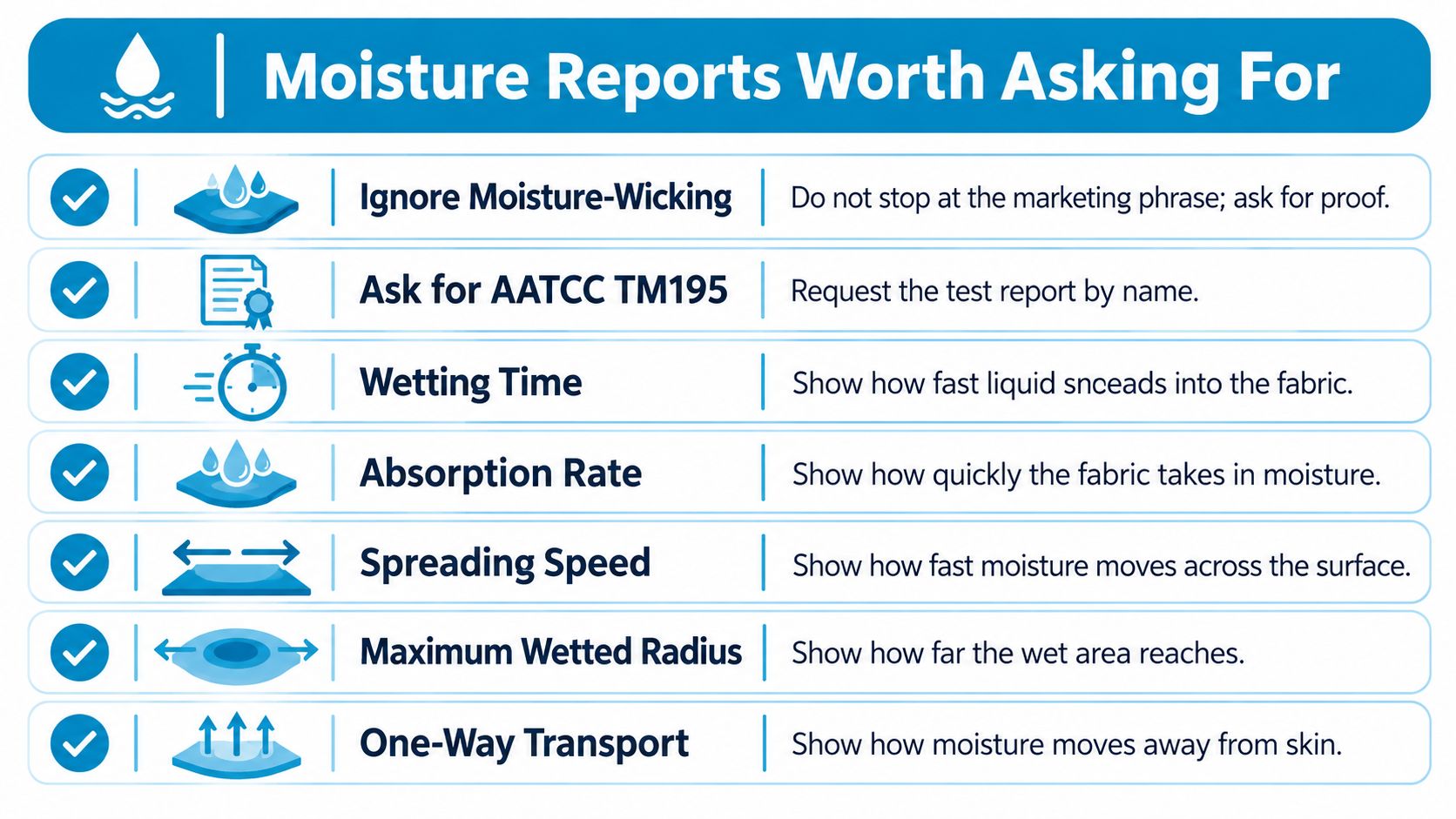
| Measure | Preferred direction |
|---|---|
| Wetting time, skin side | Short |
| Absorption rate | Fast |
| Spreading speed | Fast outward spread |
| Maximum wetted radius | Large on the outer side |
| One way transport | Positive |
| Overall Moisture Management Capacity (OMMC) | Strong, compared only within similar weight and knit |
What Good Numbers Look Like in Plain Terms
You want liquid to wet the skin side quickly, move outward, and spread wide on the outside where it can evaporate. You don't want it pooling against the skin or moving back inward. That's why positive one way transport matters more than a supplier saying the fabric feels cool in the showroom.
Only compare TM195 results between fabrics of similar weight and knit construction. A very light mesh and a structured uniform knit solve different problems, so ranking them on one score misleads you. If you need background on how these fabrics are built, this overview of moisture wicking fabric covers the basics before you review lab values.
Why Weight and Fiber Travel Together
A controlled field study in Ergonomics on a 100% polyester moisture wicking polo found that a shirt weighing 145 ± 6 g/m² improved thermal comfort by 0.49 points on a -3 to +3 scale, with a 95% confidence interval of 0.16 to 0.82, while not changing mean skin temperature. The comparison polo was 72% cotton / 28% polyester at 250 ± 15 g/m². Read that correctly. Polyester alone wasn't the guarantee. Fiber and mass together drove the result, and the study doesn't prove superiority for every climate or wearer.
Buying rule: If a supplier won't share composition, weight, knit, test method, test date, and actual TM195 values, treat the shirt as unproven, no matter what the catalog calls it.
Sun protection is a separate claim. If crews work outdoors, require UPF documentation under ASTM D6603 labeling guidance, with UPF determination relying on AATCC TM183, including specimens after one laundering when the garment carries a wash before wearing label. TM195 doesn't measure fit, airflow, seam feel, color, or how a logo changes the finished shirt. Get the moisture report, get UPF paperwork only if you need it, then test the decorated garment.
Decoration That Survives Stretch and Washing
Ask a different question than embroidery or print. Ask what survives your wear pattern without making the polo hotter, heavier, or visibly distorted. That's the standard for Custom Polo Shirts Dri Fit programs that get washed every week.

| Method | On stretch knits | Dense or tiny art | Wash risk | Added heat or weight |
|---|---|---|---|---|
| Embroidery | Can pucker lightweight stretch | Strong for small text if density stays modest | Very durable | Adds weight and can feel hotter |
| Direct to film | Stays flexible | Good for color and detail | Adhesion must be tested | Low added weight |
| Screen print | Best on stable, simple areas | Weak for tiny type | Cracks if cure is wrong for poly | Low if coverage stays small |
| Sublimation | Excellent on light polyester | Photos and full color | Excellent when the fiber is polyester | No extra layer |
| Custom patch | Best on structured zones | Badges, not all over art | Very durable | Local stiffness and weight |
When Embroidery Is the Wrong Durable Choice
Embroidery looks traditional and holds small text better than most prints. On a midweight or heavy knit, it's usually my first recommendation for a left chest mark. On the 145 g/m² class, dense stitching is where buyers get burned. It adds a stiff plate to a stretch fabric, pulls the surrounding knit, and creates puckering that no pressing fixes. It can also feel warmer in sun because thread and backing block the very area meant to breathe.
Keep stitch density modest, avoid huge filled chests on lightweight knits, and place badges where the fabric is stable. If your logo has a solid background block, don't stitch the whole block on a light polo. Redraw it as an outline or switch methods. For a side by side look at the two classic options, this breakdown of screen printing and embroidery shows where each one fits.
Direct to film (DTF) keeps more stretch and color detail and adds little weight, so it suits illustrated logos on performance knits. Its risk is adhesion on that exact polyester and finish. Wash test it, don't assume it. Screen printing suits bold, simple marks with low coverage, but polyester needs the right ink and cure or the print cracks and fades early.
Sublimation is the cleanest option for light or white polyester because the color goes into the fiber and adds no layer. The hand stays dry and flexible, which is why it works so well for event shirts with full color art. It won't work the same way on dark bodies or cotton rich blends. A custom patch works for a structured chest badge and reorders easily, but it's local weight and stiffness, not an all over solution.
Real use matters more than a wash cold slogan. Textile research indexed in PubMed on worn cotton polyester polo shirts found worn shirts released significantly more fibers than unworn controls across repeated wear and wash cycles, while polyester fragments became progressively smaller over successive use. Seat belts, backpacks, tool straps, and layered uniforms abrade both cloth and decoration. Tell your decorator about that abrasion before they choose placement.
Require four things before bulk approval: stitch density or print coverage, fabric stretch, the actual wash method staff will use, and a physical decorated preproduction sample. A shop that runs embroidery, screen printing, DTF, sublimation, and patches can put the same logo on two sample methods so you can feel the difference. Approve the sample that stays flat after washing, not the one that looks best on a proof PDF.
Which Polo Fits Uniforms Golf and Events
Match the scenario to a row you have already chosen. Don't invent a new spec for every event.

Four Scenarios, Four Calls
Front desk and retail teams who stand indoors and need a crisp collar should take the midweight polyester with a modest embroidered mark. It looks like a uniform all day and doesn't wilt by afternoon. Choose the heavy cotton blend only in a cool office where staff complain that polyester feels slick and nobody is working up a sweat.
Golf outings and outdoor booths in heat should take the lightweight polyester with a small chest mark by DTF or light embroidery. If the day is in full sun, get the separate UPF document instead of assuming a light knit protects skin. If you want to see how retail golf polos handle fit and collar structure before you brief a decorator, Vice Golf polos for men are a useful visual reference for modern golf styling. Your custom version still needs its own weight and moisture spec.
One day promotional runs with colorful art should use sublimation or DTF on light polyester. The shirt stays soft, the art can be photographic, and nobody wears a stiff chest plate for photos. Don't pay for dense embroidery on a shirt whose job is color impact for one weekend, unless the client will keep wearing it as a uniform after.
Warehouse, delivery, and layered uniform crews should avoid the lightest knit under dense chest embroidery. Abrasion and stitch weight show up fast where straps and seat belts rub. A midweight knit with a smaller mark, or a patch on a reinforced area, lasts longer and looks cleaner after repeated washing.
Fit Checks Performance Cuts Hide
Performance polos often run slimmer and shorter than cotton pique, so a cotton size chart is a poor guide. Order a sample size run and check chest, shoulder, and length on the people who will wear them. Add tall or extended sizes before the bulk quote, not after someone complains.
Men's and women's blocks differ in shoulder, waist, and length. Don't assume one unisex size list covers a mixed staff well. Color matters too. Light bodies sublimate cleanly and feel cooler in sun. Dark bodies hide sweat marks but limit sublimation and change logo contrast. Let the use case pick the row, then let a sample on a real body confirm it.
Recycled Polyester and the Wash Burden
A recycled badge changes feedstock. Wash physics stays the same. If a polyester knit sheds, mechanical action, heat, and chemistry will still pull fibers loose whether the yarn began as bottles or virgin resin.

Research indexed in PubMed on microfiber release from hand washed polyester found higher total dissolved solids water increased release, with some coated samples releasing 210% to 540% more fibers than in deionized water. Coatings helped in some constructions and hurt in others: measured reductions ran 26% to 92% depending on fabric. Water, coating, and knit all changed the result.
That makes recycled content a sourcing claim, not a shedding guarantee. Tight knits and stable yarn can lower lint risk. Loose brushed faces and heavy finishes raise it. Wash frequency multiplies whatever the construction does, so a light polyester worn twice and washed once can shed less over a month than a recycled shirt washed after every shift because it sees fewer cycles.
The Practical Question to Ask
Ask which specification offers moisture management with the lowest likely shedding for your wash habit. Compare fiber composition, knit structure, any coating, expected wash frequency, and care instructions, then match that fabric to heat, stretch, and the logo method. A shirt that flexes hard, carries dense stitching, and gets washed daily needs a cleaner construction than a soft event piece worn for one weekend.
Full loads, less frequent washing when hygiene allows, and a construction that does not rely on a heavy coating are more honest levers than a recycled hangtag by itself.
Ask the supplier what is documented on that exact style versus general marketing language. Can the mill document recycled content? Has shedding been tested on that construction, or is the claim borrowed from a fiber brochure? Comfort, colorfastness, and logo adhesion still come from weight, moisture data, and a wash test. Request recycled content when it is documented, but keep the same checks.
Lock the Spec Before You Order
Send one page with your logo. If your spec fits in an email thread scattered across five messages, you'll get five interpretations and one bulk order you can't fix.
Your One Page Spec
- Use case in one line, such as outdoor event staff in summer heat.
- Fabric class and target g/m², not just performance polo.
- Fiber content, confirmed in writing.
- AATCC TM195 values or the full report, required the same way for every candidate.
- UPF documentation only if the crew works in full sun.
- Decoration method, placement, and maximum stitch density or print coverage.
- Colors and any tall or extended sizes.
- Size run with chest, shoulder, and length measurements checked on staff.
Require a physical decorated sample. Wash it the way staff will wash it, then check puckering, adhesion, collar shape, and fit on two or three body types. Approve bulk only after that sample passes. A digital proof can't show stitch pull, hand feel, or how a collar rolls after drying.
If you want one partner for blank selection and the mark, Dirt Cheap Product, Inc. decorates polos with screen printing, embroidery, direct to film, sublimation, and patches, takes a logo upload, and returns proofs so color, placement, and stitch detail can be corrected before production. Confirm current sales hours and shipping coverage with the company before ordering. Apply the same weight, test, and sample rules regardless of supplier, and don't skip them because a catalog says performance.
Send your logo, your use case, and your target fabric weight to Dirt Cheap Product, Inc. and ask for decorated samples in the method that fits your knit before you commit to bulk. You'll get proofing support for embroidery, screen printing, DTF, sublimation, or patches so you can approve color, placement, and feel on the actual polo. Start with the spec, wash the sample, and order only when the shirt passes on a real body.